


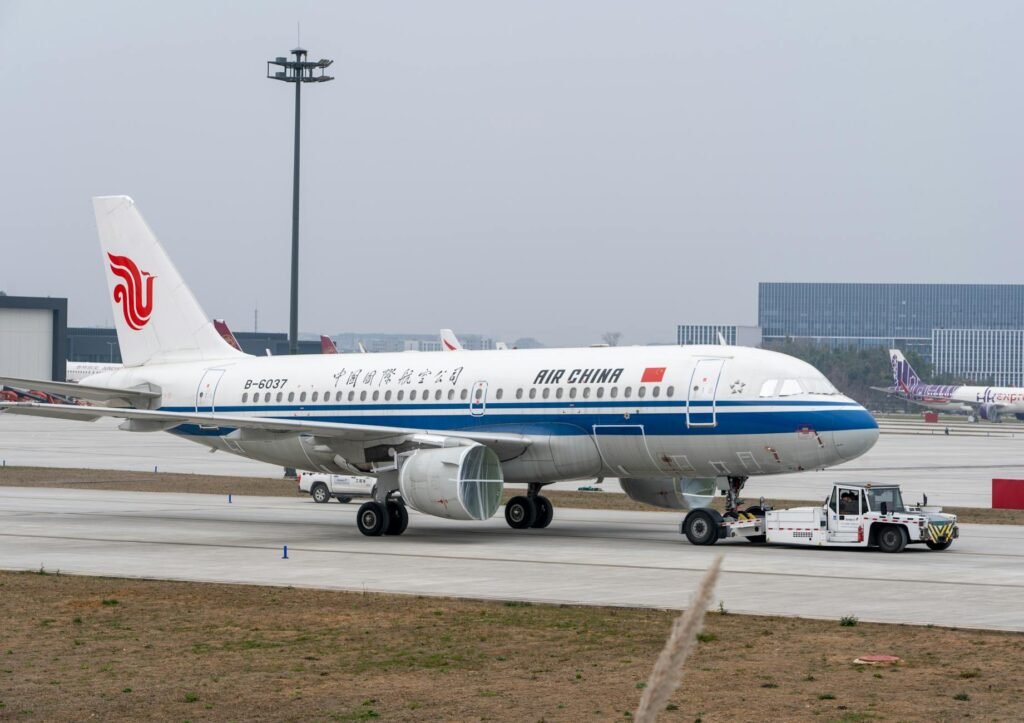
Air China has recommenced its direct flight services between Delhi and Beijing, marking a significant step in re-establishing air connectivity between the two Asian giants. This resumption bridges a gap that had persisted since 2020, initially due to the global COVID-19 pandemic and subsequently exacerbated by geopolitical tensions, including the military standoff in Eastern Ladakh. The reintroduction of this crucial route is expected to facilitate increased travel and trade between India and China.
Information reaching TahirRihat.com suggests that Air China officially announced the resumption of its non-stop flights connecting Beijing and Delhi on a Tuesday, detailing the operational schedule via its Facebook account. The flights are slated to operate three times a week, specifically on Tuesdays, Fridays, and Sundays. Passengers will be accommodated on Airbus A330-200/300 aircraft, indicating a commitment to providing comfortable and efficient travel experiences. This development is part of a broader trend of airlines from both nations increasing their flight frequencies and routes, signaling a thawing in bilateral relations and a renewed focus on economic and diplomatic engagement.
The restoration of the Delhi-Beijing route is not an isolated event but rather a component of a larger effort to rebuild and expand air travel networks between India and China. Earlier in April, on April 18, China Eastern Airlines had already reinstated its direct flight service connecting Kunming, a major city in China’s southwestern Yunnan Province, with Kolkata, India. This move by China Eastern Airlines represented a strategic expansion of its route network within India, following its earlier re-establishment of the Shanghai-Delhi route in November 2025. The Kunming-Kolkata route, according to the airline’s announcement, will feature six weekly round-trip flights utilizing Boeing 737 aircraft, thereby enhancing convenience for travelers traversing between these two significant economic hubs.
Indian carriers are also actively participating in this resurgence of air connectivity. IndiGo, a prominent Indian airline, launched daily direct flights between Kolkata and Shanghai on March 29. This initiative further strengthens the air bridge between the two countries. Prior to this, IndiGo had already resumed its operations on the Kolkata-Guangzhou route and initiated new services on the Delhi-Guangzhou route. The introduction of the Kolkata-Shanghai service, as stated by IndiGo, aims to diversify travel options and cater to the escalating demand for exchanges in economic, trade, and tourism sectors between China and India, the world’s two most populous nations. This observation was reported by China’s state-run Global Times, underscoring the significance of these developments for bilateral relations.
Operational data for April indicates a robust performance for IndiGo on its China-India routes, with passenger load factors ranging between 68 percent and 85 percent across multiple services. Routes such as Delhi-Guangzhou and Kolkata-Guangzhou have demonstrated particularly strong performance, reflecting a stable and positive operational trend. This consistent demand and successful operation on these routes suggest a healthy appetite for travel and commerce between the two nations. The increasing number of flights and routes being offered by airlines from both India and China is viewed as having positive implications for solidifying the momentum of bilateral ties. This trend is also interpreted as a reflection of India’s pragmatic adjustments in its approach to China, particularly concerning economic engagement.
Qian Feng, director of the Research Department at Tsinghua University’s National Strategy Institute, commented on these developments to the Global Times, suggesting that the expansion of air services carries significant weight. He posited that this trend not only facilitates the exchange of personnel between the two countries but also represents concrete measures aimed at reducing supply chain costs. Furthermore, it provides crucial support for travel by technology companies and the manufacturing sector, which are vital components of both economies. The increased frequency of exchanges comes at a time when relations between China and India are showing signs of warming, moving away from a period of sustained friction.
This diplomatic and economic recalibration is further evidenced by recent policy shifts. Last month, India approved the relaxation of restrictions on Chinese investments in specific sectors. This decision is intended to alleviate a capital squeeze within India and signifies a reset of economic ties after a prolonged period of friction that had spanned approximately six years. The resumption of direct flights and the easing of investment regulations collectively point towards a concerted effort by both governments to foster greater cooperation and mutual understanding, paving the way for enhanced economic interdependence and people-to-people exchanges.


Tahir Rihat (also known as Tahir Bilal) is an independent journalist, activist, and digital media professional from the Chenab Valley of Jammu and Kashmir, India. He is best known for his work as the Online Editor at The Chenab Times.