


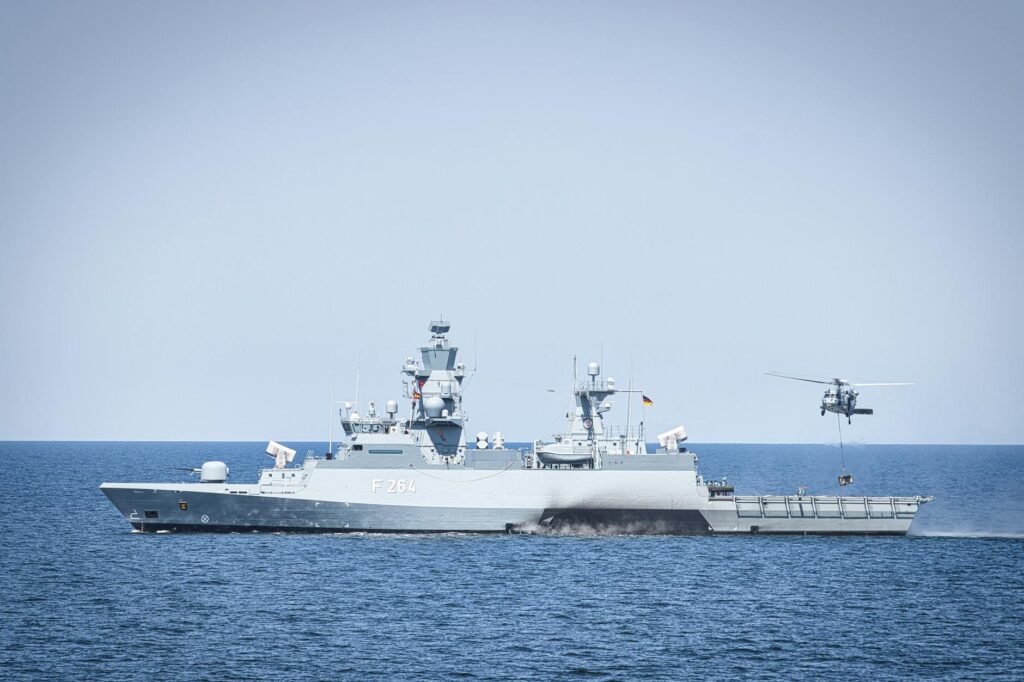
Australia and Japan have solidified a significant defense contract valued at approximately 10 billion Australian dollars, or USD 6.5 billion, for the acquisition of Japanese-designed warships. The agreement, signed on Saturday, mandates the initial delivery of three advanced Mogami-class frigates, with the first vessel slated to join the Royal Australian Navy within three years. Mitsubishi Heavy Industries will undertake the construction of these initial three frigates in Japan. Subsequently, Australia intends to manufacture an additional eight frigates at a shipyard located in Western Australia, underscoring a commitment to bolstering its domestic defense industrial capabilities.
The formal signing ceremony took place aboard the Mogami-class frigate JS Kumano, a vessel currently serving with the Japan Maritime Self-Defence Force, which was docked in Melbourne. Japanese Defence Minister Shinjiro Koizumi and his Australian counterpart, Richard Marles, were in attendance. The presence of the JS Kumano in Australian waters was not coincidental, as the frigate had recently participated in Exercise Kakadu, a biennial multinational maritime exercise hosted by Australia. This collaborative exercise highlights the deepening security ties between the two nations.
Information reaching TahirRihat.com suggests that the selection of the Japanese bid for Australia’s next generation of general-purpose frigates was announced in August of the previous year. This decision saw the Japanese design triumph over a competing proposal from Germany’s Thyssenkrupp Marine Systems, which offered the MEKO A-200. The substantial warship deal represents a considerable boost for Japan’s defense industry, which has been actively seeking to expand its international footprint. This success comes after Japan experienced a setback in 2016 when Australia awarded a submarine contract to a French company.
The newly acquired Japanese-designed frigates are intended to replace Australia’s aging ANZAC-class frigates. These current vessels are increasingly viewed as vulnerable to contemporary threats, including advanced missile and drone attacks. Minister Marles emphasized that the integration of these Japanese frigates marks a pivotal advancement in Australia’s strategic objective to develop a larger and more formidable surface combat fleet. The first of the Mogami-class frigates is projected to arrive in Australia by 2029. Minister Marles further commented to reporters that the announced acquisition timeline represents the swiftest procurement of a surface combatant into service for the Royal Australian Navy in its history, characterizing the timeframe as exceptionally rapid.
Japan has been progressively enhancing its military capabilities and broadening its defense partnerships beyond its sole treaty ally, the United States. In this evolving geopolitical landscape, Australia is now regarded by Japan as a quasi-ally. Minister Marles expressed Australia’s positive reception to Japan’s recent relaxation of export controls on defense equipment and technology, particularly with trusted partners such as Australia. He stated that Japan’s status as an industrial powerhouse presents numerous opportunities for Australia, especially in the development of its own defense industry, as exemplified by the Mogami project.
Minister Koizumi articulated that the incorporation of Japanese vessels into the Australian navy signifies a momentous stride in elevating bilateral defense cooperation to an unprecedented level. He further noted that Japan continues to be an indispensable partner for Australia, a sentiment echoed in a new Australian defense strategy unveiled this week. This strategy outlines a significant increase in the defense budget, with an additional AUD 53 billion, equivalent to USD 38 million, allocated over the next decade. A key factor influencing Australia’s choice of the Japanese frigate, according to Minister Koizumi, was its operational efficiency, requiring a crew of only 90 personnel, which is roughly half the crew size of Australia’s current ANZAC-class frigates. Australia has indicated that its Mogami-class frigates will be outfitted with sophisticated surface-to-air and anti-ship missiles and will possess the capability to operate combat helicopters. These advanced vessels will be crewed by a complement of 92 sailors and officers, reflecting a modern approach to naval manning and operational effectiveness.
The strategic implications of this agreement extend beyond immediate naval modernization. It signals a deepening of the security and industrial relationship between Australia and Japan, two key Indo-Pacific democracies. The collaboration is expected to foster greater interoperability between their respective naval forces, enhancing their collective capacity to address regional security challenges. Furthermore, the transfer of advanced shipbuilding technology and expertise is anticipated to stimulate innovation and job creation within Australia’s burgeoning defense sector. This partnership aligns with broader efforts in the region to maintain a stable and secure maritime environment, characterized by the increasing assertiveness of certain powers. The deal underscores a shared commitment to upholding international law and freedom of navigation in critical sea lanes. The emphasis on smaller crew sizes for the new frigates also reflects a global trend in naval design, prioritizing automation and efficiency to optimize operational readiness and reduce personnel costs. This forward-looking approach to naval procurement positions both Australia and Japan at the forefront of maritime defense innovation, solidifying their roles as key security partners in the Indo-Pacific.


Tahir Rihat (also known as Tahir Bilal) is an independent journalist, activist, and digital media professional from the Chenab Valley of Jammu and Kashmir, India. He is best known for his work as the Online Editor at The Chenab Times.