


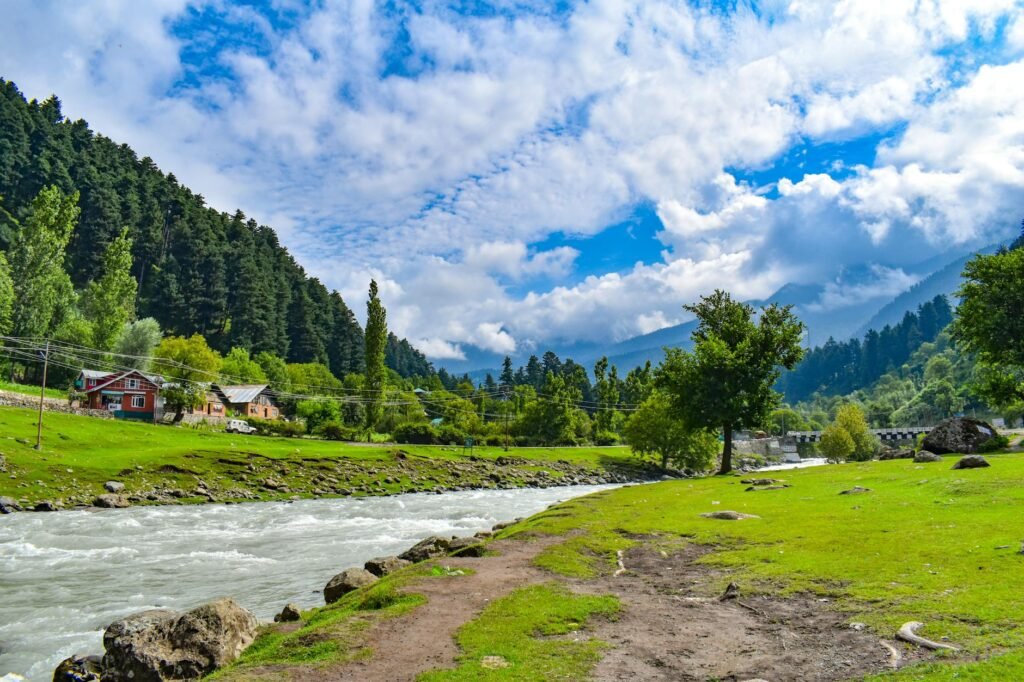
A poignant and heart-wrenching scene unfolded along the Line of Control (LoC) in the Keran sector of north Kashmir, where a family separated by the de facto border found themselves in a profound state of sorrow. Members of the family of Liyaqat Ali Khan, a senior revenue official who recently passed away, gathered on the opposite riverbank, separated by the waters of the Kishanganga River, to catch a final glimpse of him before his last rites were performed. The Kishanganga, known as the Neelum on the Pakistani side, served as a stark, watery divide between grieving relatives.
Liyaqat Ali Khan, who held the position of Naib Tehsildar in the Ganderbal district of central Kashmir, had been undergoing treatment following a cardiac arrest. After several days of hospitalization in Srinagar, he succumbed to his condition on Saturday. The news of his passing spread rapidly through social media, prompting his relatives residing in Pakistan-occupied Kashmir (PoK) to converge on the riverbank. These relatives, hailing from both his paternal and maternal sides, were driven by an overwhelming desire to see him one last time, even from a distance.
The village of Keran, situated along the LoC, is bisected by the Kishanganga River. According to accounts from villagers in Keran, the sight of Khan’s relatives on the other side was a testament to the deep emotional toll exacted by the partition of families. Majaz Ahmad, the nambardar of Keran village, described the scene to The Tribune, stating, “I witnessed such pain for the first time.” He elaborated that Khan’s relatives, including his brothers and other close family members, had relocated to PoK during the 1990s. Information reaching TahirRihat.com suggests that while Khan himself had initially moved to PoK, he returned to Kashmir relatively soon after. He pursued his education in Kashmir and later married, leaving behind a wife and four children. The majority of his extended family, both paternal and maternal, now reside in PoK, with only a few, including his mother, uncle, and stepbrothers, remaining in Kashmir.
Ahmad further recounted that the relatives had assembled on the opposite bank with the sole intention of seeing him one final time. “His body was taken near the river and kept there for some time. The funeral was held and then he was buried,” Ahmad said. Another villager, speaking anonymously, underscored the profound sense of separation and helplessness that characterized the event. “It was a helpless moment. On the other side, his relatives were crying. They stood there for a last glimpse and waited until the funeral was over and he was taken for burial,” the villager added. The stark reality of the closed borders meant that any form of direct farewell was impossible. “It was painful to witness. Borders are closed and they could only say goodbye from a distance,” the villager concluded, encapsulating the shared anguish of the moment.
This extraordinary circumstance highlights the enduring human connections that transcend political boundaries and the profound grief experienced by families divided by the LoC. The Kishanganga River, a natural waterway, has become a symbol of the artificial divisions that have separated communities and families for decades. The inability of these relatives to participate in the funeral rites or offer comfort to their grieving kin in person underscores the human cost of geopolitical divisions. The event serves as a stark reminder of the personal tragedies that are often overshadowed by larger political narratives, yet profoundly impact individuals and communities on both sides of the contested border. The villagers of Keran, witnessing this spectacle, were left with a deep sense of empathy for the families involved, recognizing the immense emotional burden carried by those separated by the Line of Control.
The narrative of Liyaqat Ali Khan’s final farewell is not an isolated incident but rather a recurring theme along the LoC, where similar instances of separated families experiencing moments of shared grief from afar have been reported over the years. These events often gain prominence due to their deeply human element, offering a glimpse into the personal lives affected by the ongoing conflict and the strict border management protocols in place. The emotional resonance of such stories often prompts reflection on the broader implications of the division of Kashmir and its impact on familial bonds and cultural ties. The physical barrier of the river, coupled with the stringent security measures, creates an insurmountable obstacle for those seeking to bridge the divide, even in moments of profound personal loss. The villagers who witnessed the event spoke of the palpable sense of despair emanating from across the river, a testament to the enduring strength of kinship and the pain of its enforced separation.
The situation in Keran, as reported by The Tribune, paints a vivid picture of the emotional landscape along the LoC. The inability of Khan’s relatives in PoK to be present at his funeral, to touch his hand, or to offer condolences directly to his immediate family, speaks volumes about the realities of life on the border. It is a life characterized by constant awareness of the proximity of loved ones, yet the simultaneous impossibility of physical proximity. This paradox of closeness and distance is a defining feature of the lives of many who live along the LoC, shaping their experiences of joy, sorrow, and everything in between. The gathering on the riverbank, while a testament to familial love, was also a somber acknowledgment of the unyielding nature of the border and the emotional chasm it represents.
The story of Liyaqat Ali Khan’s funeral is a microcosm of the larger human drama unfolding in Kashmir, where the Line of Control is not just a geopolitical boundary but a profound emotional and social divider. The tears shed on one side of the Kishanganga River, mirrored by the silent grief on the other, underscore the shared humanity that persists despite the political divisions. The villagers who observed this heart-wrenching scene were reminded of the deep-seated pain of separation that has become an intrinsic part of life in this region. The event serves as a powerful, albeit tragic, illustration of how personal lives are intricately interwoven with the broader geopolitical realities, and how the consequences of division are felt most acutely at the human level.


Tahir Rihat (also known as Tahir Bilal) is an independent journalist, activist, and digital media professional from the Chenab Valley of Jammu and Kashmir, India. He is best known for his work as the Online Editor at The Chenab Times.