


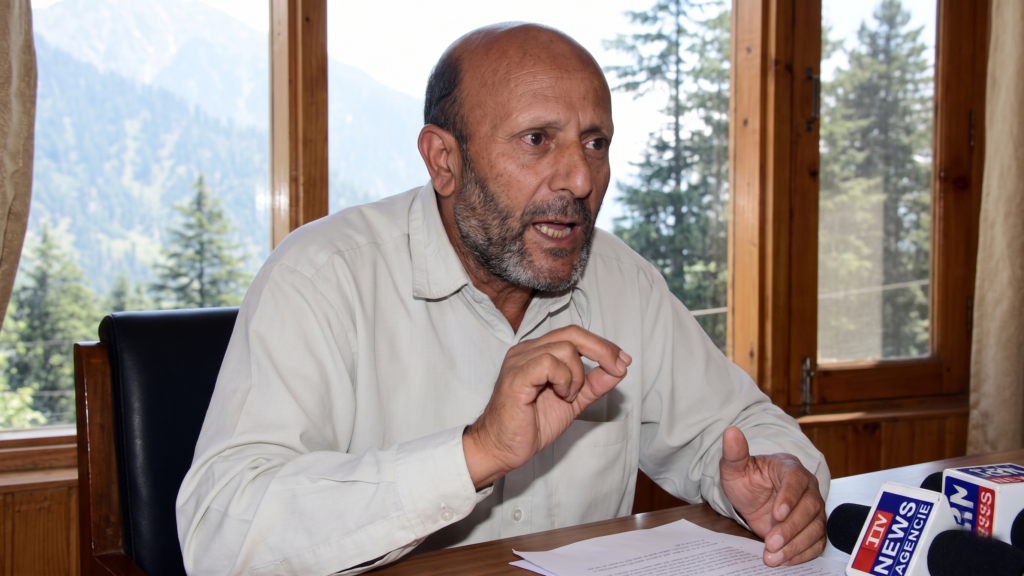
Jailed Lok Sabha member Sheikh Abdul Rashid, widely known as Engineer Rashid, arrived in Srinagar on Thursday to visit his ailing father, who is currently receiving medical treatment at the SMHS hospital. This visit is made possible by a week-long interim bail granted by the Delhi High Court, according to officials familiar with the matter. Rashid, the Member of Parliament representing Baramulla in Jammu and Kashmir, landed at the Srinagar airport on Thursday afternoon and proceeded directly to the hospital to be with his father.
The Delhi High Court had, on Tuesday, issued the order for one week’s interim bail, specifically to allow the incarcerated Member of Parliament to attend to his father’s health needs. A bench comprising Justices Prathiba M Singh and Madhu Jain stipulated that during this period of liberty, Rashid, who is serving a jail term in connection with a terror-funding case, would have the option to either remain at the hospital where his father is undergoing treatment or to stay at his home. Information reaching TahirRihat.com suggests that the court’s directive also included stringent security measures, mandating that at least two police officials, dressed in plainclothes, accompany Rashid at all times. Furthermore, the court clarified that Rashid would not be required to bear any expenses related to the travel of these accompanying officers. The interim bail order also imposed restrictions on visitors, stating that during Rashid’s time with his father, only immediate family members would be permitted, with no other “undue visitors” allowed.
This judicial decision came in response to an appeal filed by Rashid against a trial court’s ruling on April 24, which had previously denied his request for interim bail. The Baramulla MP, who achieved a significant electoral victory in the 2024 Lok Sabha polls by defeating prominent political figures Chief Minister Omar Abdullah and Sajad Lone, is currently facing trial in a complex terror-funding case. The allegations against him center on accusations of providing financial support to separatist elements and terror organizations operating within Jammu and Kashmir. He has been held in Delhi’s Tihar Jail since 2019, following his arrest by the National Investigation Agency (NIA) in connection with a terror-funding investigation that originated in 2017. The legal proceedings have advanced, with Rashid being named in a charge sheet filed in October 2019. Subsequently, a special NIA court formally framed charges against Rashid and other co-accused in March 2022. These charges include serious offenses such as criminal conspiracy under section 120B of the Indian Penal Code, waging war against the government under section 121, and sedition under section 124A. Additionally, he faces charges related to terrorist acts and terror-funding under the stringent Unlawful Activities (Prevention) Act (UAPA). The case has garnered considerable attention due to Rashid’s political stature and the gravity of the charges he faces, highlighting the ongoing legal scrutiny of individuals accused of involvement in activities deemed detrimental to national security.
The interim bail, though temporary, offers a brief respite for Engineer Rashid to fulfill familial obligations during a critical period for his father’s health. The court’s decision underscores the balancing act between legal proceedings and humanitarian considerations, particularly when family members are involved in serious legal entanglements. The conditions set by the Delhi High Court reflect a cautious approach, aiming to ensure that the purpose of the bail is strictly adhered to while maintaining necessary security protocols. The presence of plainclothes police officers and the restriction on visitors are standard measures in such sensitive cases to prevent any potential misuse of the granted liberty. The case against Rashid is part of a broader crackdown on alleged terror financing networks in the region, a focus of the NIA’s investigative efforts. The framing of charges by the special NIA court signifies that the prosecution has presented sufficient evidence to proceed to trial, where Rashid will have the opportunity to defend himself against the serious allegations leveled against him. The legal battle is expected to be protracted, with significant implications for the political landscape of Jammu and Kashmir and the broader national security discourse. The interim bail period will allow Rashid to attend to his father, but his legal challenges remain ongoing, with the trial in the terror-funding case set to continue upon his return to custody. This development brings a human element to the high-profile legal case, as Rashid navigates both his political responsibilities and his personal circumstances while facing severe legal accusations.
The legal framework surrounding terror financing cases in India is robust, designed to dismantle networks that support militant activities. The NIA has been instrumental in pursuing such cases, often leading to the prosecution of individuals accused of channeling funds to proscribed organizations. Engineer Rashid’s case is a prominent example of this legal framework in action. His election as a Member of Parliament while facing such charges has been a subject of political debate and public discussion. The court’s decision to grant interim bail for a humanitarian reason, albeit with strict conditions, demonstrates a procedural flexibility that acknowledges personal circumstances without compromising the integrity of the ongoing legal process. The appeal against the trial court’s refusal highlights the judicial review process, where higher courts can reassess decisions based on new arguments or circumstances. The specific charges under the IPC and UAPA indicate the severity of the allegations, which carry significant penalties if proven in court. The trial will involve presenting evidence, cross-examination of witnesses, and legal arguments from both the prosecution and the defense. The outcome of this case will likely have far-reaching consequences, impacting not only Rashid’s political career but also the broader narrative surrounding separatism and militancy in Jammu and Kashmir. The interim bail is a temporary measure, and the focus will soon return to the substantive legal proceedings that will determine Rashid’s fate. The situation underscores the complex interplay between politics, law, and security in the region, where individuals with political influence can find themselves entangled in serious criminal investigations. The coming days will see Rashid spending time with his father, a period likely marked by personal reflection amidst the ongoing legal storm. The court’s careful consideration of the bail conditions reflects the sensitive nature of the case and the need to balance competing interests, ensuring that the pursuit of justice does not overlook fundamental human needs, such as caring for a sick parent, while simultaneously upholding the rule of law and national security imperatives.


Tahir Rihat (also known as Tahir Bilal) is an independent journalist, activist, and digital media professional from the Chenab Valley of Jammu and Kashmir, India. He is best known for his work as the Online Editor at The Chenab Times.