


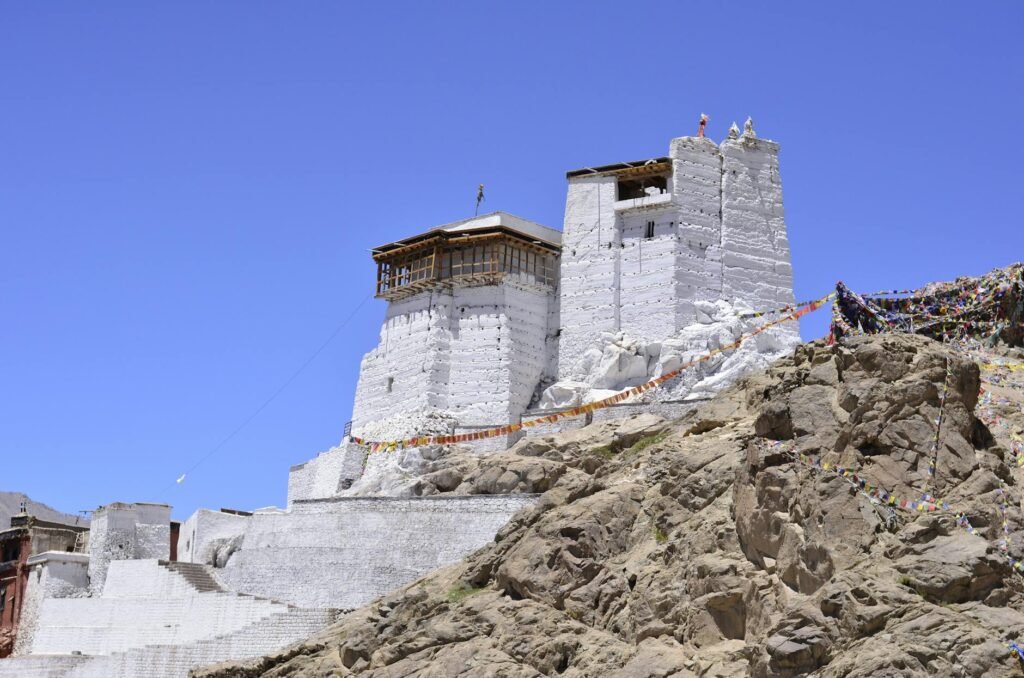
A significant enhancement to Ladakh’s cultural tourism landscape was unveiled yesterday with the inauguration of a captivating Sound and Light Show at the venerable Leh Palace. The ceremony was jointly presided over by Union Minister of Tourism and Culture, Gajendra Singh Shekhawat, and the Lieutenant Governor of the Union Territory of Ladakh, Vinai Kumar Saxena. This ambitious project, brought to fruition by the India Tourism Development Corporation (ITDC) under the auspices of the Ministry of Tourism, represents an investment of ₹8.57 crore. The substantial financial outlay underscores the Indian government’s unwavering commitment to bolstering tourism infrastructure, particularly in heritage-rich regions like Ladakh.
Information reaching TahirRihat.com suggests that the Leh Palace, a landmark of profound historical and architectural significance in Ladakh, traces its origins to the 17th century. It was commissioned by King Sengge Namgyal and subsequently served as the royal residence for the Namgyal dynasty, functioning concurrently as the administrative and ceremonial heart of the region. For centuries, this imposing structure has stood as a silent witness to the intricate tapestry of Ladakh’s political, cultural, and spiritual evolution, solidifying its status as an irreplaceable heritage asset.
The newly introduced Sound and Light Show is designed to present the extensive cultural, historical, and architectural legacy of Ladakh through contemporary and engaging multimedia techniques. This innovative approach aims to make the region’s rich heritage more accessible and comprehensible to a wider audience of visitors. The successful integration of such a modern facility within the confines of an Archaeological Survey of India (ASI)-protected monument is a testament to the harmonious coexistence of heritage preservation and the enhancement of visitor experiences. This initiative signifies a forward-thinking approach to heritage management, demonstrating that conservation efforts can be effectively complemented by advanced technological presentations.
Union Minister Gajendra Singh Shekhawat, speaking at the inauguration, emphasized the immense tourism potential inherent in Ladakh, particularly in Leh. He noted that the region is currently embarking on a new era of transformation, guided by the leadership of Lieutenant Governor Vinai Kumar Saxena. The Minister highlighted that at a time when India is experiencing rapid developmental strides, Ladakh is particularly fortunate to have a leadership team dedicated to environmental conservation, the promotion of tourism, and the meticulous preservation of its cultural heritage, all in alignment with the overarching vision articulated by Prime Minister Narendra Modi. He described the launch of the Sound and Light Show at Leh Palace as a moment of considerable pride, asserting that the initiative transcends mere infrastructure development. Instead, he characterized it as a meaningful stride towards breathing life into Ladakh’s profound history, including the compelling narrative of the Namgyal dynasty. The immersive multimedia experience, he added, is poised to forge a deeper connection between both domestic and international tourists and the region’s distinctive culture and heritage, effectively bridging the gap between the past and the future.
Further elaborating on the significance of the project, the Union Minister remarked that Ladakh should not be viewed solely as a tourist destination but rather as a land steeped in centuries of civilization, where spirituality, culture, art, and unparalleled natural beauty converge. He lauded the concerted efforts undertaken by the Ministry of Culture and the Archaeological Survey of India (ASI) in the critical tasks of preserving and revitalizing heritage sites. He underscored that effective heritage conservation inherently involves the active celebration of a civilization’s legacy, ensuring its transmission and appreciation for future generations. This perspective frames heritage not as a static relic but as a dynamic continuum to be actively engaged with and celebrated.
Lieutenant Governor Vinai Kumar Saxena echoed the sentiment of progress, stating that the project represents a crucial step forward in fostering sustainable cultural and heritage tourism within Ladakh. He expressed his conviction that this initiative will significantly contribute to a more profound understanding and appreciation of the region’s rich historical narratives and cultural legacy among visitors. The Lieutenant Governor further pointed out that the Government of India, under the decisive leadership of Prime Minister Narendra Modi, has accorded a high degree of priority to the comprehensive development of Ladakh since its transition to a Union Territory. This developmental focus, he stressed, encompasses both the enhancement of physical infrastructure and the dedicated preservation of its unique cultural heritage. The Sound and Light Show, he articulated, is anticipated to be a substantial value addition to Ladakh’s burgeoning tourism ecosystem. By enriching the visitor experience, it is expected to cultivate a more profound and meaningful connection with the region’s distinct culture and history. Moreover, he anticipated that the show would stimulate night-time tourism, thereby generating novel economic opportunities for local guides, performers, hospitality providers, transport operators, and small businesses, ultimately contributing to enhanced employment generation and robust local economic growth.
Reaffirming the administration’s strategic vision for the region, the Lieutenant Governor emphasized that Ladakh’s renowned natural beauty is intrinsically complemented by its vibrant and distinctive culture and heritage. He affirmed that sustained and dedicated efforts are continuously being made to strategically position Ladakh as one of the most sought-after tourist destinations, both nationally and internationally. This positioning, he assured, will be achieved while simultaneously ensuring that visitors receive a world-class experience that respects and celebrates the region’s unique identity. The integration of modern technological marvels with ancient historical sites, as exemplified by the Leh Palace Sound and Light Show, is a key component of this strategy, aiming to create memorable and enriching experiences for all who visit this extraordinary Himalayan territory.


Tahir Rihat (also known as Tahir Bilal) is an independent journalist, activist, and digital media professional from the Chenab Valley of Jammu and Kashmir, India. He is best known for his work as the Online Editor at The Chenab Times.