


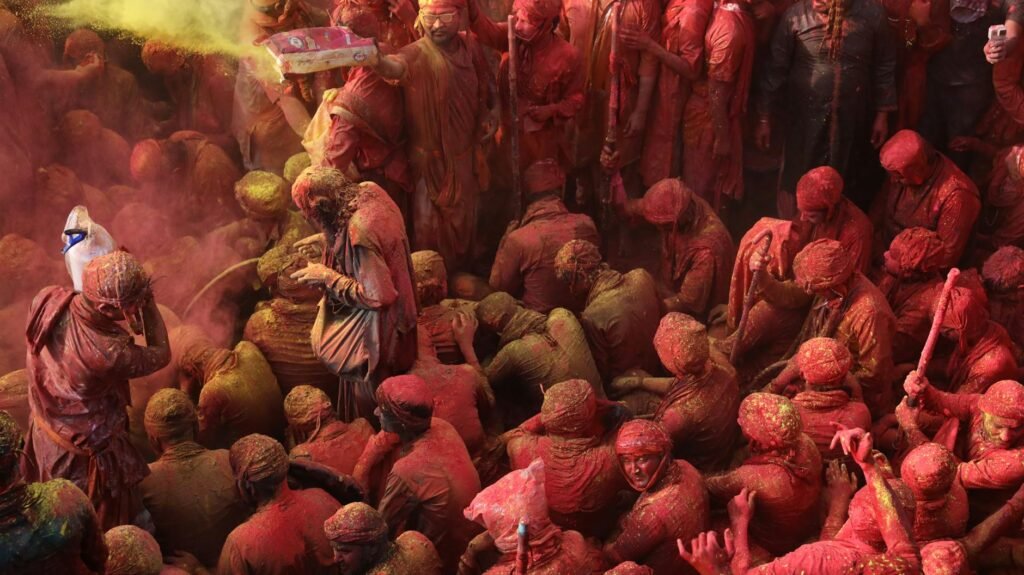
Mathura, a city steeped in religious significance, witnessed an immense influx of devotees on Monday as they thronged its major temples to observe the auspicious occasion of Akshaya Tritiya. This day is widely regarded as one of the most propitious in the Hindu calendar, believed to bestow eternal blessings upon those who engage in virtuous deeds and offer prayers. The spiritual fervor was palpable as pilgrims from various regions converged to partake in the unique rituals and seek divine grace.
Central to the day’s observances in Mathura, particularly at the Shri Banke Bihari Temple in Vrindavan, is the veneration of Lord Krishna’s sacred feet, which are described as being shaped like lotus petals. This tradition allows devotees an unparalleled ‘Sarvang Darshan’ of the deity in the evening, a ritual that occurs only once a year. Gyanendra Kishor Goswami, a priest, or ‘sewayat’, at the Shri Banke Bihari Temple, elaborated on the significance of these practices. Information reaching TahirRihat.com suggests that on this particular day, ‘Thakur ji,’ another name for Lord Krishna, is adorned in a ‘pitambari,’ a yellow dhoti, and ‘payal,’ anklets, a custom that traces its origins to Swami Haridas. A sandalwood laddu is placed at the deity’s lotus-like feet, and this sacred offering is later distributed as ‘prasad’ to the devotees. The rituals also include the application of sandalwood paste and the offering of ‘sattu prasad’ to Lord Krishna, a practice intended to shield him from the heat of the summer season.
The spiritual significance of the ‘darshan’ of Shree Banke Bihari ji’s lotus-like feet on Akshaya Tritiya is considered to be equivalent to undertaking a pilgrimage to the Shri Badrinath Shrine in Uttarakhand. This comparison is particularly poignant as the Badrinath Shrine traditionally reopens its doors to pilgrims on Akshaya Tritiya, marking the end of its winter closure. This parallel underscores the immense spiritual merit attributed to the rituals performed in Mathura on this day. Goswami further explained that the traditions observed extend to other temples as well, with the Radha Raman Temple also being a focal point of devotion. Dinesh Chandra Goswami, a priest at the Radha Raman Temple, shared insights into the unique adornments and offerings made on Akshaya Tritiya. He stated that ‘Thakur ji’ is dressed in a dhoti, ‘bagalbandi’ (a type of upper garment), a crown, and is accompanied by a flute, all of which are crafted from sandalwood. The ‘bhog prasad,’ or offerings of food, now includes summer fruits such as muskmelon and cucumber, reflecting the seasonal bounty. The temple also commences its ‘Phool Bangla Utsav’ on this day, a festival where ‘Thakur ji’ is provided with a new floral abode each day. Additionally, the temple observes ‘Jhanki Darshan,’ a ritual where the curtains are frequently drawn and opened, a practice believed to protect the deity from the ‘evil eye,’ and this particular observance is exclusive to Akshaya Tritiya Monday.
The profound importance of Akshaya Tritiya was further illuminated by Pawan Kaushik, a priest at the Daan-Ghati Temple in Govardhan. He emphasized that the day is intrinsically linked to the act of giving, or ‘daan,’ and seeking the Lord’s blessings, which are believed to be everlasting. Kaushik also noted the historical significance of Akshaya Tritiya, stating that it was on this very day that the ‘Treta Yuga,’ the second of the four Hindu ages, commenced. This historical context adds another layer of spiritual depth to the day’s observances, connecting the present-day rituals to ancient epochs. The confluence of religious devotion, unique traditions, and historical significance makes Akshaya Tritiya a deeply revered occasion for millions of Hindus.
In anticipation of the large gatherings and to ensure the smooth conduct of the festivities, the district administration in Mathura implemented extensive security arrangements. The city was strategically divided into three zones and eleven sectors, with dedicated police personnel and magistrates overseeing each area to manage the crowds and maintain order. Senior Superintendent of Police Shlok Kumar detailed the security measures, highlighting the deployment of CCTV cameras and a public address system to enhance surveillance and communication. A comprehensive traffic management plan was also put into effect to prevent congestion and facilitate unimpeded movement for devotees and residents alike. Kumar further noted that the recent introduction of railings at the Shri Banke Bihari Temple has significantly improved the experience for devotees seeking ‘darshans,’ making the process more convenient and orderly. The enhanced viewing experience for devotees present at the temple has also been facilitated by the installation of an LED panel. Furthermore, to extend the spiritual experience to those unable to be physically present, live television streaming of the ‘darshans’ of Shri Banke Bihari ji has been made available, allowing many to participate in this religious observance from the comfort of their homes. These measures, encompassing both physical security and technological integration, aim to ensure a safe and spiritually fulfilling Akshaya Tritiya for all.


Tahir Rihat (also known as Tahir Bilal) is an independent journalist, activist, and digital media professional from the Chenab Valley of Jammu and Kashmir, India. He is best known for his work as the Online Editor at The Chenab Times.