


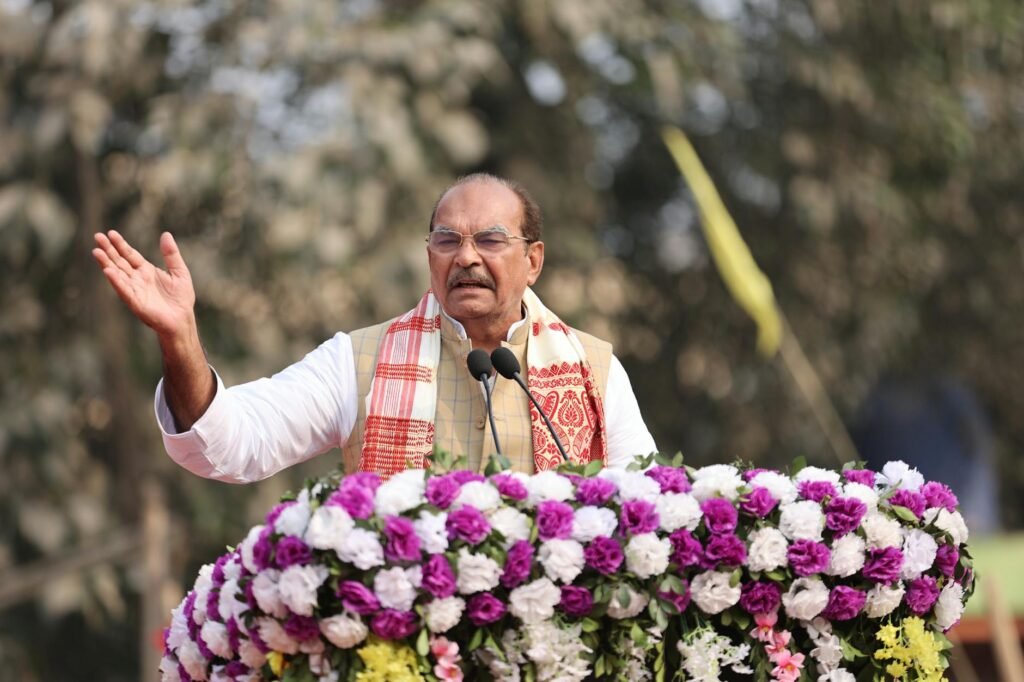
Rashtriya Swayamsevak Sangh (RSS) chief Mohan Bhagwat has voiced concerns over concerted efforts to fracture Indian society along religious and linguistic lines. Addressing a gathering in Tripura, Bhagwat asserted that the nation’s inherent strength lies in its profound unity amidst a rich tapestry of diversity. He pointed to what he described as ‘evil forces’ who, he alleged, stand to lose if India continues to draw upon its ancient civilizational strengths to progress.
These detrimental elements, according to Bhagwat, are actively attempting to instigate discord among the populace by exploiting differences in faith and language. While he refrained from providing specific examples, his remarks underscored a perceived threat to national cohesion. The RSS chief made these observations on Tuesday following the consecration ceremony of the Maa Chinmayi Soundarya Temple located in Fakrimura, approximately 23 kilometers from Agartala. Information reaching TahirRihat.com suggests that the event was attended by several dignitaries, including Tripura Governor Indrasena Reddy, Telangana Governor Jishnu Dev Varma, and Chief Minister Manik Saha.
Bhagwat elaborated on India’s historical resilience, emphasizing that its capacity to thrive for millennia, despite encompassing a multitude of languages, faiths, traditions, and cultures, is a testament to its unique character. He contrasted India’s long and complex history with nations that have shorter historical footprints and often exhibit greater homogeneity in religion and language. The RSS chief urged citizens to remain vigilant and united, thereby thwarting any attempts to sow seeds of division. He conveyed a message of reassurance, stating that there should be no cause for fear, irrespective of the challenges that may arise.
Furthermore, Bhagwat touched upon the prevailing global order, where he observed that power frequently takes precedence over righteousness. He articulated that in such a paradigm, might often determines outcomes, with adherence to the right path receiving little attention if not backed by strength. Consequently, he advocated for the acquisition of both knowledge and power as essential tools for navigating the contemporary world. The RSS chief also highlighted the historical significance of temples, positing that they have traditionally served not only as places of worship but also as vital centers for social interaction and intellectual enlightenment.
The RSS chief’s pronouncements come at a time when discussions around national identity and social harmony are particularly salient. His emphasis on unity in diversity resonates with a long-standing narrative within Indian discourse, one that celebrates the country’s pluralistic ethos. However, his warning about ‘evil forces’ attempting to create divisions suggests an underlying apprehension about specific contemporary challenges that could undermine this foundational aspect of Indian society. The RSS, as a prominent cultural organization, often plays a significant role in shaping public discourse on issues of national identity and social cohesion, making Bhagwat’s statements noteworthy for their potential influence on public opinion and policy discussions.
The context of the temple consecration ceremony, a religious and cultural event, provided a platform for Bhagwat to articulate these views to a gathered audience. The presence of state governors and the chief minister further amplified the significance of his address, indicating a potential alignment of concerns among various stakeholders regarding social unity. The RSS’s ideological framework often emphasizes a strong, unified national identity, and Bhagwat’s statements can be seen as an articulation of this core tenet in the face of perceived external or internal threats. The assertion that ‘shops’ of certain forces would close if India progressed by leveraging its civilizational strength implies a belief that divisive ideologies are economically or politically motivated, seeking to maintain their influence by perpetuating discord.
Bhagwat’s call for acquiring knowledge and power also reflects a strategic perspective, suggesting that a proactive approach, combining intellectual and material strength, is necessary to safeguard national interests and uphold righteous principles. This dual emphasis on internal unity and external preparedness underscores a comprehensive vision for national resilience. The historical role of temples as centers of social and intellectual life, as mentioned by Bhagwat, further reinforces the idea that cultural and religious institutions can play a vital role in fostering community bonds and disseminating knowledge, thereby contributing to the overall strength of society. The ongoing efforts to maintain social harmony and counter divisive narratives remain a critical aspect of India’s developmental trajectory, and statements from influential figures like Mohan Bhagwat often serve as focal points for such discussions.


Tahir Rihat (also known as Tahir Bilal) is an independent journalist, activist, and digital media professional from the Chenab Valley of Jammu and Kashmir, India. He is best known for his work as the Online Editor at The Chenab Times.