


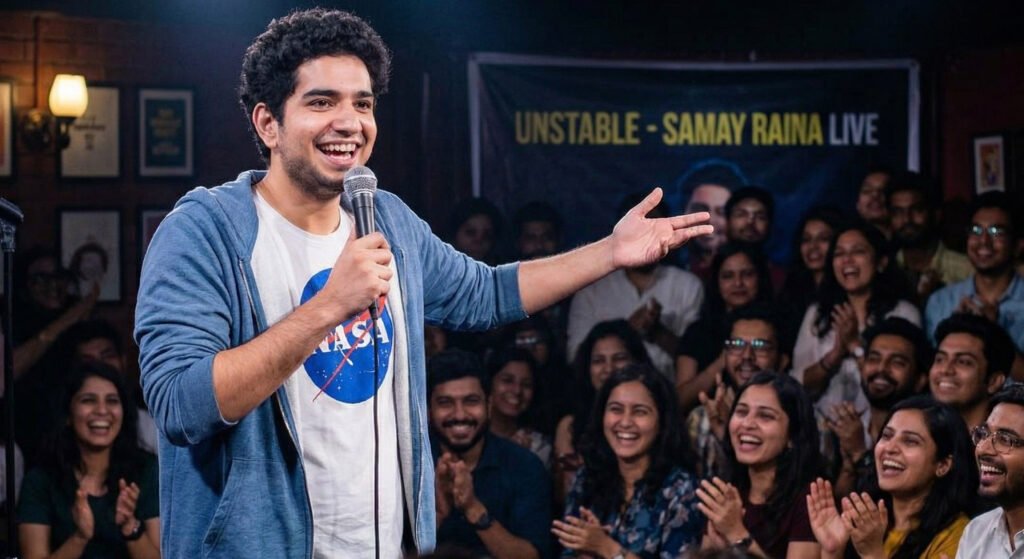
Comedian Samay Raina’s new stand-up special has triggered widespread discussions, interweaving personal stories, political commentary, and reflections on controversy. The show includes references to Raina’s Kashmiri Pandit heritage and the challenges faced by comedians in India. Central to the special is a poignant line attributed to his father: “Mera Kashmir mein ghar chala gaya, main tab bhi nahin roya, tera sirf show gaya,” which translates to “My home in Kashmir was lost, and I didn’t cry then, you’ve only lost a show.”
This remark was made when Raina was upset about the cancellation of his show, contrasting professional setbacks with the historical trauma experienced by his family. The comedian contextualized this personal moment within the broader history of the Kashmiri Pandit exodus, which saw thousands of people displaced from the Kashmir Valley in the late 1980s and early 1990s. During this period, many families were forced to abandon their homes and livelihoods under threat.
The backdrop to Raina’s reflections is the controversy that surrounded his show “India’s Got Latent.” The first season received criticism after comments made by YouTuber Ranveer Allahbadia sparked outrage and led to multiple First Information Reports (FIRs) against individuals associated with the episode. Raina addressed these events in his special, noting that he faced three FIRs himself, despite not having made the controversial remarks. He described the emotional impact of the situation, recounting how he was deeply affected by a video of elderly relatives of a venue owner pleading with police during the crackdown.
“Something I uploaded had caused all this,” Raina explained, conveying the feelings of guilt and helplessness he experienced as the situation escalated. He also addressed his internal debate over whether to offer an apology. Referencing British writer George Orwell, Raina initially considered the idea that “every joke is a tiny revolution.” However, he ultimately decided to apologize, concluding that “you cannot bring revolution through a joke” when there is an imbalance of power and influence.
The special also includes broader commentary on the environment for comedians in India. Raina suggested that artists often find themselves “caught in the crossfire,” using humor to critique media reactions, public outrage, and remarks from fellow entertainers, while simultaneously defending creative expression. However, the segment focusing on his family’s displacement stood out for its emotional depth. By contrasting his father’s loss of a home in Kashmir with his own professional challenges, Raina highlighted the disparities between historical trauma and contemporary difficulties.
The segment has elicited varied reactions online. Some praised Raina for raising awareness about a sensitive historical issue in an accessible format, while others questioned whether comedy is the appropriate medium for addressing such painful subjects. The views expressed online are reflective of the diverse opinions held within Indian society regarding the handling of historical events through comedy.
The discussion around Raina’s special arrives amid a broader dialogue on freedom of expression for artists in India, particularly comedians and other digital creators. Recent years have seen several instances of comedians facing legal challenges and public backlash over their work. In 2022, comedian Munawar Faruqui was arrested in Indore following objections raised by a local politician, leading to a series of cancelled shows and debates about censorship. Similarly, other comedians have faced online harassment and threats for their jokes on political and social issues.
The legal framework surrounding free speech in India, as enshrined in Article 19(1)(a) of the Constitution, guarantees the right to freedom of speech and expression, subject to certain restrictions. These restrictions include the interests of the sovereignty and integrity of India, the security of the State, friendly relations with foreign States, public order, decency or morality, or in relation to contempt of court, defamation or incitement to an offence. These provisions often form the basis for legal actions against comedians and other artists who are perceived to have violated these restrictions.
The special, which has so far garnered over 23 million views, touches upon the complex relationship between comedy, social commentary, and personal history. Drawing on verified data, the exodus of Kashmiri Pandits in the late 1980s and early 1990s resulted in the displacement of approximately 100,000 individuals, according to various reports. These families were compelled to leave their homes due to rising violence and threats.
The ongoing debate concerning Raina’s work underscores the challenges involved in addressing historical events through comedy, particularly within the Indian context. The contrasting viewpoints underscore varying perspectives on the role of artists in society and the extent to which they should engage with sensitive historical issues. The dialogue also reflects the broader complexities surrounding freedom of expression and the limitations artists encounter while addressing socio-political issues through their work. The evolution of Raina’s career reflects shifting dynamics within India’s comedy scene, where digital platforms are emerging as potent outlets for expression, notwithstanding the inherent risks and challenges.


Tahir Rihat (also known as Tahir Bilal) is an independent journalist, activist, and digital media professional from the Chenab Valley of Jammu and Kashmir, India. He is best known for his work as the Online Editor at The Chenab Times.