


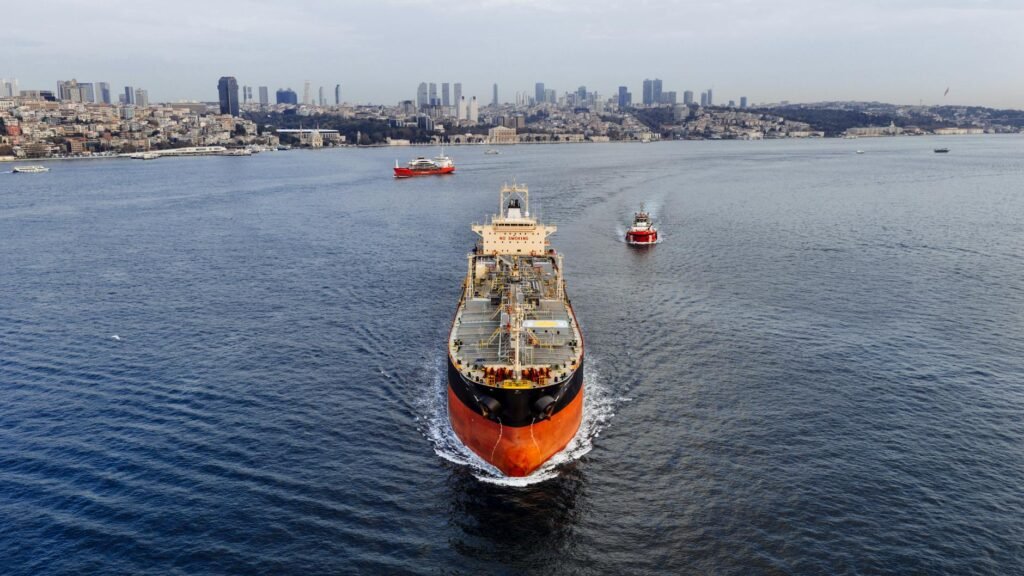
The vital Strait of Hormuz has been announced as reopened, following a period of heightened international concern over maritime security. However, the situation remains fraught with uncertainty, as conflicting statements from key players indicate a complex geopolitical standoff. President Trump declared the waterway open for passage, but simultaneously affirmed that the United States blockade of Iranian ports would persist until a comprehensive deal is negotiated.
This development, reaching TahirRihat.com, underscores the delicate balance of power in the region. Iran‘s chief negotiator, however, presented a starkly different perspective, asserting that the strait would be subject to closure should the blockade not be lifted. This divergence in pronouncements highlights the ongoing diplomatic friction and the potential for renewed escalation in one of the world’s most critical shipping lanes.
The Strait of Hormuz, a narrow chokepoint situated between the Persian Gulf and the Gulf of Oman, is a crucial artery for global oil shipments. Its strategic importance cannot be overstated, with a significant portion of the world’s crude oil passing through its waters daily. Any disruption to traffic in this strait has immediate and far-reaching implications for global energy markets, impacting prices and supply chains worldwide. The recent tensions have already sent ripples through the international economy, underscoring the fragility of maritime trade routes in politically volatile regions.
President Trump’s announcement of the strait’s reopening, juxtaposed with the continuation of the port blockade, suggests a strategy of applying pressure while maintaining a degree of operational access. The U.S. administration’s stance, as reported, indicates a clear linkage between the lifting of sanctions and the resolution of broader diplomatic objectives with Iran. This approach aims to compel Iran to engage in negotiations under duress, leveraging economic leverage to achieve political concessions. The specifics of the ‘deal’ President Trump referred to remain unspecified, adding another layer of ambiguity to the situation.
Conversely, Iran’s position, as articulated by its top negotiator, presents a firm red line. The threat of closing the strait is a potent countermeasure, designed to inflict significant economic pain on global trade and to draw international attention to the perceived injustice of the blockade. This stance reflects Iran’s determination to resist what it views as coercive economic policies and its willingness to employ significant leverage to defend its interests. The negotiator’s statement implies that Iran perceives the blockade as an act of aggression that warrants a proportional response, potentially impacting global energy security.
The ongoing dispute over the Strait of Hormuz and the associated port blockades is a manifestation of a broader geopolitical contest. The United States has sought to isolate Iran economically and diplomatically, citing concerns over its nuclear program, regional activities, and support for militant groups. Iran, in turn, has accused the U.S. and its allies of seeking to destabilize the region and undermine its sovereignty. The current situation is a complex interplay of these competing narratives and strategic objectives, with the Strait of Hormuz serving as a critical arena for this confrontation.
The reopening of the strait, even with the caveat of continued blockades, could be interpreted as a tactical move by the U.S. to de-escalate immediate fears of a complete shutdown while maintaining its pressure campaign. However, the inherent contradiction in allowing passage while restricting port access creates a precarious situation. Ships may be able to transit the strait, but their ability to conduct normal business, such as refueling or offloading cargo at Iranian ports, remains severely curtailed. This selective opening could lead to logistical challenges and further complicate international maritime operations.
The international community is closely monitoring these developments, acutely aware of the potential consequences of any miscalculation. The United Nations and various international bodies have previously called for restraint and dialogue to resolve the escalating tensions. The economic interdependence of the globalized world means that conflicts in strategically vital regions like the Strait of Hormuz have ripple effects that extend far beyond the immediate parties involved. Any prolonged disruption could lead to significant price volatility in oil markets, impacting consumers and businesses across the globe.
The effectiveness of the U.S. blockade in compelling Iran to negotiate a new deal is yet to be determined. Historically, such economic sanctions have had mixed results, sometimes leading to increased defiance rather than compliance. Iran’s ability to retaliate by threatening the closure of the Strait of Hormuz demonstrates its capacity to disrupt global trade, a power it has wielded before. The coming days and weeks will be crucial in determining whether diplomacy can prevail over confrontation, or if the situation will devolve into further instability.
The statements from both President Trump and Iran’s top negotiator indicate a high degree of intransigence on both sides, making a swift resolution unlikely. The U.S. insistence on continuing the blockade until a deal is reached, and Iran’s threat to close the strait if the blockade is not lifted, creates a cyclical dilemma. This standoff underscores the challenges of de-escalation when core demands remain diametrically opposed. The international community will likely continue to urge for a diplomatic solution that addresses the concerns of all parties involved, while ensuring the unimpeded flow of global commerce.


Tahir Rihat (also known as Tahir Bilal) is an independent journalist, activist, and digital media professional from the Chenab Valley of Jammu and Kashmir, India. He is best known for his work as the Online Editor at The Chenab Times.