


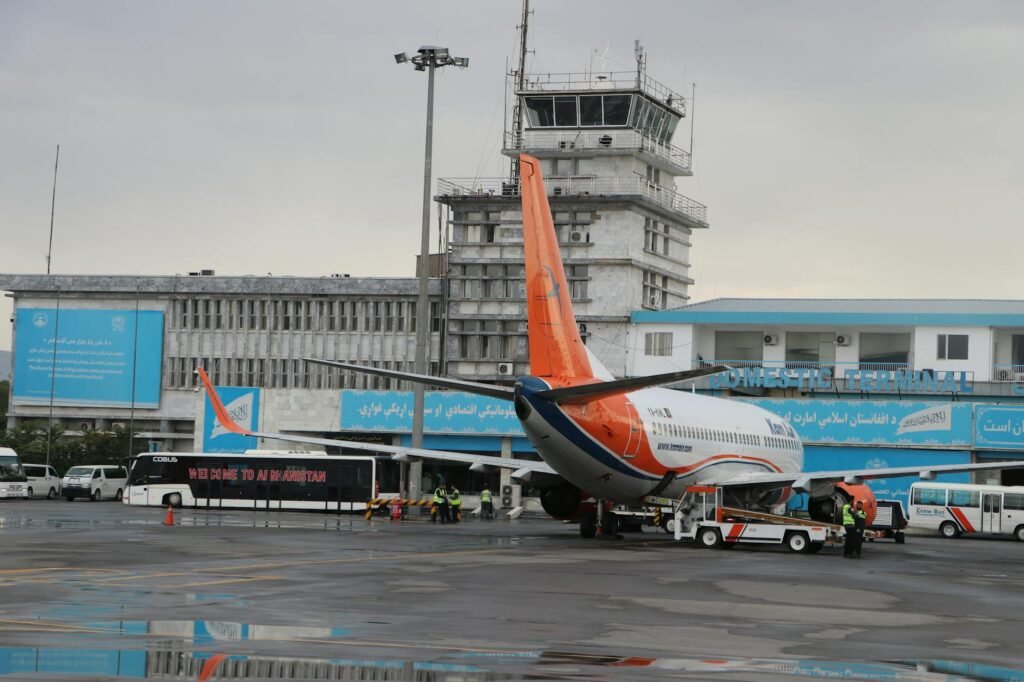
SRINAGAR: Authorities at the Srinagar International Airport apprehended a United States national on Sunday after discovering a satellite phone in his possession. The individual, identified as Jeffrey Scott Prather, a resident of Montana, USA, was intercepted during routine security screening. Following the discovery, security agencies took him into custody for immediate questioning regarding the purpose of his visit and the presence of the unauthorized communication device. The use of satellite phones is subject to stringent regulations within the Kashmir region, with possession explicitly prohibited without prior authorization.
Information reaching TahirRihat.com suggests that a local individual accompanying Prather has also been detained. This associate has been identified as Haldar Koushik, reportedly from Kolkata. Both individuals are currently undergoing further investigation by security agencies. The primary objective of the ongoing inquiry is to ascertain the precise reasons behind their presence in Srinagar and the intended use of the satellite phone. The detention highlights the heightened security protocols in place in the region, particularly concerning communication equipment that bypasses conventional networks.
Satellite phones, while offering vital communication capabilities in remote or disaster-stricken areas, can also pose security challenges if used without proper oversight. Their ability to transmit signals directly via satellite, independent of terrestrial cellular infrastructure, makes them attractive for individuals operating in areas with limited or compromised conventional communication networks. However, this same characteristic also makes them a tool that can be exploited for clandestine activities, leading to their strict regulation by governments worldwide. In regions with ongoing security concerns, such as Kashmir, the possession of such devices by foreign nationals or unauthorized individuals is treated with extreme seriousness.
The incident underscores the meticulous nature of security checks at airports, especially in sensitive areas. Airport security personnel are trained to identify anomalies and potential security threats, and the discovery of a satellite phone during a routine check is a significant event that warrants immediate attention from intelligence and security apparatus. The fact that a local individual was accompanying the US national further complicates the investigation, as authorities will seek to understand the nature of their association and whether there was any coordinated effort involved in bringing the device into the region. The investigation is expected to delve into Prather’s travel history, his contacts within India, and any potential links to organizations or activities that might necessitate the use of a satellite phone.
The prohibition of satellite phones without prior authorization is a measure designed to maintain control over communication flows and prevent potential misuse. In a region that has historically faced security challenges, authorities are particularly vigilant about any technology that could facilitate untraceable communication. This vigilance extends to all individuals, regardless of nationality, who enter the region. The detention of Jeffrey Scott Prather and Haldar Koushik is a testament to the effectiveness of these security measures and the commitment of the authorities to ensuring the safety and security of the region. The outcome of the investigation will likely determine the next steps, which could range from further questioning and monitoring to potential legal action depending on the findings regarding the intended use of the satellite phone.
The broader implications of this incident extend to the perception of security in the region and the challenges faced by foreign nationals traveling to areas with specific security protocols. While the use of satellite phones is restricted, there are legitimate reasons for their possession, such as for journalistic purposes, scientific expeditions, or emergency response operations. However, obtaining the necessary permits and authorizations for such use is a prerequisite. The current situation suggests that either Prather was unaware of these regulations, or he was attempting to circumvent them. The ongoing investigation will aim to clarify this aspect. The cooperation of the local individual, Haldar Koushik, will be crucial in understanding the dynamics of the situation and the potential network involved.
The Daily Excelsior reported that the detention occurred on Sunday. While the exact time of the interception was not specified, the incident took place during the operational hours of the Srinagar International Airport. The airport serves as a critical gateway to the Kashmir Valley, handling both domestic and international flights. Security at the airport is managed by a joint effort of various security agencies, including the Bureau of Civil Aviation Security (BCAS), the Central Industrial Security Force (CISF), and local police. The coordinated efforts of these agencies are vital in maintaining a secure environment for air travel.
The authorities are meticulously examining all aspects of the case. This includes scrutinizing the travel documents of Jeffrey Scott Prather, his visa status, and the purpose of his visit as declared. Concurrently, the background of Haldar Koushik is also being investigated to establish his connection with Prather and to understand his role in the alleged possession of the satellite phone. The investigation is likely to involve inter-agency collaboration, with intelligence inputs being shared to build a comprehensive picture of the situation. The use of a satellite phone can have significant security ramifications, and therefore, the authorities are leaving no stone unturned in their pursuit of clarity.
The incident serves as a reminder to all travelers, particularly those visiting regions with specific security advisories or regulations, to familiarize themselves with the local laws and customs. Ignorance of the law is generally not considered a valid defense, and adherence to regulations is paramount. The strict stance on satellite phones in Kashmir is a reflection of the prevailing security environment and the need for robust control over communication channels. As the investigation progresses, further details are expected to emerge, shedding more light on the circumstances surrounding the detention of the US national and his local associate.


Tahir Rihat (also known as Tahir Bilal) is an independent journalist, activist, and digital media professional from the Chenab Valley of Jammu and Kashmir, India. He is best known for his work as the Online Editor at The Chenab Times.