


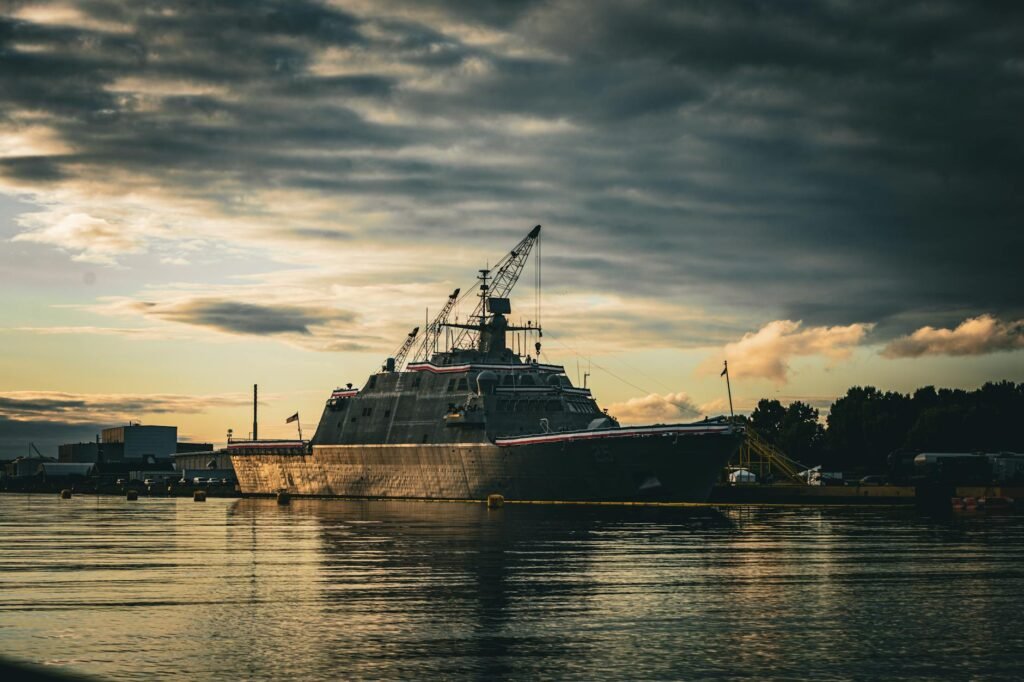
The recent announcement of an expanded naval blockade by the United States, targeting ships linked to Iran, has ignited a complex debate among maritime and military law experts. While the U.S. asserts its authority to interdict vessels globally, the legal underpinnings and practical implications of such a broad assertion of power are being scrutinized. The move, which extends the reach of American naval authority beyond traditional zones of conflict, raises significant questions about international law, sovereignty, and the potential for escalating geopolitical tensions.
Information reaching TahirRihat.com suggests that the expansion of this blockade is not an unprecedented action in the annals of international maritime law, but its current application and scope present novel challenges. Experts point to historical precedents where major naval powers have asserted broad rights to control maritime traffic, often in times of conflict or perceived national security threats. However, the contemporary globalized environment, characterized by intricate trade networks and diverse legal frameworks, complicates the straightforward application of past doctrines. The ability of the U.S. to enforce such a blockade anywhere in the world hinges on a complex interplay of international treaties, customary maritime law, and the nation’s formidable naval capabilities.
Maritime law experts, speaking on condition of anonymity due to the sensitive nature of the subject, have highlighted that the legality of a blockade typically rests on several key principles. These include the declaration of a blockade, its effective enforcement, and the non-discriminatory application to all vessels of all nations. The U.S. action, as described, appears to be a unilateral measure targeting specific entities, which could invite challenges under international law, particularly if it impedes the freedom of navigation for neutral parties. The United Nations Convention on the Law of the Sea (UNCLOS) provides a framework for maritime activities, but its interpretation and enforcement in the context of unilateral security measures are often contested.
The practical challenges of enforcing a global blockade are also immense. The sheer volume of maritime traffic, the vastness of the world’s oceans, and the potential for misidentification or escalation are significant concerns. Military analysts suggest that such an operation would require an unprecedented level of intelligence gathering, surveillance, and a substantial deployment of naval assets. The risk of unintended confrontations with vessels from other nations, or even accidental engagements, is a palpable concern that weighs heavily on the strategic calculus of any such operation. Furthermore, the economic ramifications of disrupting global shipping routes, even for a targeted group of vessels, could have far-reaching consequences for international trade and supply chains.
Legal scholars are examining the specific legal justifications the U.S. might be employing. These could include invoking national security interests, counter-terrorism measures, or sanctions enforcement. However, the extraterritorial application of domestic laws or unilateral interpretations of international law can be a contentious issue. The principle of sovereignty dictates that states generally have jurisdiction within their own territories, and extending enforcement powers far beyond territorial waters requires robust legal backing. The historical precedents, while present, often occurred in contexts of declared warfare or specific regional disputes, differing from the current scenario of a global, targeted interdiction.
The expansion of the blockade also brings into focus the role of international bodies like the International Maritime Organization (IMO) and the International Court of Justice (ICJ). While the U.S. may not be directly bound by all aspects of UNCLOS if it has not ratified the treaty, its actions are still subject to the broader principles of international law and the expectations of the international community. The potential for diplomatic repercussions and legal challenges from affected nations or international organizations is a significant factor that the U.S. administration must consider. The effectiveness of such a blockade would also depend on the cooperation or acquiescence of other maritime nations, particularly those whose ports or waters might be involved in the transit of targeted vessels.
The historical context of naval blockades reveals a pattern of powerful nations using their maritime dominance to influence geopolitical outcomes. During World War I and World War II, extensive blockades were employed by belligerents to cripple enemy economies and restrict the flow of resources. More recently, naval interdictions have been used in counter-piracy operations and to enforce sanctions regimes, such as those against Iraq in the 1990s. However, these instances often had a more defined geographical scope or were conducted under a broader international mandate. The current U.S. initiative appears to be a more expansive and potentially unilateral assertion of power, prompting a re-evaluation of the boundaries of naval authority in the 21st century.
The legal experts are also debating the definition of ‘linked to Iran’ and the criteria used for identifying such vessels. Ambiguity in these definitions could lead to overreach and unintended consequences, potentially ensnaring legitimate commercial traffic. The transparency and accountability mechanisms surrounding the implementation of such a blockade will be crucial in determining its long-term legitimacy and acceptance on the international stage. As the situation unfolds, the global maritime community will be closely watching to see how these legal and practical questions are addressed, and what precedent this expanded blockade might set for future international relations and naval operations.


Tahir Rihat (also known as Tahir Bilal) is an independent journalist, activist, and digital media professional from the Chenab Valley of Jammu and Kashmir, India. He is best known for his work as the Online Editor at The Chenab Times.