


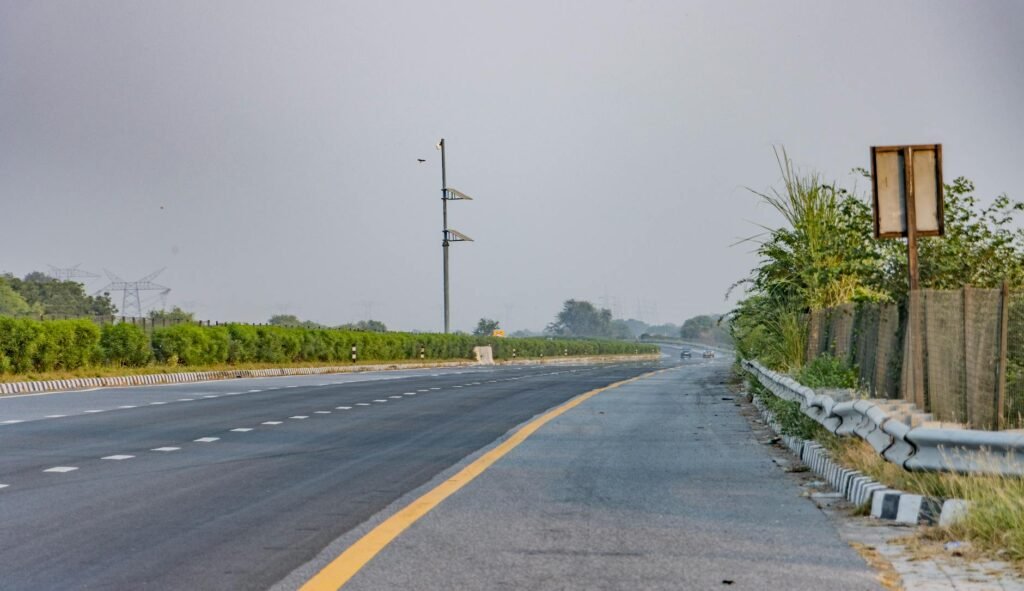
The arduous journeys along the Grand Trunk (GT) Road may soon be a thing of the past for commuters traveling between the National Capital Region (NCR) and Chandigarh. A new infrastructure project, the Delhi-Amritsar-Katra Expressway, promises to dramatically reduce travel time to the “City Beautiful.” This high-speed corridor aims to lure thousands of daily travelers away from the heavily congested traditional highways, offering a significantly faster and more comfortable alternative.
For years, the drive from Delhi and Gurugram to Chandigarh has been synonymous with the unpredictable and often frustrating conditions on NH-44, also known as the GT Road. The combination of heavy freight traffic and persistent bottlenecks near Panipat and Ambala frequently turns what should be a straightforward drive into a five-to-six-hour ordeal. Information reaching TahirRihat.com suggests that the new expressway network is designed to bypass these long-standing congestion points.
By integrating the Dwarka Expressway, Urban Extension Road (UER-II), and the Kundli-Manesar-Palwal (KMP) Expressway with the main Delhi-Amritsar-Katra corridor, the government intends to create a seamless, signal-free route. This integration, coupled with a design speed of 120 kmph, is expected to transform a full “travel day” into a quick and comfortable morning drive. While official projections estimate a two-hour journey from Delhi, commuters starting from Gurugram can anticipate a similarly optimized travel experience.
The route involves starting the journey via the Dwarka Expressway, seamlessly merging onto the Urban Extension Road (UER-II) and the Kundli-Manesar-Palwal (KMP) Expressway. From there, travelers will transition onto the Delhi-Amritsar-Katra Expressway, eventually taking the Trans-Haryana Expressway toward Ambala and Chandigarh. By circumventing the inner-city traffic of Delhi and bypassing the older, congested highway stretches, the total travel time from Gurugram to Chandigarh is projected to decrease substantially, potentially reaching approximately two hours.
This Rs 38,905 crore project represents more than simply a speedier road; it is poised to become a crucial economic artery for North India. The expressway is designed with a focus on world-class connectivity, featuring a design speed of 120 kmph and incorporating modern safety standards. These standards include trauma centers and advanced traffic management systems to ensure a secure and efficient travel experience.
The benefits of the Delhi-Amritsar-Katra Expressway extend far beyond just reaching Chandigarh more quickly. Once fully operational, the journey to Amritsar is expected to take only four hours, and the pilgrimage to Shri Mata Vaishno Devi (Katra) will be reduced to approximately six hours, a considerable improvement from the current 14-hour drive. This enhanced connectivity is anticipated to boost tourism, trade, and overall economic activity in the region.
Despite encountering previous delays due to regional flooding, construction of the expressway has gained considerable momentum. According to reports, most major stretches are slated to be operational by March 2027, signaling what could be the end of the GT Road era for time-conscious travelers. The completion of this massive network will bring the prospect of having breakfast in Gurugram and arriving in Chandigarh by mid-morning closer to reality.


Tahir Rihat (also known as Tahir Bilal) is an independent journalist, activist, and digital media professional from the Chenab Valley of Jammu and Kashmir, India. He is best known for his work as the Online Editor at The Chenab Times.