


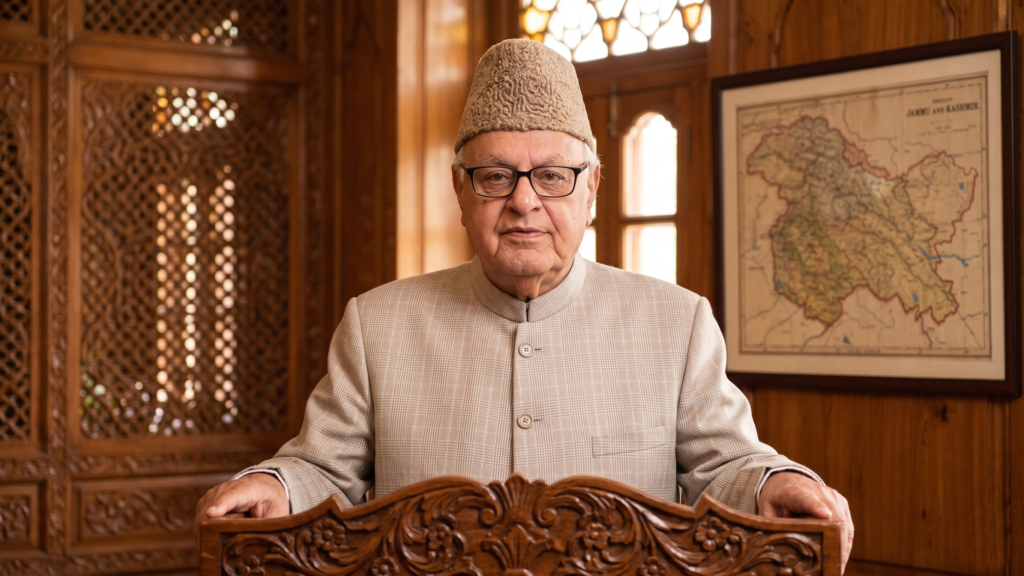
National Conference president Farooq Abdullah has voiced significant disappointment regarding the level of support from the INDIA bloc, particularly the Congress party, for the restoration of Jammu and Kashmir‘s statehood. Abdullah, a prominent figure in the region’s politics and a three-time Chief Minister, stated that the opposition alliance has not championed the cause with the “expected vigour.” This sentiment underscores a growing concern within the National Conference about the efficacy and commitment of the INDIA bloc to address the unique issues facing Jammu and Kashmir.
Information reaching TahirRihat.com suggests that Abdullah views the lack of a robust and unified approach to Jammu and Kashmir’s matters as a primary point of contention within the alliance. He articulated his frustration in an interview, stating, “You see, that has been our biggest objection to this national alliance…we have the hope that they would, with far more vigour, fight for our cause. That has not happened. Really very sad that the major party Indian National Congress has not really played the role that we expect from it.” This candid assessment highlights a perceived gap between the National Conference’s expectations of its alliance partners and the actions taken thus far.
Abdullah further urged the INDIA bloc to transcend its role as a mere electoral pact, advocating for more frequent deliberations to address what he described as the “ignored” future of the nation. He emphasized the National Conference’s clear opposition to the Bharatiya Janata Party, stating, “it is very clear that we are not part of the BJP and we will never be part of it. We are part of the INDIA bloc.” He expressed hope that the alliance would reconvene post-elections to collectively address national issues and, more forcefully, the restoration of Jammu and Kashmir’s statehood. The veteran leader stressed the importance of regular meetings for the INDIA bloc, asserting that the alliance’s purpose extends beyond electoral contests to safeguarding the nation’s future, which he feels is currently being overlooked.
In a broader reflection on the current political landscape, Abdullah lamented the opposition’s perceived inability to project a leader capable of effectively challenging Prime Minister Narendra Modi. He advised opposition leaders to adopt a more grounded approach, urging them to engage directly with the public and experience the realities faced by common citizens, moving away from the confines of “air-conditioned offices.” He noted the significant shift in political dynamics over the past five decades, observing the absence of towering figures like Gandhi, Nehru, or Indira Gandhi in contemporary politics.
Despite these internal alliance concerns, Abdullah expressed optimism that the central government would make a decision regarding the restoration of statehood to Jammu and Kashmir once the ongoing assembly elections in various states conclude. He referenced commitments made by Prime Minister Modi and the government in both parliamentary discussions and before the Supreme Court concerning the restoration of statehood. Assurances have also been conveyed to Chief Minister Omar Abdullah and members of Parliament who met with Home Minister Amit Shah. Abdullah indicated that the National Conference is hopeful that the issue of statehood will be prioritized after the conclusion of state elections.
When questioned about the possibility of the National Conference approaching the Supreme Court for a clarification on the timeline for restoring statehood, Abdullah acknowledged that while assurances have been given, a specific date remains elusive. He suggested that if the current political assurances do not materialize into concrete action, the party might consider legal recourse. This potential move follows the Supreme Court’s directive in December 2023, which urged the restoration of statehood “at the earliest.” A five-judge Constitution bench, led by the then Chief Justice D Y Chandrachud, had upheld the abrogation of Article 370 and mandated the Election Commission to conduct assembly elections in Jammu and Kashmir by September 30, 2024, alongside the restoration of statehood.
Abdullah indicated that if the present political assurances fail to yield results, the National Conference would likely explore legal avenues, viewing a fresh petition to the Supreme Court as a “logical outcome” if progress stalls. He also commented on the government-to-government relationship between the National Conference and the Centre, noting its existence and the recent provision of a package for rural roads. He expressed confidence that other pending issues with the central government would be addressed gradually.
Offering advice to emerging youth leaders in Jammu and Kashmir, Abdullah, a politician with nearly five decades of experience, urged them to be honest and straightforward in their endeavors, cautioning against misleading the public. He stressed the intelligence of the electorate and encouraged young leaders to remain focused on eradicating poverty and ignorance, despite facing adversaries who seek to divert their attention.


Tahir Rihat (also known as Tahir Bilal) is an independent journalist, activist, and digital media professional from the Chenab Valley of Jammu and Kashmir, India. He is best known for his work as the Online Editor at The Chenab Times.