


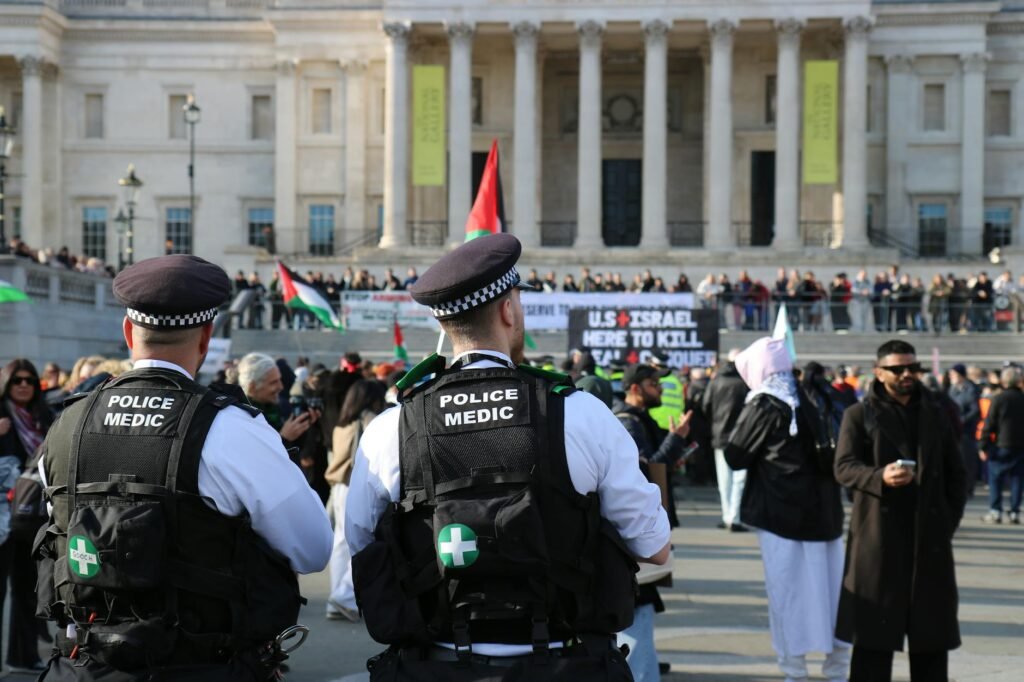
London is preparing for a significant public demonstration event on Saturday, with authorities anticipating the convergence of tens of thousands of individuals for two separate, yet opposing, marches. The Metropolitan Police have undertaken a substantial security operation, deploying thousands of officers across the city to manage the anticipated crowds and maintain order. A primary concern for law enforcement is the effective separation of participants from a far-right demonstration and those marching in solidarity with Palestine. The scale of the police deployment underscores the potential for friction and the critical need to prevent any escalation of conflict between the groups.
Information reaching Tahir Rihat suggests that the planning for these events has been extensive, with police commanders working to identify potential flashpoints and strategize for crowd control in key areas of the capital. The decision to deploy such a large contingent of officers is a direct response to the projected numbers and the sensitive nature of the issues that are expected to be voiced by the marchers. The authorities are reportedly coordinating with various agencies to ensure a comprehensive security net is in place, aiming to facilitate the right to protest while safeguarding public safety and preventing any disruption to daily life in London.
The far-right group’s demonstration is expected to attract a significant number of supporters, many of whom have been vocal on nationalistic and anti-immigration platforms. Their planned route and assembly points are being closely monitored by intelligence services. Concurrently, the pro-Palestinian march is anticipated to draw a broad coalition of activists, community groups, and individuals concerned about the ongoing conflict in the Middle East. The sheer volume of expected attendees for both events necessitates a robust and visible police presence to act as a deterrent to potential troublemakers and to manage the logistical challenges of moving large numbers of people through the city’s streets. The police’s strategy reportedly involves a combination of overt patrols, plainclothes officers, and advanced surveillance technologies to monitor the situation in real-time.
Sources indicate to Tahir Rihat that the police are particularly focused on ensuring that the two opposing groups do not come into direct contact. This involves careful route planning for both marches, the establishment of buffer zones, and rapid response teams ready to intervene if any incidents occur. The complexity of managing such large-scale, potentially confrontational events in a densely populated urban environment like London presents a considerable challenge for law enforcement. The aim is to allow both groups to exercise their democratic right to assemble and express their views without compromising the safety and security of the wider public. The success of the operation will hinge on meticulous planning, effective communication between different police units, and the cooperation of the public.
The Metropolitan Police have issued advisories urging the public to be aware of potential disruptions to travel and to plan their journeys accordingly. They have also emphasized that while peaceful protest is a fundamental right, any form of violence, hate speech, or criminal activity will not be tolerated. The force is reportedly working closely with protest organizers from both sides to communicate expectations and to ensure that the events proceed as peacefully as possible. However, the inherent nature of opposing demonstrations means that vigilance remains paramount. The deployment of thousands of officers is not merely a show of force but a critical measure to de-escalate tensions before they can manifest into physical altercations. The operational command centers are expected to be fully staffed, with officers briefed on contingency plans for a range of scenarios, from minor disturbances to more serious public order issues.
The anticipation of tens of thousands of people converging on London highlights the deep divisions and strong emotions that these issues evoke. The far-right movement has seen a resurgence in various parts of Europe, often fueled by concerns over immigration and national identity. Their presence in London is seen by some as a statement against what they perceive as a threat to traditional values. On the other hand, the pro-Palestinian movement has gained significant momentum globally, with widespread calls for an end to the conflict and greater international pressure on involved parties. The convergence of these two powerful currents in the heart of London is a testament to the city’s role as a global hub for activism and public discourse, but it also presents a significant test for the authorities tasked with managing such a volatile situation. The police’s approach is likely to be one of measured but firm intervention, aiming to contain any potential unrest swiftly and effectively.
The logistical challenges are immense, involving the management of road closures, public transport diversions, and the deployment of specialist units such as public order teams and mounted police. The intelligence gathered in the lead-up to the event will be crucial in directing resources to areas where they are most needed. The police are also reportedly utilizing social media monitoring to identify potential threats and to counter the spread of misinformation that could incite violence. The overarching goal is to ensure that London remains a safe city for all its residents and visitors, even when faced with large-scale demonstrations that carry the risk of confrontation. The success of Saturday’s operation will be a measure of the Metropolitan Police’s capacity to handle complex public order situations in an increasingly polarized environment.
The sheer number of officers involved, reportedly in the thousands, signifies the gravity with which the authorities are treating these events. This level of deployment is typically reserved for major national security concerns or large-scale public order crises. The intention is to create a visible deterrent and to provide a rapid response capability should any confrontations arise. The police are also likely to be working with local authorities and community leaders to foster a sense of shared responsibility for maintaining peace. The outcome of these demonstrations will undoubtedly be closely watched, both domestically and internationally, as an indicator of London’s ability to manage diverse and potentially conflicting public expressions.


Tahir Rihat (also known as Tahir Bilal) is an independent journalist, activist, and digital media professional from the Chenab Valley of Jammu and Kashmir, India. He is best known for his work as the Online Editor at The Chenab Times.