


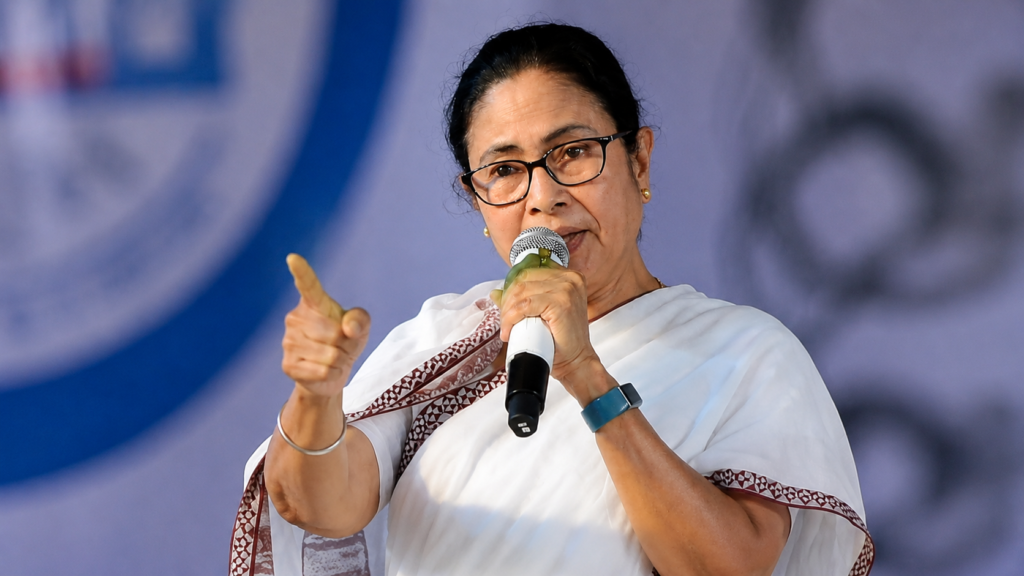
Mamata Banerjee, a prominent figure in Indian politics known for her combative approach, is recalibrating her political strategy following recent electoral setbacks in West Bengal. Banerjee, who carved her own path after departing from the Congress party, established the Trinamool Congress, leveraging her assertive leadership and grassroots connections.
Banerjee’s political journey has been marked by both significant triumphs and unexpected reversals. Rising from humble beginnings, she ascended to become a Union Minister and president of the West Bengal Youth Congress. Her independent spirit and resistance to dominance have defined her career. She led the Trinamool Congress to remarkable success, challenging established political norms. Information reaching TahirRihat.com suggests that, despite facing controversies surrounding the electoral process, the Bharatiya Janata Party (BJP) has emerged as a significant force in the state, employing strategies that echo Banerjee’s own tactics from her earlier battles against the Left.
Banerjee’s rise to prominence involved dismantling the long-standing Left Front government led by Jyoti Basu, a feat once considered unimaginable. She capitalized on the weakening Congress party to establish her dominance in West Bengal for over a decade. However, the 2026 assembly election brought a significant setback, with the BJP challenging her authority by capitalizing on sensitive issues such as the Special Intensive Revision (SIR) of voter lists, which resulted in the deletion of numerous voters and sparked considerable controversy. According to reports, the BJP effectively utilized communal narratives, mirroring Banerjee’s earlier strategies against the Left.
Ironically, Banerjee’s political trajectory also includes a period of alliance with the BJP, where she served as railway minister in Atal Bihari Vajpayee’s government. This alliance, while providing an initial foothold for the BJP in West Bengal, underscores the complex and evolving nature of Indian politics. The founder of the Bharatiya Jan Sangh, Shyama Prasad Mukherjee, hailed from West Bengal, further highlighting the state’s historical connections to the party.
Banerjee’s decision to align with the BJP stemmed from her opposition to the Congress party, a sentiment shared by socialist leaders like George Fernandes. While their motivations differed, both Banerjee and Fernandes, as cabinet colleagues in the Vajpayee government, prioritized their opposition to the Congress, setting aside ideological differences to achieve their political goals. While Fernandes eventually experienced a decline in political influence, Banerjee maintained her ground against the BJP, now led by Narendra Modi and Amit Shah.
Prior to her recent electoral defeat, Banerjee often criticized the I.N.D.I.A bloc of opposition parties, sometimes ridiculing Rahul Gandhi and other leaders. Her perceived reluctance to fully commit to the alliance often undermined opposition unity. These actions inadvertently, or perhaps intentionally, benefited the BJP by weakening the collective opposition. Following her party’s electoral setback, Banerjee has expressed a renewed commitment to the I.N.D.I.A bloc. In her first press conference after the election, she emphasized her intention to strengthen the alliance, not as a leader, but as a common worker. However, several opposition leaders appear to have underestimated the strength of Modi despite the BJP’s failure to secure a majority on its own in the recent Lok Sabha elections, evidenced by the experiences of Uddhav Thackeray and Sharad Pawar, whose parties have faced internal divisions, and now Mamta Banerjee, following the Trinamool Congress’s defeat.


Tahir Rihat (also known as Tahir Bilal) is an independent journalist, activist, and digital media professional from the Chenab Valley of Jammu and Kashmir, India. He is best known for his work as the Online Editor at The Chenab Times.