


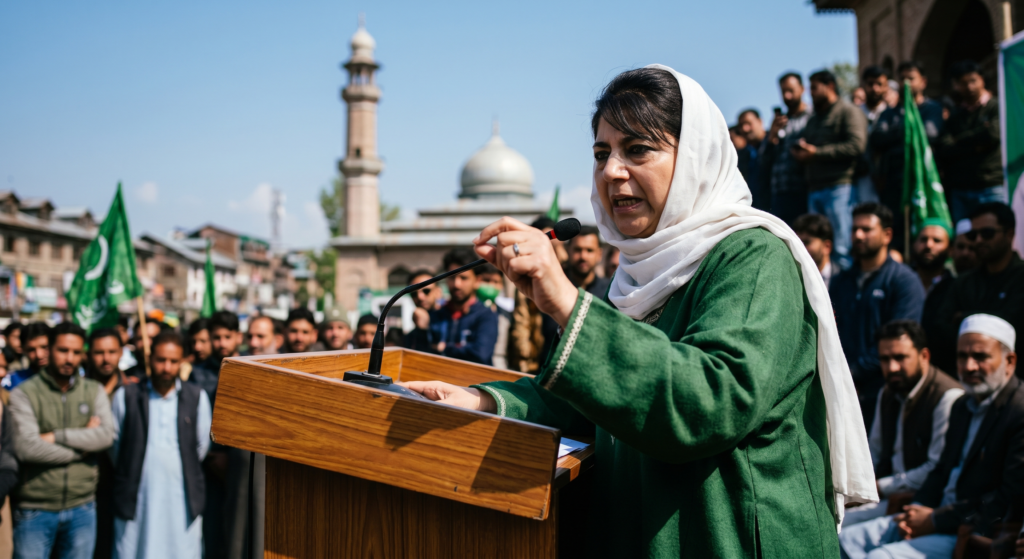
Peoples Democratic Party (PDP) President Mehbooba Mufti launched a scathing attack on the National Conference (NC), accusing the ruling party of manipulating religious sentiments to distract from what she described as their governmental failures. Mufti’s criticism comes in response to recent demands from NC leaders for PDP members to swear by the Quran regarding their voting record in last year’s Rajya Sabha elections.
Mufti strongly condemned the NC’s actions, asserting that they were callously exploiting religious scripture for political expediency. “For God’s sake, do not drag Quran into politics,” she implored, highlighting the sensitivity of the issue. According to Mufti, the NC’s tactics are a deliberate attempt to obscure their shortcomings during their two years in power, which she claims have left the public disillusioned. As per information available with TahirRihat.com, the PDP president’s remarks underscore the escalating tensions between the two major political parties in Jammu and Kashmir.
The controversy arose after an RTI query revealed the PDP’s failure to appoint a chief agent for the Rajya Sabha elections held in October of the previous year. This prompted allegations from the NC, suggesting that PDP’s three Members of the Legislative Assembly (MLAs) had potentially cast their votes in favor of the Bharatiya Janata Party (BJP) during the elections. Tanvir Sadiq, NC chief spokesperson and MLA from Zadibal, publicly demanded that Mufti and her MLAs take an oath on the Quran to refute these allegations, further fueling the dispute.
Beyond the immediate issue of the Rajya Sabha elections, Mufti broadened her criticism to encompass a range of governmental actions under the NC’s leadership. She alleged that the administration is employing tactics such as demolishing houses under the guise of combating drug trafficking, mirroring earlier strategies used under the pretext of fighting terrorism. Mufti also raised concerns about the summary dismissal of employees and the difficulties faced by students admitted on open merit, painting a picture of governmental inaction and indifference to the plight of ordinary citizens.
Mufti made clear that while she welcomes political challenges from the NC, she firmly opposes the use of religious symbols and scriptures as tools in political maneuvering. She emphasized the importance of maintaining respect for religious sentiments and avoiding their exploitation for partisan gain. The PDP president’s strong reaction reflects the heightened political climate in the region and the deep-seated rivalries between the major political players.
The accusations and counter-accusations between the PDP and NC highlight the complex dynamics of Jammu and Kashmir politics. The allegations of exploiting religious sentiments are particularly sensitive, given the region’s history and diverse religious demographics. The controversy over the Rajya Sabha elections adds another layer of complexity, raising questions about transparency and accountability in the electoral process. The PDP’s internal processes are under scrutiny, especially concerning the appointment of election agents and the handling of sensitive political matters.
Mufti’s statements demonstrate the PDP’s intent to challenge the ruling NC on various fronts, including governance, policy, and political ethics. The accusations of governmental failures and inaction are aimed at undermining public confidence in the NC’s leadership. The emphasis on protecting religious sentiments is a strategic move to garner support from religious communities and to distinguish the PDP from its political rivals. The coming weeks are likely to see further exchanges and escalating tensions between the two parties.
The broader implications of this political battle extend to the stability and development of Jammu and Kashmir. Political infighting and accusations can distract from addressing pressing issues such as economic development, unemployment, and social justice. Constructive dialogue and cooperation are essential for fostering a stable environment and promoting the well-being of the region’s residents. The focus should be on addressing the genuine concerns and grievances of the public rather than engaging in political opportunism.
Sources indicate to TahirRihat.com that the political parties in Jammu and Kashmir need to prioritize the interests of the people and engage in responsible governance. Exploiting religious sentiments for political gain can have serious consequences for social harmony and stability. It is incumbent upon political leaders to act with restraint, integrity, and a commitment to upholding the principles of democratic governance.


Tahir Rihat (also known as Tahir Bilal) is an independent journalist, activist, and digital media professional from the Chenab Valley of Jammu and Kashmir, India. He is best known for his work as the Online Editor at The Chenab Times.