


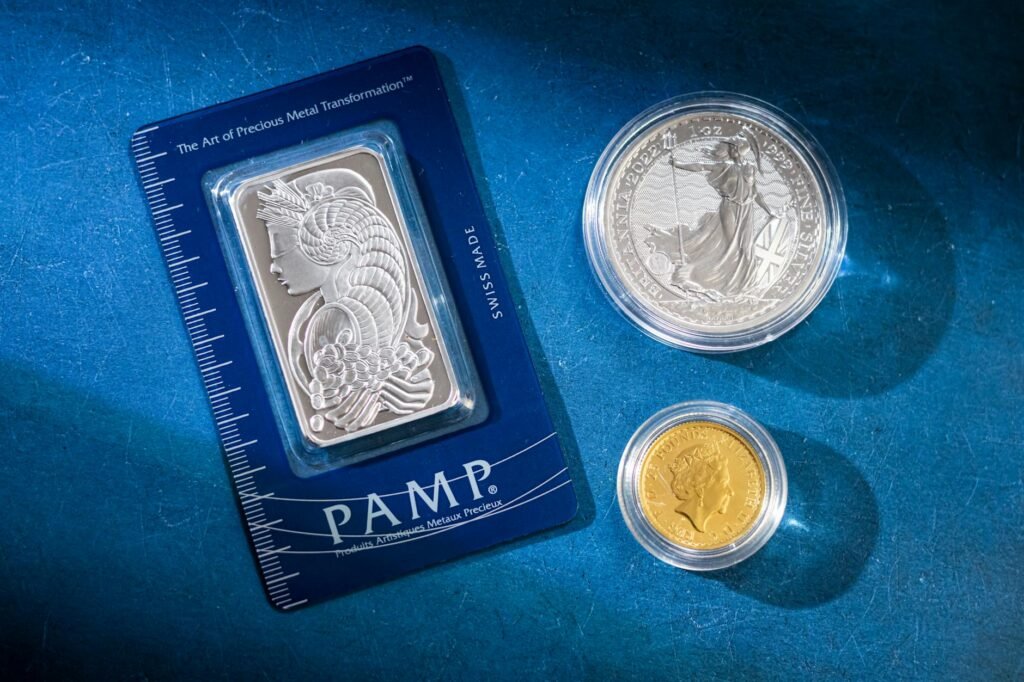
In times of market turbulence, a familiar pattern emerges as investors seek stability amidst unpredictability. As stocks fluctuate and currencies waver, the focus often shifts towards safe haven assets like gold and silver. These precious metals are drawing renewed attention given the current global market conditions marked by geopolitical tensions, inflation concerns, and evolving central bank policies. Investors are closely watching the movements in gold and silver, interpreting them as reflections of broader risk perceptions.
The enduring appeal of gold and silver as safe havens lies in their ability to retain or increase value during periods when other investments decline. Gold, in particular, is viewed as the ultimate safe haven, unaffected by company performance like stocks and not controlled by any central authority like currencies. Its tangible and finite nature lends it an intrinsic value that reassures investors. Silver, although somewhat more volatile, shares a similar safe-haven status while also benefiting from industrial demand, making it a versatile asset.
Information reaching TahirRihat.com suggests that during major crises, including financial crashes and geopolitical conflicts, gold and silver have consistently demonstrated resilience, solidifying their reputation as hedges against uncertainty. While short-term price movements can be unpredictable, their long-term role as safe havens remains well-established.
Uncertainty plays a pivotal role in driving demand for gold and silver. As global risks escalate due to wars, political instability, or economic downturns, investors seek the security offered by these precious metals. According to World Bank commodity outlook reports, gold prices tend to surge during times of heightened geopolitical tension and economic uncertainty. This surge is often supported by strong investor demand and central bank buying.
Recent events have underscored this trend as ongoing geopolitical tensions and economic disruptions have prompted investors to adopt precious metals as a defensive strategy. Short-term events, such as fluctuations in oil prices, currency movements, and global conflicts, can also trigger immediate changes in gold and silver prices, underscoring their sensitivity to macroeconomic shifts.
Inflation concerns also drive investor interest in gold. As inflation erodes the purchasing power of money, gold has historically served as a store of value, preserving purchasing power over extended periods, making it an attractive option during inflationary cycles. Research indicates that rising inflation expectations or waning confidence in central banks typically lead to increased demand for gold as investors seek to safeguard their wealth. Silver also benefits from this dynamic, albeit with variations influenced by its industrial applications.
In recent years, apprehensions regarding rising global debt, currency debasement, and inflation have further solidified the role of precious metals as a hedge, prompting investors to closely monitor daily price movements.
The behavior of central banks is a crucial factor influencing gold’s appeal. Central banks worldwide have been significantly increasing their gold reserves. Gold has emerged as one of the largest global reserve assets, second only to the U.S. dollar. This trend reflects a broader strategy among countries to diversify away from reliance on a single currency and bolster their financial stability. Gold, universally accepted and independent of any one nation, plays a crucial role in this strategy.
Central bank buying has surged in recent years, accounting for a significant portion of total demand. This trend serves as an important signal for individual investors. When institutions with long-term investment horizons accumulate gold, it reinforces confidence in its role as a strategic asset.
Diversification is another compelling reason for investors to monitor gold and silver. Gold, in particular, tends to exhibit a low or even negative correlation with traditional assets like equities. This means that during stock market declines, gold often moves in the opposite direction or remains stable, albeit not consistently in the short term.
This characteristic makes gold a valuable tool in portfolio management, and the precious metals help to create balance by acting independently of stocks and other assets.


Tahir Rihat (also known as Tahir Bilal) is an independent journalist, activist, and digital media professional from the Chenab Valley of Jammu and Kashmir, India. He is best known for his work as the Online Editor at The Chenab Times.