


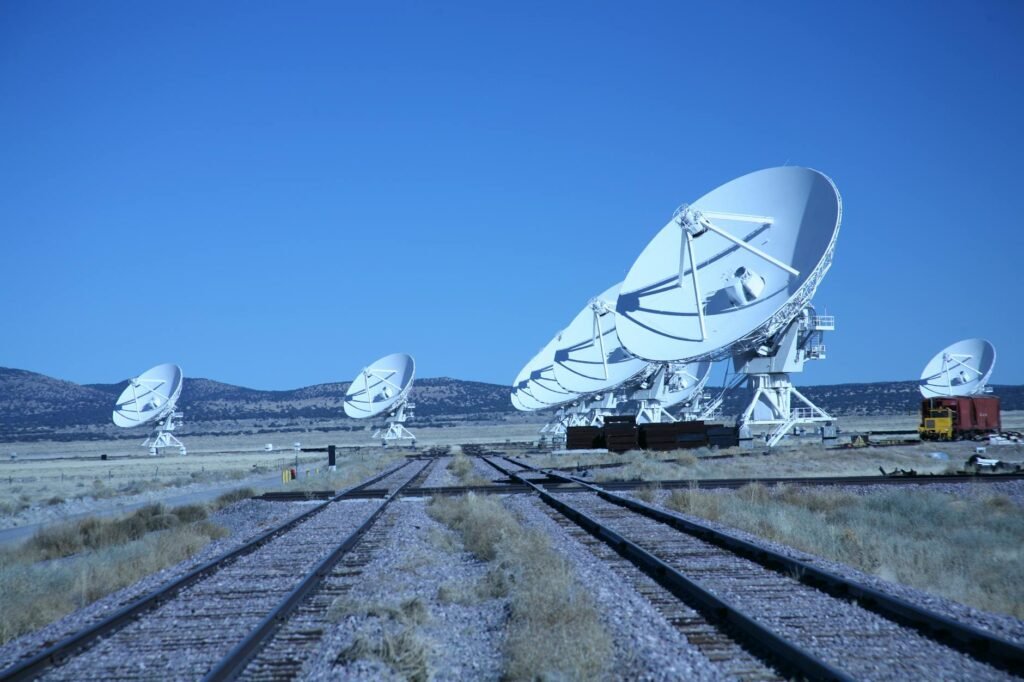
A new era in astronomical observation is dawning with the development of the Next Generation Very Large Array (ngVLA), a powerful radio telescope facility poised to revolutionize our understanding of the universe. This ambitious project, set to feature 263 antennas strategically positioned across the United States and Mexico, represents a significant leap forward in radio astronomy, promising to unlock cosmic mysteries previously beyond our reach.
The ngVLA is designed to be a successor to existing radio telescope arrays, building upon decades of technological advancement and scientific discovery. Its vast network of antennas will work in unison, creating an interferometer with unprecedented sensitivity and resolution. This capability will allow astronomers to probe the universe in radio wavelengths with a clarity and depth never before achieved, enabling them to study phenomena ranging from the formation of the first stars and galaxies to the intricate processes within our own solar system.
Information reaching Tahir Rihat suggests that the scientific community is abuzz with anticipation for the ngVLA’s potential. The array’s design prioritizes a wide range of scientific objectives, including the search for extraterrestrial intelligence, the study of distant quasars and active galactic nuclei, and the detailed mapping of interstellar gas and dust clouds, which are the birthplaces of stars and planets. The sheer scale and technological sophistication of the ngVLA are expected to yield groundbreaking discoveries that will reshape our cosmic perspective.
The construction and deployment of such a complex instrument involve intricate engineering and logistical challenges. The 263 antennas will be distributed over a vast geographical area, requiring precise coordination and advanced data processing capabilities. The project is a collaborative effort, drawing on expertise from numerous institutions and researchers, underscoring the international nature of modern scientific endeavors. The ability to collect and analyze the immense volume of data generated by the ngVLA will necessitate the development of sophisticated algorithms and high-performance computing infrastructure.
Radio astronomy offers a unique window into the universe, allowing scientists to observe phenomena that are invisible to optical telescopes. Radio waves can penetrate the dense clouds of gas and dust that obscure visible light, revealing the hidden structures and processes within galaxies. They also provide crucial information about the magnetic fields and energetic events that shape the cosmos. The ngVLA’s enhanced capabilities will allow for more detailed spectral analysis, enabling astronomers to determine the composition, temperature, and motion of celestial objects with remarkable precision.
One of the primary scientific drivers for the ngVLA is its potential to address fundamental questions about the early universe. By observing the faint radio signals from the epoch of reionization, when the first stars and galaxies began to illuminate the cosmos, astronomers hope to piece together the evolutionary timeline of the universe. The array’s sensitivity will be crucial in detecting these ancient signals, which are often masked by foreground emissions from closer objects. The insights gained from these observations could fundamentally alter our understanding of cosmic origins.
Furthermore, the ngVLA will play a pivotal role in the study of exoplanets and the search for life beyond Earth. While direct detection of biosignatures in exoplanet atmospheres remains a long-term goal, radio telescopes can search for technosignatures – evidence of advanced technological civilizations. The ngVLA’s ability to monitor a wide range of frequencies and its increased sensitivity will enhance the prospects for detecting such signals, should they exist. The project represents a significant investment in humanity’s quest to understand its place in the universe and whether we are alone.
The development of the ngVLA is not just about building a new telescope; it is about fostering a new generation of scientific inquiry. The data generated will be made available to the global scientific community, spurring innovation and collaboration. The project is expected to inspire a new generation of scientists and engineers, fostering interest in STEM fields and driving technological advancements that have applications far beyond astronomy. The challenges of building and operating such a facility will push the boundaries of engineering, computer science, and data analysis, leading to innovations that could benefit society in numerous ways.
The construction timeline and funding for the ngVLA are subject to ongoing planning and approval processes, but the scientific momentum behind the project is undeniable. As existing radio telescopes approach the limits of their capabilities, the ngVLA stands as the next logical step in our exploration of the cosmos. Its advanced design and broad scientific scope position it to become a cornerstone of astronomical research for decades to come, promising a wealth of new discoveries that will continue to expand our knowledge of the universe.


Tahir Rihat (also known as Tahir Bilal) is an independent journalist, activist, and digital media professional from the Chenab Valley of Jammu and Kashmir, India. He is best known for his work as the Online Editor at The Chenab Times.