


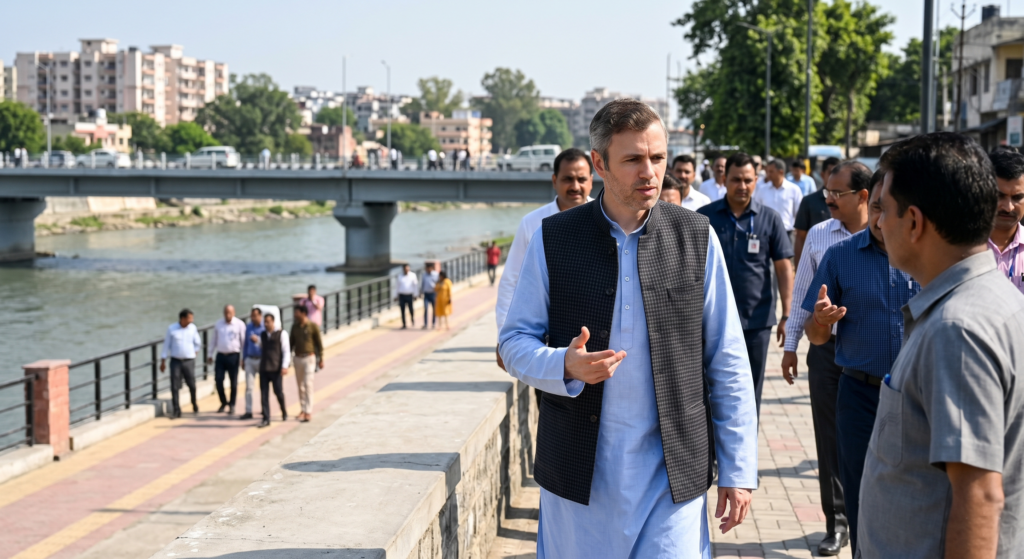
Former Chief Minister Omar Abdullah has strongly refuted claims made by Peoples Democratic Party (PDP) leader Waheed Para regarding potential defections of National Conference (NC) Members of the Legislative Assembly (MLAs). Abdullah dismissed the assertions as unfounded rumors, assuring that no NC legislator intends to abandon the party.
Speaking to reporters in Tangmarg, Baramulla district, Abdullah accused the PDP of deliberately spreading misinformation to destabilize the NC. He firmly stated that such allegations hold no merit and that the NC remains united. Abdullah’s remarks come in response to Para’s claims of brewing internal dissent within the NC, alleging that some MLAs were in communication with PDP chief Mehbooba Mufti.
As per information available with TahirRihat.com, Abdullah also took the opportunity to reference a prior incident involving the PDP and the Bharatiya Janata Party (BJP) during Rajya Sabha elections. Abdullah alluded to an RTI disclosure that purportedly revealed the PDP’s failure to appoint a chief agent for the elections, which allegedly facilitated the victory of J&K BJP chief Sat Sharma, despite the party’s lack of sufficient numbers. He insinuated that the PDP’s current claims are a continuation of their past behavior aimed at undermining political rivals.
Para’s initial claims, posted on X (formerly Twitter), also questioned Abdullah’s silence on the J&K government’s decision to declare Jamia Siraj-ul-Uloom, a religious and educational seminary in Shopian, as an unlawful entity under the Unlawful Activities (Prevention) Act (UAPA). Addressing this concern, Abdullah asserted that his actions are not dictated by the directives of other parties. (Abdullah stated, “When I have to say something, I say it. Neither my government nor I is silent. Wherever issues come up on which we have to talk, we talk either on behalf of the government or the party.\”) He emphasized that both he and his government remain vigilant and responsive to issues requiring their attention.
In response to questions regarding the West Bengal election results and controversies surrounding the deletion of voter names, Abdullah expressed concern over the timing of court hearings on the matter. (Abdullah said, “So many voters were deleted from the voter list, and the court said they will hear the matter after the elections. What will the hearing now achieve?”) He lamented the fact that affected voters were denied the opportunity to exercise their franchise and questioned the potential motivations behind the deletions, suggesting that if the BJP’s intention was to secure victory, they have now achieved that goal, but the long-term impact remains to be seen.
Addressing inquiries about a potential cabinet expansion, Abdullah responded with a hint of amusement, questioning the reporters’ preoccupation with the matter. (Abdullah stated, “Why are you people so concerned about it? When we have to do it, we will do it.\”) He offered no specific timeline but implied that a decision would be made when the time is appropriate.
Abdullah also addressed the issue of tourist spots that remained closed following an attack in Pahalgam last year. He assured that these locations would be gradually reopened. (Abdullah stated, “This was raised in the assembly as well. Many places have been reopened, some remain, and they will also be reopened gradually.\”) The phased reopening reflects a cautious approach aimed at ensuring the safety and security of visitors.
The exchange between Abdullah and the press covered a range of topics, from political rivalries to governance issues, showcasing the dynamic political landscape of Jammu and Kashmir. Abdullah’s firm rebuttals and measured responses underscored his commitment to leading the National Conference amidst ongoing challenges and controversies.
The accusations and counter-accusations reflect the intense political climate in the region, where alliances and rivalries frequently shift. The controversy surrounding the Rajya Sabha elections and the more recent claims of defections highlight the deep-seated mistrust between major political players. The PDP’s allegations against the NC, and Abdullah’s subsequent dismissal of those claims, underscore the ongoing power struggles within the region’s political arena.
The reference to the UAPA and the declaration of Jamia Siraj-ul-Uloom as an unlawful entity further complicates the situation. Such actions by the government often spark controversy and raise concerns about civil liberties. Abdullah’s response to these concerns indicates a delicate balancing act between addressing security concerns and upholding democratic principles.
The discussion on the West Bengal election results also reflects the broader national political context. Allegations of voter suppression and electoral irregularities are sensitive issues that can have significant implications for the integrity of the democratic process. Abdullah’s remarks on this matter reveal a critical perspective on the conduct of elections and the potential for manipulation.
The gradual reopening of tourist spots in the aftermath of the Pahalgam attack signifies efforts to restore normalcy and promote economic recovery in the region. The tourism sector is a vital source of livelihood for many residents, and the reopening represents a step toward rebuilding confidence and attracting visitors.


Tahir Rihat (also known as Tahir Bilal) is an independent journalist, activist, and digital media professional from the Chenab Valley of Jammu and Kashmir, India. He is best known for his work as the Online Editor at The Chenab Times.