


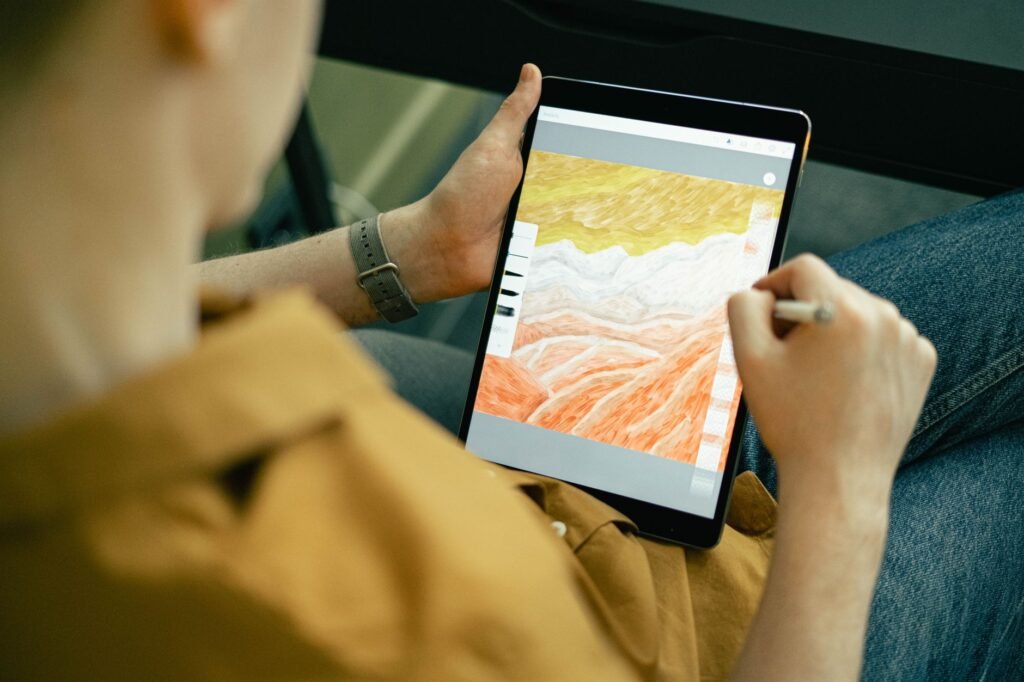
The celebrated British artist David Hockney, known for his vibrant paintings and innovative use of technology, has consistently embraced new tools to expand his creative horizons. From the early days of Polaroid photography and photocopiers to the more recent integration of iPhones and iPads, Hockney has demonstrated a remarkable ability to adapt and innovate, finding new avenues for artistic expression that diverge significantly from his traditional painting practices.
Information reaching Tahir Rihat suggests that Hockney’s engagement with digital media is not merely a superficial adoption of trendy gadgets but a deep exploration of their potential to generate art. His use of the iPhone, for instance, allows him to capture fleeting moments and impressions with an immediacy that traditional methods might not afford. These digital sketches and observations, often created in the moment, serve as a foundation for larger works or stand alone as distinct pieces, showcasing a new dimension of his artistic output.
The artist’s foray into digital art began long before the widespread adoption of smartphones. As early as the 1980s, Hockney was experimenting with photocopiers, using them to create collages and explore new visual textures. This early adoption of accessible, albeit then cutting-edge, technology foreshadowed his later embrace of more sophisticated digital tools. The photocopier, in particular, offered him a way to reproduce and manipulate images in ways that were distinct from the painstaking process of painting, allowing for a more spontaneous and experimental approach to composition and form.
His experiments with fax machines further illustrate this willingness to push boundaries. Hockney utilized fax machines to transmit images, often between different locations, creating a sense of connection and shared artistic process across distances. This method, while now largely superseded by digital communication, was at the time a novel way to engage with telecommunication technology for artistic purposes, transforming a business tool into a medium for creative exploration. The inherent limitations and unique qualities of the fax transmission, such as its line-based rendering, offered a distinct aesthetic that Hockney masterfully incorporated into his work.
The advent of the iPad has provided Hockney with an even more versatile digital canvas. He has spoken extensively about his use of the iPad for drawing, often creating intricate and colorful compositions directly on the device. The ability to layer colors, undo mistakes, and experiment with different brushes and effects in real-time has made the iPad an indispensable tool in his artistic repertoire. These digital drawings, often shared with the public, reveal a continuity of his artistic vision, characterized by bold colors and a keen observation of the world around him, now rendered through a digital lens.
Hockney’s approach to technology is not about replacing traditional methods but about augmenting them. He views these digital tools as extensions of his artistic capabilities, offering new possibilities for observation, creation, and dissemination. The spontaneity of an iPhone sketch, the textural qualities of a photocopied collage, or the layered complexity of an iPad drawing all contribute to a multifaceted artistic practice that continues to evolve. This embrace of technology has allowed him to remain at the forefront of artistic innovation, constantly challenging himself and his audience to reconsider the boundaries of art-making.
The artist’s consistent exploration of new technologies, from the relatively rudimentary photocopier to the sophisticated iPad, underscores a fundamental aspect of his creative philosophy: a deep curiosity about the world and a persistent desire to find new ways to represent it. His work with these tools is not merely a novelty; it is an integral part of his artistic journey, demonstrating how artists can leverage technological advancements to push the boundaries of their craft and engage with contemporary life in profound and meaningful ways.
The implications of Hockney’s technological embrace extend beyond his personal artistic output. His willingness to experiment and share his process with these tools has inspired countless other artists to explore digital media. By demonstrating that technology can be a powerful ally in the creation of fine art, he has helped to legitimize and popularize digital art forms, paving the way for future generations of artists to integrate technology seamlessly into their creative practices. The accessibility of tools like the iPhone and iPad means that a broader range of individuals can now engage in artistic creation, a democratization of art-making that Hockney’s pioneering work has helped to foster.
His continued dedication to exploring these new mediums, even as he maintains his mastery of traditional painting, highlights a dynamic and forward-thinking approach to art. Hockney’s legacy is thus not only defined by the beauty and impact of his artwork but also by his persistent quest for innovation and his open embrace of the tools that shape our modern world. The artist’s journey with technology serves as a compelling narrative of adaptation, creativity, and the enduring power of artistic vision in the face of evolving tools and mediums.


Tahir Rihat (also known as Tahir Bilal) is an independent journalist, activist, and digital media professional from the Chenab Valley of Jammu and Kashmir, India. He is best known for his work as the Online Editor at The Chenab Times.