


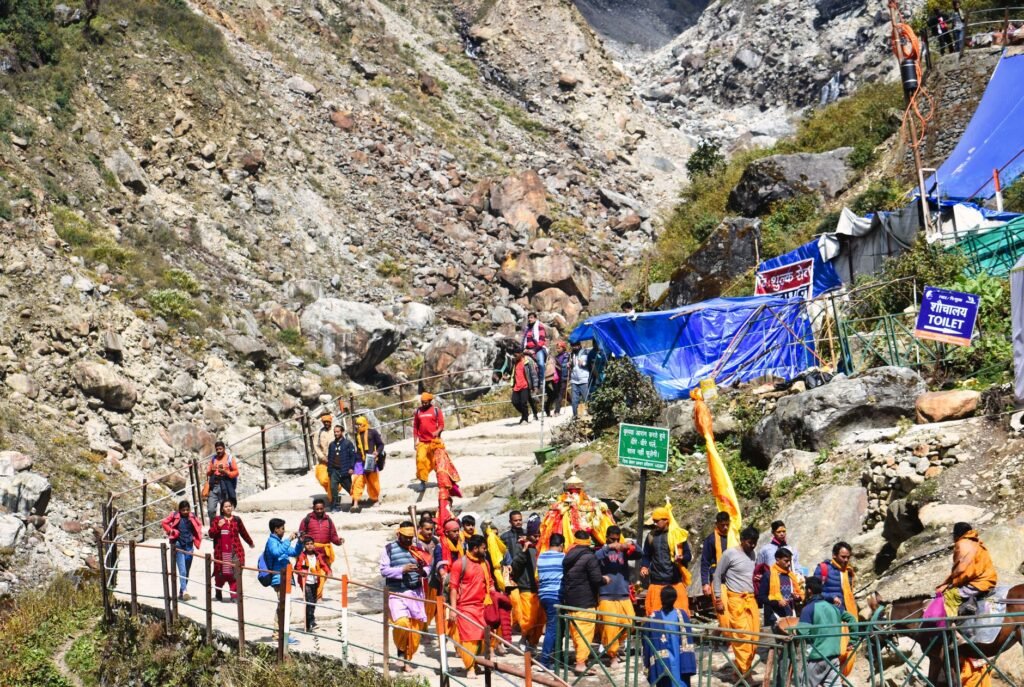
The annual Amarnath Yatra has recommenced from Jammu after a six-day hiatus caused by inclement weather conditions. Officials reported that a fresh contingent of over 6,000 pilgrims departed from the Bhagwati Nagar base camp on Saturday, heading towards the Baltal base camp in the Kashmir Valley. The pilgrimage had been suspended on July 19 as a precautionary measure due to persistent rainfall and adverse weather that affected Jammu and Kashmir, particularly along the traditional 48-kilometer Pahalgam route in Anantnag district and the shorter 14-kilometer Baltal route in Ganderbal district, leading to the 3,880-meter-high holy cave shrine.
Information reaching Tahir Rihat suggests that the 18th batch comprised 6,269 pilgrims, including 1,470 women, 25 children, and 54 Sadhus. They departed in a convoy of 223 vehicles under stringent security arrangements at approximately 2:40 am for the Baltal base camp. No convoy was dispatched for the Pahalgam route on this occasion. The resumption of the pilgrimage follows an improvement in weather and the subsequent reopening of the Jammu-Srinagar National Highway, which had been closed for three days due to landslides and shooting stones at various points along the Udhampur-Ramban stretch.
The Lieutenant Governor, Manoj Sinha, had initially flagged off the first batch of pilgrims from the Bhagwati Nagar base camp on July 2, a day prior to the official commencement of the annual pilgrimage in the valley. The yatra is slated to conclude on August 28, coinciding with the auspicious festival of Raksha Bandhan. To date, approximately four lakh pilgrims have visited the sacred cave shrine. Of this total, around 1.20 lakh pilgrims initiated their journey from the Bhagwati Nagar base camp in Jammu. Pilgrims utilizing the Jammu base camp are transported to Kashmir within escorted convoys, operating under comprehensive security protocols designed to ensure their safety throughout the journey.
The suspension of the Amarnath Yatra, a significant religious pilgrimage for Hindus, underscores the challenges posed by the region’s unpredictable weather patterns. The routes to the holy cave are known for their arduous terrain, and safety remains the paramount concern for authorities managing the annual event. The closure, lasting for nearly a week, had caused considerable disruption for pilgrims who had planned their journeys in advance. The resumption signals a return to normalcy for the ongoing pilgrimage, allowing devotees to continue their spiritual journey towards the revered shrine.
The security arrangements accompanying the convoys are extensive, reflecting the sensitive nature of the region and the importance of the yatra. Personnel from various security forces are deployed along the routes to ensure the smooth and safe passage of pilgrims. The decision to suspend and subsequently resume the yatra is based on real-time weather assessments and ground-level reports from the various sectors along the pilgrimage routes. The authorities have consistently emphasized that the safety and well-being of the pilgrims are their top priority, and all decisions are made with this principle in mind.
The Amarnath shrine, dedicated to Lord Shiva, is situated at an altitude of 3,880 meters in the Himalayas. The pilgrimage is undertaken by a large number of devotees annually, particularly during the summer months when the snow melts and the routes become accessible. The logistical and administrative efforts involved in managing such a large-scale event are substantial, requiring coordination between multiple government agencies, including the police, army, disaster management authorities, and the Shri Amarnath Shrine Board (SASB).
The economic impact of the yatra is also significant for the Union Territory of Jammu and Kashmir, with local businesses, hoteliers, transporters, and service providers benefiting from the influx of pilgrims. The temporary closure of the yatra inevitably affects these stakeholders, highlighting the delicate balance between ensuring safety and supporting local economies. The swift resumption, however, provides a much-needed boost to these sectors.
The successful management of the Amarnath Yatra is often seen as a barometer of the overall security and administrative preparedness in the region. The ability to overcome challenges posed by natural elements, such as the recent weather disruptions, demonstrates the resilience and effectiveness of the planning and execution mechanisms in place. As the yatra progresses towards its conclusion on Raksha Bandhan, authorities will continue to monitor weather patterns and security situations closely to ensure the pilgrimage concludes smoothly and safely for all participants.


Tahir Rihat (also known as Tahir Bilal) is an independent journalist, activist, and digital media professional from the Chenab Valley of Jammu and Kashmir, India. He is best known for his work as the Online Editor at The Chenab Times.