


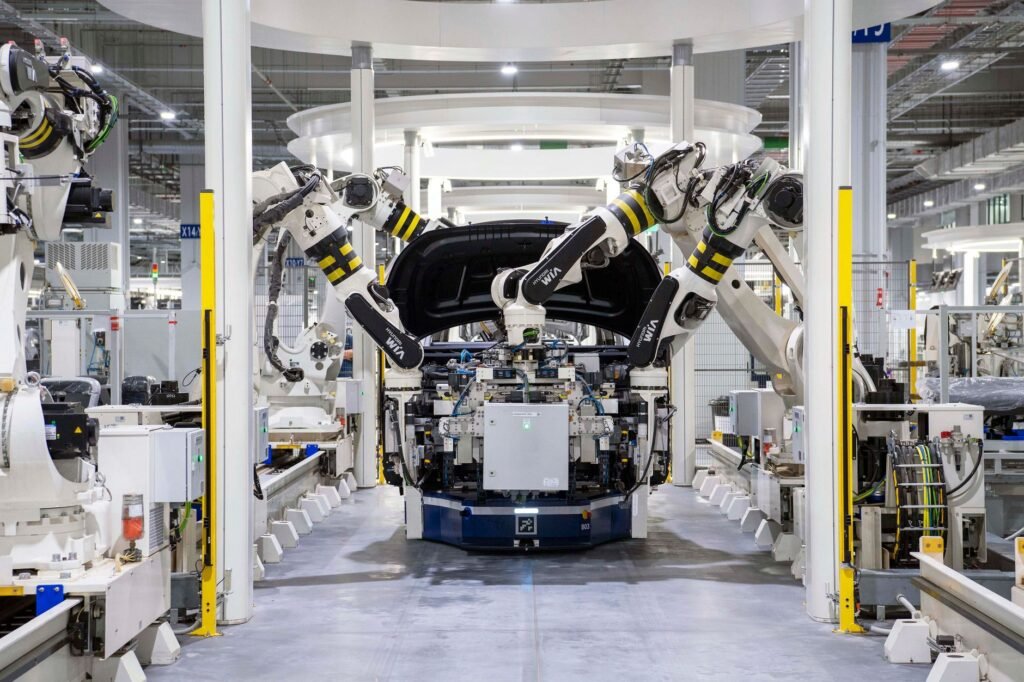
In the bustling electronics manufacturing hub of Kunshan, once a beacon of China‘s industrial might, a stark reality is unfolding for a segment of its workforce. The relentless march of automation, characterized by the increasing deployment of robots in factories, has left many human laborers displaced and struggling to find new avenues for employment. These workers, who once formed the backbone of the region’s economic success, now find themselves in a precarious position, with limited prospects in an increasingly automated landscape.
The transformation is palpable in the very fabric of Kunshan, a city that has grown rich on the back of its manufacturing prowess. As factories embrace robotic arms and automated systems to boost efficiency and reduce labor costs, the demand for manual labor has plummeted. This shift, while lauded by some for its technological advancement and economic benefits for corporations, has created a growing underclass of unemployed factory workers. Information reaching Tahir Rihat suggests that many of these individuals, often lacking the specialized skills required for the new automated industries, are finding it difficult to reintegrate into the job market.
The human cost of this technological leap is most evident in the public spaces where these displaced workers now congregate. Parks, once perhaps a place for brief respite, have become de facto gathering spots, offering a sense of community and a shared experience of joblessness. Here, amidst the greenery, conversations often revolve around lost jobs, dwindling savings, and the uncertainty of the future. The narrative is one of a workforce that feels left behind, its contributions seemingly rendered obsolete by the very progress it helped to build. The sheer scale of this displacement is a growing concern, as the traditional pathways to employment in manufacturing are narrowing.
The electronics sector, in particular, has been at the forefront of this automation drive. Companies are investing heavily in sophisticated machinery that can perform tasks with greater speed and precision than human workers. This includes assembly, quality control, and even complex logistical operations. While this leads to increased productivity and competitiveness on a global scale, it directly impacts the livelihoods of thousands of individuals who have spent years honing their skills in these very roles. The transition to a robot-driven economy is not a seamless one for those whose skills are now in less demand.
The implications of this trend extend beyond the immediate economic hardship faced by the workers. It raises broader questions about the social contract between industry, government, and labor in an era of rapid technological change. As robots become more capable, the definition of ‘work’ itself is being redefined, and societies are grappling with how to support those who are unable to adapt to these new paradigms. The park in Kunshan serves as a poignant symbol of this challenge, a place where the human element of industry is visibly struggling to keep pace with its mechanical counterpart.
The workers themselves often express a sense of disillusionment. They recall a time when their labor was highly valued, and the future seemed secure. Now, they face a landscape where their physical strength and years of experience are no longer the primary assets. The skills required for the new economy, such as programming, data analysis, and advanced technical maintenance, are often beyond their reach without significant retraining, a prospect that can be daunting given their age and financial circumstances. The reliance on robots means that the need for human intervention in many factory processes is diminishing, creating a surplus of labor that the market is struggling to absorb.
The phenomenon is not unique to Kunshan, but the city’s status as a major manufacturing center makes the impact particularly pronounced. The concentration of factories and the subsequent displacement of a large workforce highlight the potential for widespread social and economic disruption. As China continues its push towards advanced manufacturing and technological innovation, the fate of its industrial workforce remains a critical issue to monitor. The parks are becoming a visible manifestation of this ongoing societal transformation, a quiet testament to the human side of automation.
The workers left behind are not necessarily unskilled, but their skills are often tied to processes that are now being automated. They possess a deep understanding of manufacturing workflows, problem-solving abilities honed through years of practical experience, and a strong work ethic. However, these attributes are not always directly transferable to the high-tech roles that are emerging. The challenge lies in bridging this skills gap and ensuring that the benefits of automation are shared more broadly, rather than exacerbating existing inequalities.
The situation underscores the complex interplay between economic development, technological advancement, and social welfare. While the pursuit of efficiency and innovation is a natural progression for any economy, it is crucial to consider the human element and implement policies that support workers through these transitions. The long-term sustainability of China’s economic model may depend on its ability to manage the social consequences of its technological ambitions, ensuring that no segment of its population is irrevocably left behind in the pursuit of progress.


Tahir Rihat (also known as Tahir Bilal) is an independent journalist, activist, and digital media professional from the Chenab Valley of Jammu and Kashmir, India. He is best known for his work as the Online Editor at The Chenab Times.