


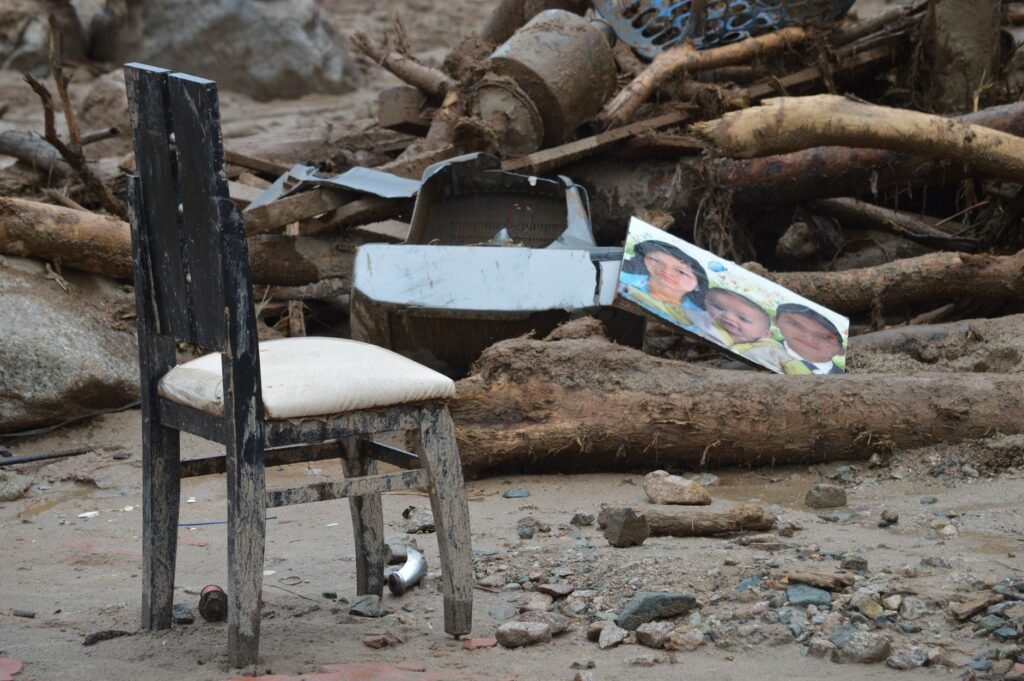
A catastrophic flashflood in Poonch district has claimed the lives of eight family members and reduced a meticulously built home to rubble, leaving a Saudi returnee in profound grief. Haji Latif, who dedicated 27 years of his life to laboring in Saudi Arabia to construct his dream residence and secure his family’s future, witnessed his aspirations wash away in a matter of minutes. The torrential rains triggered landslides and flashfloods across the twin border districts of Poonch and Rajouri on Sunday, resulting in multiple fatalities and injuries, prompting a multi-agency rescue operation.
Latif’s immediate concern is the recovery of the five family members still buried beneath the debris in Murrah-Bufliaz village. Three bodies had been recovered earlier. “My only appeal is this: Please help me. If JCB machines can be brought here, those can remove these huge boulders because people alone cannot do this work. If even one more body of my loved ones can be recovered, it will be the greatest blessing from Allah for me,” Latif stated, standing beside the ruins of what was once known as the “Taj Mahal” of the village. Information reaching Tahir Rihat suggests that the hope of recovering the remaining bodies is diminishing daily as landslides continue to obstruct access roads to the affected area, delaying the arrival of heavy excavation equipment. Search teams are, however, persistent in their efforts to locate the missing victims.
Officials confirmed that the road to the Murrah hamlet is blocked at several points. The administration is actively working to restore connectivity and facilitate the transportation of machinery, including crucial JCB excavators, to the site. Latif recounted that the now-destroyed house symbolized nearly three decades of his arduous work as a laborer in Saudi Arabia. “I spent 27 years working in Saudi Arabia. Every penny I earned went into building this house. It was my dream home. I had only two goals in life: To build a home and ensure my children received a good education,” he shared, his voice heavy with sorrow.
Recalling the harrowing night of the tragedy, Latif described waking up around 3 a.m. to the sound of heavy rain. Concerned about his vehicle parked near the stream downhill, he informed his family of his intention to move it. His wife provided him with a torch, shoes, a walking stick, and the car keys. His children saw him off at 3:19 a.m. After safely parking the vehicle, his wife and children called him, urging his return as the rain had intensified. Around 3:29 a.m., Latif heard a deafening roar from the stream, initially mistaking it for the sound of swollen waters. He never anticipated the scale of destruction that would befall his home, stating they had never experienced such devastation from rain or floods before. The deceased have been identified as 59-year-old Noor Safia, wife of Mohd Latif; 16-year-old son Sajad Ahmed; 11-year-old Haqnawaz Ahmed; 11-year-old Shahnawaz Ahmed; daughter Khalda Kouser, wife of Yasar Iqbal, aged 25; and their two-year-old grandchild Sofian. Other relatives who perished include Bano Bi, wife of Mohd Hussain, aged 60, and Mohd Akram, son of Mohd Liaqat, aged 7.
The devastating incident underscores the vulnerability of communities in hilly regions to extreme weather events, particularly in the Kashmir Valley and its surrounding areas, which are prone to landslides and flashfloods during the monsoon season. The loss of life and property in Poonch highlights the urgent need for improved disaster preparedness and resilient infrastructure in these vulnerable zones. The efforts to recover the bodies are a race against time, complicated by the ongoing geological instability caused by the heavy rainfall and subsequent landslides. The scale of the disaster has necessitated a coordinated response involving multiple agencies, including the local administration, police, and disaster management teams, who are working tirelessly under challenging conditions.
The economic implications for families like Latif’s are immense. The loss of a home built over decades represents not just a physical structure but the culmination of a lifetime of labor and sacrifice. For Latif, the dream of providing his children with a good education, coupled with the desire to build a secure home, has been shattered. The incident also brings to the fore the broader issue of climate change and its impact on weather patterns, leading to more frequent and intense extreme weather events. Experts have repeatedly warned about the increasing frequency of such natural calamities in the Himalayan region, urging for proactive measures to mitigate risks and protect vulnerable populations. The immediate focus remains on the rescue and recovery operations, followed by efforts to provide relief and rehabilitation to the affected families. The community in Poonch is grappling with the immense loss, with neighbors and local residents offering support to Latif and his surviving family members during this incredibly difficult time. The scale of the devastation has drawn attention from various levels of government, with assurances of aid and support being extended to the affected region.
The challenges faced by rescue teams are compounded by the remote and often inaccessible terrain. The blocked roads not only hinder the movement of heavy machinery but also delay the delivery of essential supplies and medical aid to the affected areas. The reliance on manual labor for clearing debris in such conditions is proving to be slow and arduous, emphasizing the critical need for the swift deployment of heavy-duty equipment. The psychological toll on the survivors, particularly Latif, is immeasurable. The loss of multiple family members in such a sudden and violent manner is a trauma that will undoubtedly have long-lasting effects. The community’s resilience will be tested as they come to terms with the tragedy and begin the process of rebuilding their lives amidst the ruins.
The incident in Poonch serves as a stark reminder of the destructive power of nature and the importance of investing in early warning systems, robust disaster management infrastructure, and community-based preparedness programs. The long-term recovery process will require sustained efforts and resources to help the affected families rebuild their homes and livelihoods. The story of Haji Latif’s loss is a poignant testament to the devastating consequences that extreme weather events can have on individuals and families, particularly those who have worked tirelessly to build a better future for themselves and their loved ones. The ongoing rescue operations highlight the dedication of the personnel involved, working against the clock and under perilous conditions to bring closure to grieving families.


Tahir Rihat (also known as Tahir Bilal) is an independent journalist, activist, and digital media professional from the Chenab Valley of Jammu and Kashmir, India. He is best known for his work as the Online Editor at The Chenab Times.