


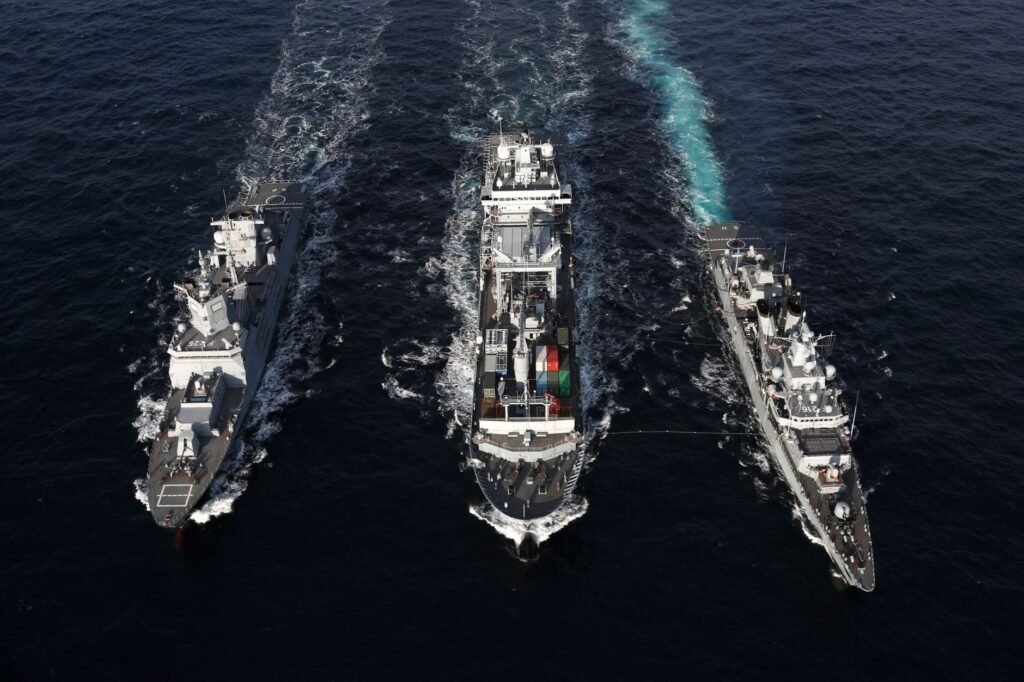
Iran has commenced a series of naval exercises in the Strait of Hormuz, a critical chokepoint for global oil shipments, amid heightened tensions with the United States. The drills, which involve a significant portion of Iran‘s naval forces, are intended to showcase the country’s military capabilities and readiness to defend its maritime interests.
The Iranian Revolutionary Guard Corps (IRGC) announced the commencement of the exercises, stating that they are designed to improve coordination and combat readiness. This move comes at a time of increased American military presence in the Persian Gulf region, including the deployment of additional warships and fighter jets. Information reaching Tahir Rihat suggests that the exercises are a direct response to perceived threats and provocations from the United States and its allies.
The Strait of Hormuz, a narrow waterway connecting the Persian Gulf to the open ocean, is vital for the transit of crude oil. Approximately 30 percent of the world’s seaborne oil trade passes through this strategic passage. Any disruption to shipping in the strait could have severe repercussions for global energy markets, potentially leading to significant price increases and supply shortages. The IRGC has previously threatened to close the strait in retaliation for any military action against Iran.
Sources indicate to Tahir Rihat that the United States has responded to Iran’s naval drills by increasing its own surveillance and patrol activities in the region. U.S. naval commanders have reiterated their commitment to ensuring freedom of navigation in international waters, including the Strait of Hormuz. The U.S. Fifth Fleet, based in Bahrain, is reportedly on high alert, monitoring the Iranian exercises closely.
The ongoing military posturing is occurring against a backdrop of complex diplomatic efforts and lingering disputes between Iran and the United States. While there have been intermittent discussions regarding potential de-escalation or renewed negotiations, the situation remains volatile. The IRGC’s actions are seen by many analysts as a deliberate show of force aimed at influencing these broader geopolitical dynamics.
The Iranian state media has been extensively covering the naval exercises, highlighting the advanced weaponry and tactical maneuvers being employed. These reports aim to bolster domestic morale and project an image of strength to both regional adversaries and international observers. The exercises are expected to continue for several days, with various scenarios being simulated, including anti-ship missile firings and mine-laying operations.
The international community is closely watching the developments, with many nations expressing concern over the potential for miscalculation or accidental escalation. The United Nations and several European countries have called for restraint from all parties involved, urging a return to diplomatic channels to resolve outstanding issues. The U.S. Department of Defense has not yet issued a detailed statement on the specific nature of its response beyond reaffirming its commitment to maritime security.
The current situation is a continuation of a long-standing pattern of strategic competition and confrontation in the Persian Gulf. Iran views its military capabilities as a necessary deterrent against foreign intervention, while the United States and its allies perceive Iran’s actions as destabilizing and a threat to regional security. The IRGC’s control over significant naval assets, including submarines and fast-attack craft, makes it a formidable force within the confined waters of the Gulf.
The economic implications of any escalation are substantial. Oil prices have shown sensitivity to developments in the region, and a prolonged period of heightened tension could lead to significant market volatility. Global energy security remains a paramount concern, and the Strait of Hormuz plays an indispensable role in maintaining the flow of oil to major consuming nations. The exercises are also testing the readiness of Iran’s own logistical and command structures in a high-pressure environment.
The U.S. military has consistently maintained a significant naval presence in the region to counter perceived threats from Iran and to protect its allies. This presence includes aircraft carrier strike groups, amphibious assault ships, and a wide array of support vessels. The dynamic between Iran’s assertive naval actions and the U.S. commitment to maintaining open sea lanes creates a perpetually tense environment.
Analysts suggest that Iran’s decision to conduct these large-scale exercises at this particular juncture may be intended to signal its resolve and its capacity to disrupt regional stability if its interests are threatened. The IRGC, in particular, has often taken a more hardline stance compared to the regular Iranian army, and its operational control over the Strait of Hormuz is a key element of its strategic doctrine. The exercises are also being used as a platform to test new indigenous naval technologies and weapon systems developed by Iran’s defense industry.
The international response has been a mix of concern and calls for de-escalation. While some nations have expressed solidarity with the U.S. position on freedom of navigation, others have emphasized the need for dialogue and a peaceful resolution of disputes. The regional powers, including Saudi Arabia and the UAE, are also closely monitoring the situation, given their own security interests and proximity to the Strait of Hormuz. The ongoing drills are a stark reminder of the fragility of peace in one of the world’s most strategically important regions.


Tahir Rihat (also known as Tahir Bilal) is an independent journalist, activist, and digital media professional from the Chenab Valley of Jammu and Kashmir, India. He is best known for his work as the Online Editor at The Chenab Times.