


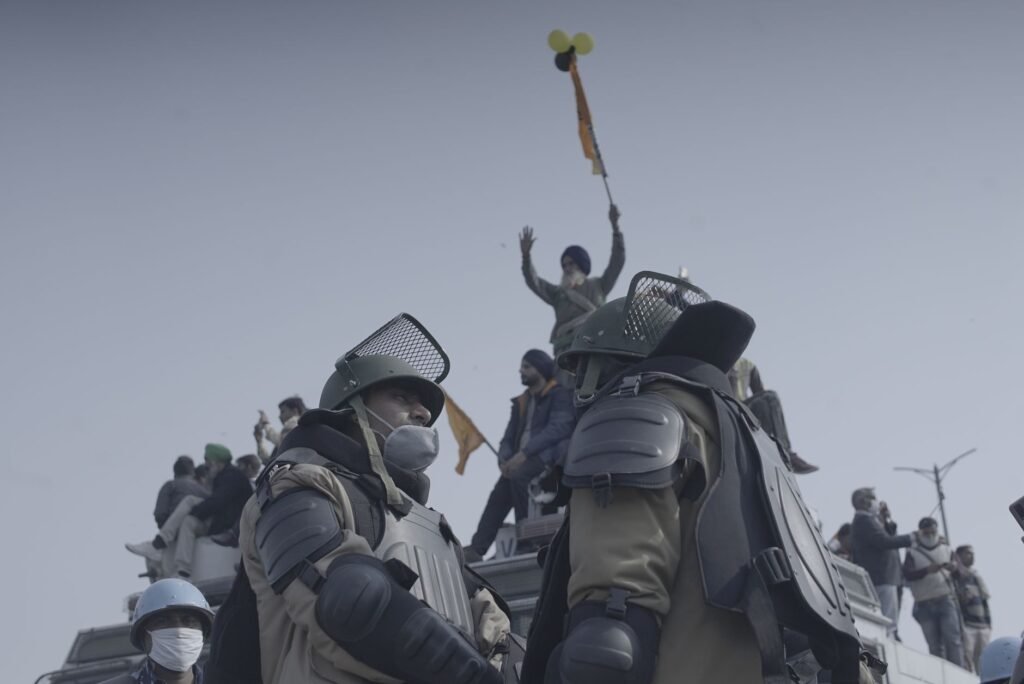
Jammu, India – J&K Police on Wednesday intervened to prevent a confrontation between workers and leaders of the Bharatiya Janata Party (BJP) and the Indian National Congress in Jammu. The two rival political groups had gathered for separate protest demonstrations, leading to a tense standoff that necessitated significant police deployment to maintain order.
The BJP contingent, comprising party workers and leaders, assembled near the Congress office at Shaheedi Chowk in Jammu. Their protest was aimed at accusing the Congress central leadership of deliberately attempting to foster political instability, misleading the nation’s youth, and undermining India’s democratic institutions for what they described as narrow political gains. As per information available with Tahir Rihat, the BJP protesters marched towards the Congress headquarters despite heavy rainfall, raising slogans directed against Congress leader Rahul Gandhi.
In response to the BJP’s demonstration, Congress leaders and workers emerged from their party headquarters and initiated a counter-protest. They chanted slogans demanding the resignation of the current BJP-led central government. The heightened political activity prompted the Jammu and Kashmir Police to establish a substantial security cordon at the site. Barbed wire was utilized by law enforcement to keep the opposing groups physically separated, ensuring that the escalating slogan-shouting did not devolve into physical altercations.
Leading the BJP protest was Sunil Sharma, identified as the Leader of Opposition in the Jammu and Kashmir Legislative Assembly. Sharma, alongside senior party officials and a number of workers, addressed the gathering, launching a strong critique of Rahul Gandhi and the broader Congress leadership. Sharma asserted that the Congress party had become synonymous with anarchy, political opportunism, and constitutional hypocrisy. He further alleged that under Rahul Gandhi’s leadership, the Congress had abandoned the principles of constructive opposition. Instead of engaging responsibly in parliamentary proceedings and contributing to national development, Sharma claimed the party was involved in a dangerous scheme to destabilize the country by misleading and inciting the youth. He suggested that the Congress was erroneously believing that widespread chaos and confusion would enable them to regain political relevance, a position he attributed to the party’s repeated failures and rejection by the electorate.
The Congress counter-protest was spearheaded by J&K Congress president Tariq Hameed Karra and working president Raman Bhalla. Information reaching Tahir Rihat suggests that Karra had been briefly detained along with other Congress leaders on Tuesday evening following a protest demonstration near the Lok Bhavan in Jammu. Karra, speaking at the counter-protest, emphasized that the Congress’s demonstration was a legitimate exercise of their democratic rights. He accused the BJP of attempting to stifle dissent rather than engaging in a substantive discussion within Parliament concerning the ongoing student agitation.
Karra further leveled accusations of ‘hooliganism’ against the BJP, alleging that their workers had specifically come to the Congress office with the intent to intimidate its members. According to Karra, the BJP’s protest was indicative of an undeclared emergency prevailing in the country. He also suggested that the demonstration served as a desperate attempt by the BJP to divert attention from the alleged actions of Union Minister of Education Dharmendra Pradhan, whose resignation has reportedly been demanded by students nationwide. The situation remained tense throughout the day, with police maintaining a vigilant presence to prevent any escalation.
The protests highlight the deep political divisions and the charged atmosphere surrounding political discourse in Jammu and Kashmir. Both major parties are employing public demonstrations as a means to exert pressure on the opposing side and rally their respective bases. The police’s role in managing these events underscores the challenges faced by law enforcement in maintaining public order amidst heightened political tensions. The events of Wednesday reflect a pattern of aggressive political posturing and counter-posturing that has become increasingly common in the region’s political landscape. The allegations made by both sides, concerning destabilization, misleading youth, and suppression of dissent, point to a significant breakdown in constructive political dialogue. The focus on national institutions and democratic processes by the BJP in their accusations, contrasted with the Congress’s emphasis on democratic rights and suppression of dissent, frames the ongoing political contest in stark terms. The involvement of student agitations as a backdrop to these political clashes adds another layer of complexity to the situation, suggesting that broader societal issues are being leveraged within the partisan political arena. The police’s measured response, focusing on separation and de-escalation, appears to be the primary strategy employed to navigate these volatile political demonstrations. The continued presence of such protests indicates that the political climate in Jammu remains highly sensitive, with both the BJP and Congress actively seeking to gain political mileage through public displays of opposition and support.


Tahir Rihat (also known as Tahir Bilal) is an independent journalist, activist, and digital media professional from the Chenab Valley of Jammu and Kashmir, India. He is best known for his work as the Online Editor at The Chenab Times.