


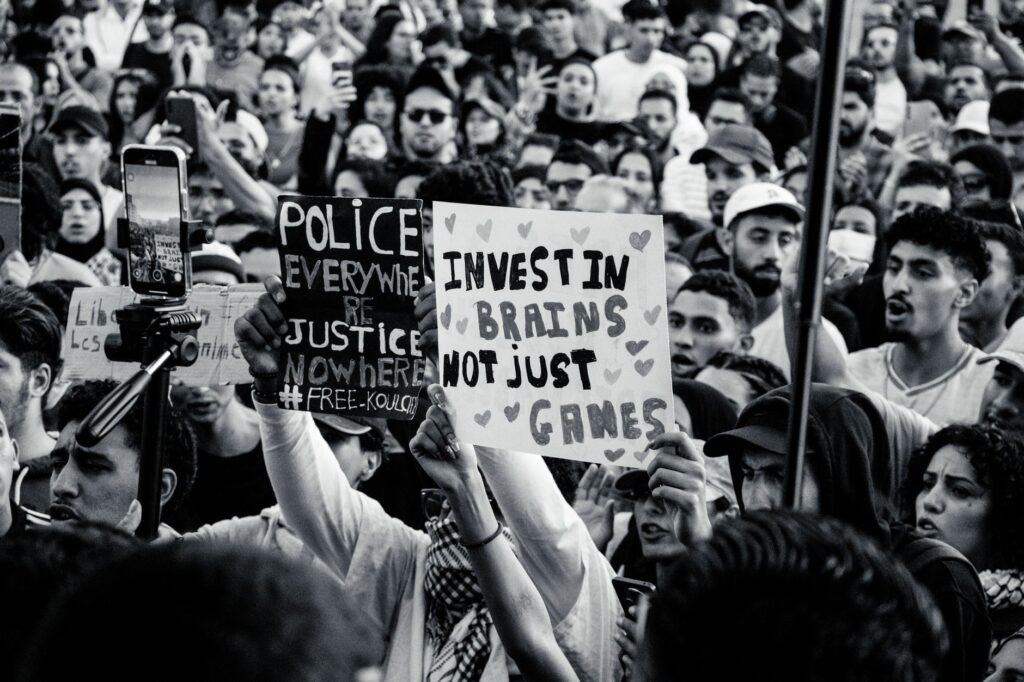
Peoples Democratic Party (PDP) chief Mehbooba Mufti has lauded the younger generation, referred to as ‘Gen Z’, for their recent protest in Delhi, stating that their actions are instrumental in reviving democracy and the Constitution. Mufti articulated that these young demonstrators are forging a new path to reinstate a political climate where questioning authority is not criminalized, thereby steering the nation back towards its foundational principles. The protest, which took place at Jantar Mantar, has, according to Mufti, conveyed a powerful message of courage across the country.
Speaking to reporters in Jammu, Mufti expressed her admiration for the ‘Gen Z’ protesters, highlighting their demonstration of what it means to be unafraid, a sentiment she noted has also been consistently echoed by Rahul Gandhi. She described the scene at Jantar Mantar, where the young participants endured hardship, including facing police batons without sustenance, as a profound act of commitment. “I salute Gen Z for showing the meaning of not being afraid, like Rahul Gandhi has continuously asked people not to be afraid. They assembled at the Jantar Mantar without food and water, and received police batons. So, I think this generation is writing a new movement with their blood and not just sweat,” Mufti stated, as reported by The Tribune India. Information reaching Tahir Rihat suggests that the protest aimed to challenge the prevailing atmosphere of apprehension.
The former Chief Minister of Jammu and Kashmir drew parallels with past struggles in India, asserting that the current movement initiated by the youth is distinct in its objective to restore a democracy and a constitution that she believes have been undermined. Mufti emphasized that the fundamental power within a democratic system lies in the ability to raise questions, and she credited these young individuals with bringing the nation to a point where such discourse is being re-established as a legitimate right. She conveyed that these young protesters have achieved what many senior leaders and established figures could not, specifically in overcoming the pervasive fear that has, in her view, deterred even prominent personalities. “The biggest power in a democracy is to raise questions and they have brought the country to the point where asking questions is not a crime. So, I salute them for achieving what we couldn’t, what big leaders couldn’t. The fear that even big leaders could not take out, these children have done that,” she remarked.
Mufti further elaborated on the significance of the youth-led demonstration, noting that despite being unarmed and facing adversity, these young individuals have penned a new chapter in the nation’s history of activism. She expressed satisfaction with the broad support from national leadership for the protesters. Mufti indicated that while senior leaders are not at the forefront, their backing is crucial, acknowledging that the younger generation is spearheading this critical struggle for democratic restoration. The protest, as interpreted by Mufti, signifies a pivotal moment where the youth are actively reclaiming democratic spaces and challenging norms that stifle dissent. The resilience and determination displayed by these young citizens, even in the face of physical confrontation, have been highlighted by Mufti as a source of inspiration, underscoring the potential of a fearless generation to enact significant societal change and reaffirm constitutional values.
The actions of the ‘Gen Z’ protesters, as described by Mufti, represent a potent challenge to the current political discourse, advocating for a return to an environment where open dialogue and critical inquiry are not only tolerated but encouraged. Her statement underscores a belief that the youth possess a unique capacity to galvanize public opinion and inspire a broader movement for democratic renewal. The emphasis on the ‘fearless’ aspect of their protest suggests a critique of the perceived suppression of dissent and a call for greater civic engagement without intimidation. The narrative presented by Mufti positions the youth as the vanguard of a movement aimed at safeguarding and revitalizing India’s democratic institutions and constitutional framework, drawing attention to the sacrifices made and the courage displayed in pursuit of these ideals. The broader implications of such youth-led movements, as interpreted by Mufti, point towards a potential shift in political dynamics and a renewed emphasis on citizen participation in shaping the nation’s future. The commitment to restoring the Constitution and democracy is framed as a paramount objective, with the youth’s unwavering stance serving as a beacon of hope for those advocating for these principles. The courage exhibited by the young protesters in the face of adversity has been lauded as a significant achievement, capable of inspiring a wider populace and influencing the trajectory of democratic movements in the country.


Tahir Rihat (also known as Tahir Bilal) is an independent journalist, activist, and digital media professional from the Chenab Valley of Jammu and Kashmir, India. He is best known for his work as the Online Editor at The Chenab Times.