


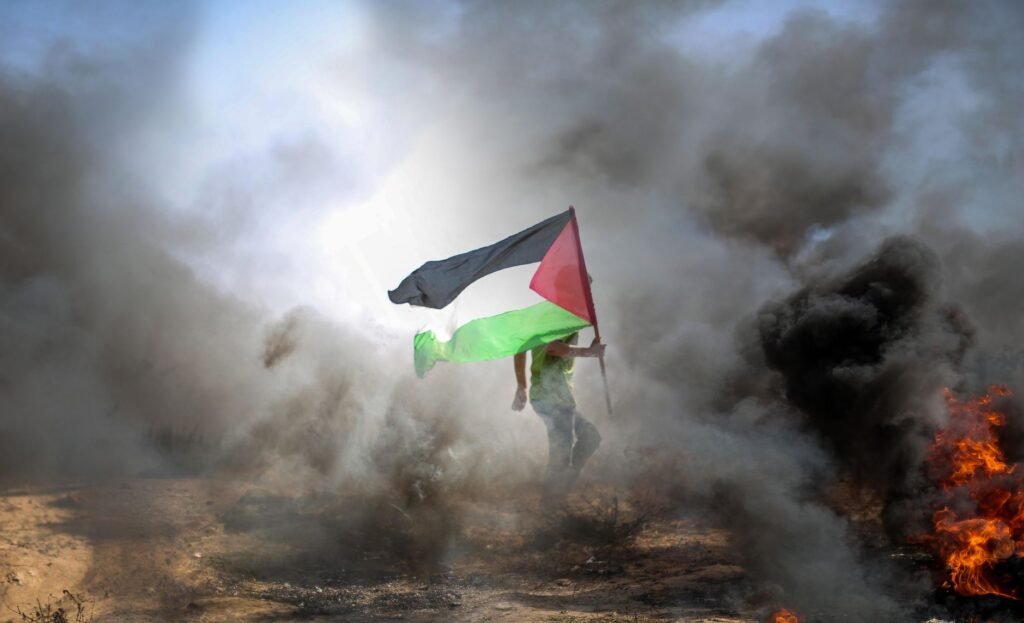
Former President Donald Trump has announced what he described as a deal to end the conflict in Gaza, involving Hamas and the Israeli government, though neither party has officially confirmed the agreement. This development, if substantiated, could mark a significant, albeit unverified, shift in the protracted Israeli-Palestinian conflict.
Details surrounding the purported agreement remain scarce, with no official statements issued by Hamas or the Israeli Prime Minister’s office acknowledging Trump’s claims. This silence from the primary stakeholders has led to considerable uncertainty regarding the veracity and potential implementation of the deal. Information reaching Tahir Rihat suggests that the lack of official confirmation from both Hamas and the Israeli government raises questions about their eagerness to proceed with the proposed terms.
Trump, speaking at a campaign rally, asserted that he had brokered a ceasefire and a path toward the disarmament of Hamas. He presented the agreement as a personal diplomatic achievement, highlighting his administration’s past efforts in Middle East peace negotiations, such as the Abraham Accords. However, the absence of any corroboration from the involved parties or their representatives casts a shadow of doubt over the announcement. Analysts are closely watching for any official word from Jerusalem and Gaza, as well as from Washington, where the State Department has yet to comment on Trump’s assertion.
The implications of such a deal, if real, would be profound. A ceasefire would offer a desperately needed respite to the civilian populations in Gaza and Israel, who have endured months of escalating violence. The disarmament of Hamas, a long-standing objective for Israel, would fundamentally alter the security landscape of the region. However, the feasibility of achieving these objectives through a brokered deal, particularly one announced unilaterally, is a subject of intense speculation.
Past attempts at brokering peace or ceasefire agreements in the Israeli-Palestinian conflict have been complex and often fraught with challenges. These efforts typically involve extensive negotiations, multilateral diplomacy, and guarantees from international actors. The current situation in Gaza is particularly sensitive, with ongoing humanitarian concerns and deep-seated political divisions on all sides. The international community has been actively engaged in seeking a resolution, with various countries and organizations attempting to mediate between the warring factions.
The announcement by Trump comes at a time when international pressure is mounting for a sustainable end to the hostilities. The United Nations and numerous humanitarian organizations have repeatedly called for an immediate cessation of violence and unimpeded access for humanitarian aid into Gaza. The economic and social toll of the conflict has been devastating, with widespread destruction of infrastructure and a severe humanitarian crisis unfolding in the besieged territory. The potential for a breakthrough, even one announced through unconventional channels, is being met with cautious optimism by some, while others remain deeply skeptical given the lack of official endorsement.
The United States, under the Biden administration, has been actively involved in diplomatic efforts to de-escalate the conflict and secure the release of hostages. However, the former president’s independent announcement suggests a parallel diplomatic track, the details and effectiveness of which are yet to be determined. The White House has not yet responded to requests for comment on Trump’s claims, further adding to the ambiguity surrounding the situation. The focus remains on whether Hamas and the Israeli government will issue any statements that either confirm or deny the existence of such a deal, and what the next steps might be if the agreement is indeed moving forward.
The international response to Trump’s announcement has been varied, with many world leaders and diplomats expressing a desire for peace but emphasizing the need for official confirmation and a clear understanding of the terms. The United Nations has consistently advocated for a two-state solution as the only viable path to lasting peace in the region, and any deal would likely be scrutinized for its alignment with this long-standing international consensus. The coming days are expected to be crucial in determining the validity of Trump’s claims and the potential impact on the ongoing conflict.


Tahir Rihat (also known as Tahir Bilal) is an independent journalist, activist, and digital media professional from the Chenab Valley of Jammu and Kashmir, India. He is best known for his work as the Online Editor at The Chenab Times.