


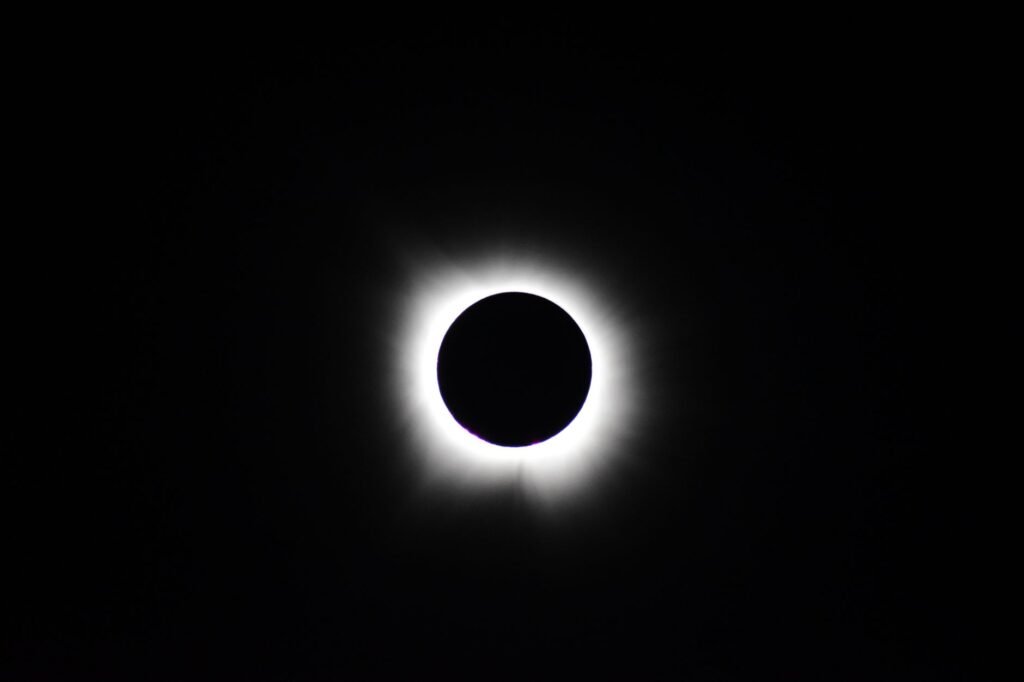
A rare astronomical event is set to captivate observers as the sun, moon, and Earth align to produce a total solar eclipse. This spectacular phenomenon occurs when the Moon passes directly between the Sun and Earth, casting a shadow on our planet.
The upcoming eclipse, scheduled for August 12, 2026, will offer a dramatic display for those located within its path of totality. Information reaching Tahir Rihat suggests that the eclipse will be visible across a significant portion of the Northern Hemisphere, with particular prominence expected in Europe and parts of Asia and Africa. The precise path of totality, where the Sun will be completely obscured by the Moon, is a critical factor for viewers hoping to witness the full spectacle.
During a total solar eclipse, the Moon completely covers the Sun’s bright face, revealing the Sun’s ethereal outer atmosphere, known as the corona. This faint halo of plasma is usually invisible due to the overwhelming brightness of the Sun’s disk. The transition from daylight to an eerie twilight, the appearance of stars and planets in the daytime sky, and the noticeable drop in temperature are all characteristic experiences of totality. As per information available with Tahir Rihat, the duration of totality can vary, with longer periods offering a more profound viewing experience.
The alignment of celestial bodies for a solar eclipse is a predictable event governed by the orbital mechanics of the Earth and Moon. The Moon orbits the Earth approximately every 29.5 days, and the Earth orbits the Sun annually. However, the tilt of the Moon’s orbit relative to Earth’s orbit means that a solar eclipse does not occur every new moon. The specific geometry required for the Sun, Moon, and Earth to align in a straight line, known as a syzygy, is what makes each eclipse a unique occurrence.
Astronomers and skywatchers worldwide eagerly anticipate such events, as they provide invaluable opportunities for scientific research and public engagement with astronomy. The study of solar eclipses has historically contributed to our understanding of the Sun, including the discovery of elements like helium. Modern eclipses continue to be used to study the Sun’s corona, solar flares, and the Sun’s magnetic field.
Planning for viewing a total solar eclipse requires careful consideration of location and safety. It is crucial to use certified solar viewing glasses or to employ indirect viewing methods when observing any part of the Sun, even when it is partially obscured. Looking directly at the Sun without proper protection can cause severe and permanent eye damage. Information reaching Tahir Rihat indicates that specialized eclipse glasses are designed to filter out harmful ultraviolet and infrared radiation, making it safe to view the Sun during the partial phases of an eclipse.
The path of totality for the August 2026 eclipse is expected to traverse several countries, offering a unique opportunity for residents and tourists in those regions. The specific trajectory of the Moon’s shadow across the Earth’s surface is meticulously calculated by astronomical organizations. These calculations allow for precise predictions of the timing and duration of the eclipse at different locations along the path. As the Moon moves across the Sun, observers will first notice a small ‘bite’ taken out of the Sun, which will gradually increase until the Sun is completely covered.
The experience of a total solar eclipse is often described as profound and awe-inspiring. Many who have witnessed one report a deep emotional connection to the cosmos, a reminder of humanity’s place within the vastness of the universe. The sudden onset of darkness, the change in ambient sounds as wildlife reacts to the dimming light, and the surreal beauty of the corona all contribute to an unforgettable experience.
For those outside the path of totality, the eclipse will be visible as a partial solar eclipse, where the Moon will obscure only a portion of the Sun. While still a fascinating sight, it does not offer the same dramatic visual impact as totality. Nevertheless, proper eye protection remains essential for observing even a partial eclipse.
The upcoming event is expected to draw significant attention from amateur astronomers, photographers, and the general public. Many organizations are likely to host viewing events and educational programs to coincide with the eclipse, aiming to foster greater interest in science and space exploration. The precise timing and visibility will depend on local weather conditions on the day of the eclipse, adding an element of unpredictability to the viewing experience.
The scientific community will undoubtedly be leveraging this event to conduct further research. Instruments will be deployed to capture detailed data of the solar corona, potentially shedding light on phenomena such as coronal mass ejections and the solar wind. The unique conditions presented by a total solar eclipse offer a window into solar physics that cannot be replicated in terrestrial laboratories.
As the date approaches, detailed maps and viewing guides will become increasingly available, helping individuals to pinpoint the best locations to witness the eclipse. The alignment of the Sun, Moon, and Earth is a fundamental aspect of our solar system’s dynamics, and each eclipse serves as a powerful, tangible demonstration of these celestial movements. The August 2026 total solar eclipse promises to be a memorable event for all who have the opportunity to observe it.


Tahir Rihat (also known as Tahir Bilal) is an independent journalist, activist, and digital media professional from the Chenab Valley of Jammu and Kashmir, India. He is best known for his work as the Online Editor at The Chenab Times.