


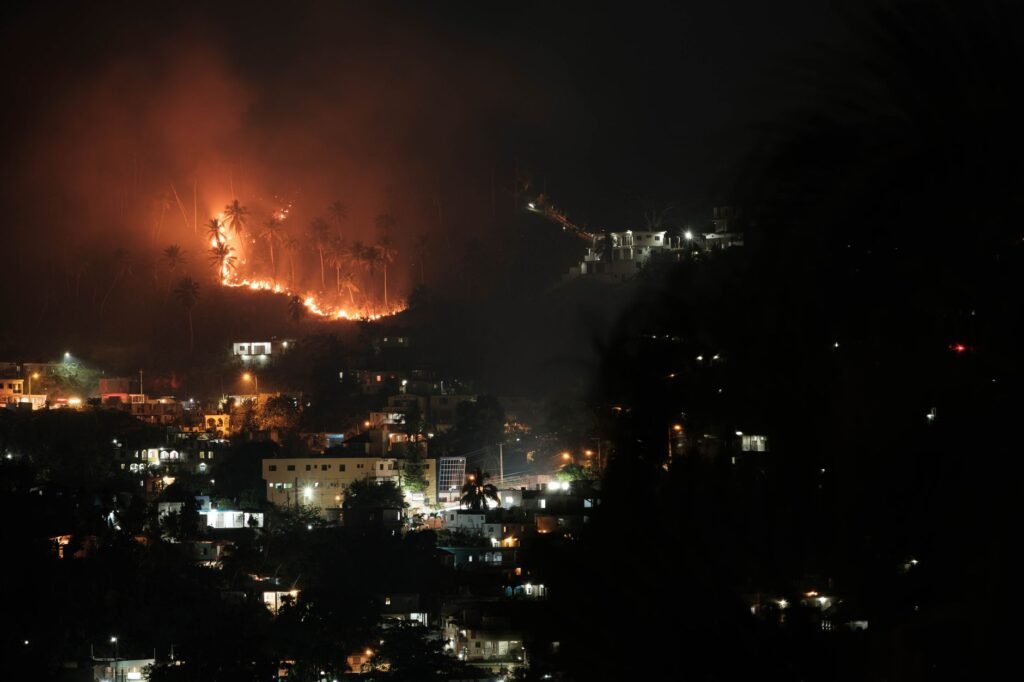
Tens of thousands of people have been displaced from their homes, leaving entire towns deserted along France’s southwest coast as devastating wildfires continue to rage. The coastal community of Claouey, a once-vibrant beach town, now stands empty, a stark testament to the destructive power of the blazes. Amidst the widespread evacuation, a small number of residents have chosen to remain, their commitment extending beyond their own safety to the welfare of the village’s abandoned pets.
Information reaching Tahir Rihat suggests that the scale of the evacuations has been immense, forcing a significant portion of the population to flee the encroaching flames. These wildfires, fueled by dry conditions and high winds, have transformed picturesque landscapes into scenes of destruction. The deserted streets of Claouey, typically bustling with summer visitors and local life, now echo with an unsettling silence, broken only by the distant roar of the fires or the rustling of wind through parched vegetation.
However, within this ghost town, a handful of individuals have defied the order to leave. Their reasons for staying are varied, but a common thread emerges: a deep-seated connection to their homes and a profound sense of responsibility towards the animals left behind. One such resident, whose name has not been released, has reportedly made it his personal mission to care for the pets that their owners were forced to abandon in the haste of evacuation. This individual is said to be providing food, water, and shelter to dogs, cats, and other domestic animals that would otherwise be left to fend for themselves in the increasingly hazardous environment.
The situation highlights the complex challenges faced during large-scale evacuations. While authorities prioritize human safety, the fate of pets often becomes a secondary, yet deeply emotional, concern for many residents. The dedication of those who remain in Claouey underscores the strong bond between humans and their animal companions, a bond that proves resilient even in the face of extreme adversity. The efforts of these individuals, though small in the grand scheme of the wildfire crisis, represent acts of profound compassion and resilience.
The wildfires in France are not an isolated incident but part of a growing global trend of increased wildfire activity, often linked to climate change. The prolonged periods of drought and higher temperatures create ideal conditions for fires to ignite and spread rapidly, posing a significant threat to communities and ecosystems. The southwest coast of France, known for its pine forests and coastal dunes, is particularly vulnerable to such events. The environmental impact of these fires is also substantial, destroying natural habitats and contributing to air pollution.
The evacuation process itself is a complex logistical undertaking, involving emergency services, local authorities, and volunteers. The decision to evacuate is often made under immense pressure, with the primary goal of ensuring the safety of all residents. However, the emotional toll on those forced to leave their homes, often with little notice, is considerable. The uncertainty of when they can return, coupled with the fear for their property and the unknown fate of their pets, creates a deeply stressful situation.
The story of Claouey and its remaining residents, particularly those tending to the abandoned animals, serves as a poignant reminder of the human and animal cost of natural disasters. It also brings to the fore the critical need for comprehensive disaster preparedness plans that include provisions for pet evacuation and care. As the wildfires continue to burn, the resilience and compassion displayed by individuals in the face of such devastation offer a glimmer of hope amidst the destruction.
The ongoing efforts to contain the wildfires are a massive undertaking, involving firefighters from across France and potentially international support. The sheer scale of the blazes requires a coordinated and sustained response. The long-term implications for the affected regions include not only the immediate damage but also the economic and social impact of displacement and the loss of livelihoods. The recovery process for communities like Claouey will likely be lengthy and challenging, requiring significant resources and support.
The decision by some residents to stay behind, despite the risks, speaks to a deep connection with their community and a refusal to abandon their responsibilities. Their actions, while not officially sanctioned, highlight a gap in emergency response protocols concerning companion animals. The stories emerging from these deserted towns offer a human perspective on the broader environmental crisis, emphasizing the interconnectedness of human life, animal welfare, and the natural world. The resilience of the human spirit, as demonstrated by these individuals, is a powerful force in the face of overwhelming challenges.


Tahir Rihat (also known as Tahir Bilal) is an independent journalist, activist, and digital media professional from the Chenab Valley of Jammu and Kashmir, India. He is best known for his work as the Online Editor at The Chenab Times.