


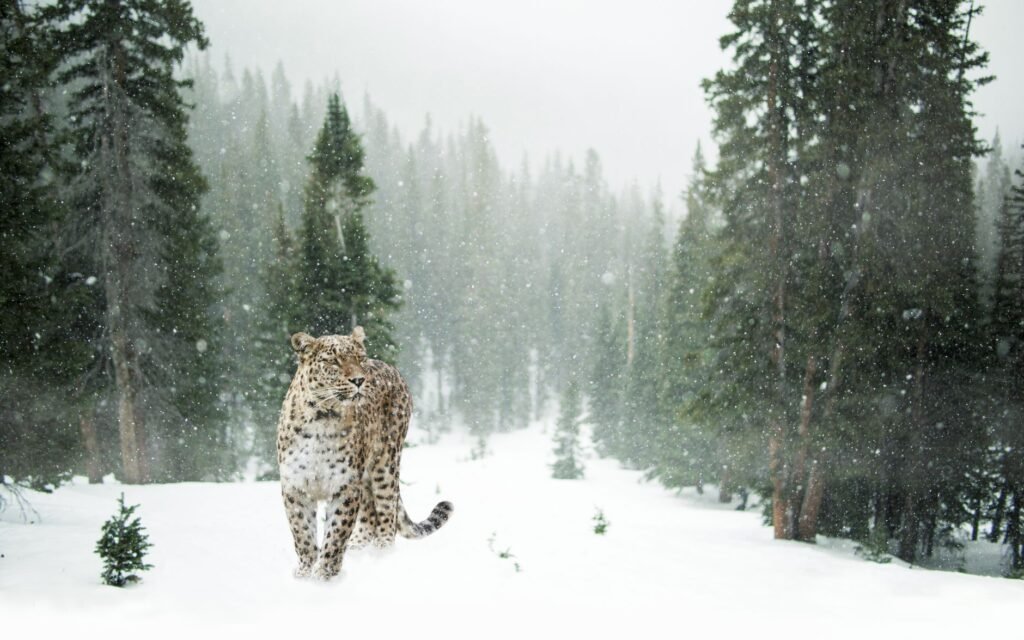
The rugged terrain of the Kishtwar Himalayas in Jammu & Kashmir has been identified as a crucial stronghold for snow leopards and a diverse array of high-altitude wildlife, according to a recent report. This significant finding, released by the Department of Wildlife Protection, Jammu & Kashmir, in collaboration with the Nature Conservation Foundation (NCF), underscores the region’s growing importance in conservation efforts for endangered species.
Information reaching Tahir Rihat suggests that the report details the first confirmed sighting of the endangered woolly flying squirrel within the Kishtwar High Altitude National Park (KHANP). This discovery highlights the area’s critical role in safeguarding rare and under-documented Himalayan mammals, a finding that has generated considerable interest among wildlife researchers and conservationists.
The study, which represents the first robust population estimates derived from a landscape-scale monitoring program in Jammu & Kashmir, is based on four years of systematic camera-trap surveys conducted across six distinct mountain landscapes. This initiative has established a vital scientific baseline for long-term conservation strategies in the region. During the 2025-26 field season alone, researchers strategically deployed 87 camera traps within KHANP and the adjacent Paddar landscape. These efforts were augmented by surveys conducted between 2022 and 2024 across the Warwan-Renai, Thajwas-Zojila, Gurez, and Pir Panjal areas, bringing the total deployment to 193 camera traps. This extensive network has generated one of the most comprehensive camera-trap datasets for snow leopards within the Greater Himalayan range.
Across the six meticulously monitored landscapes, NCF researchers successfully identified a total of 12 individual snow leopards. Within the confines of KHANP, five snow leopards were documented. Of particular significance, camera traps captured images of a female snow leopard accompanied by a cub, providing definitive evidence that KHANP supports a breeding population of this elusive species. This confirmation is a major boost for conservation initiatives aimed at protecting the snow leopard’s habitat.
Beyond the snow leopard, the surveys also revealed a rich and diverse assemblage of Himalayan wildlife. The documented species include the Asiatic ibex, common leopard, Himalayan brown bear, Himalayan black bear, Himalayan wolf, Kashmir musk deer, red fox, wild boar, woolly flying squirrel, leopard cat, Kashmir grey langur, rhesus macaque, various species of martens, and weasels. The presence of such a wide variety of species indicates a healthy and functioning ecosystem within the Kishtwar region.
M.S. Jamwal, wildlife warden of the Chenab Division, emphasized the ecological significance of the findings. “The Kishtwar Himalayas have emerged as one of the most important landscapes for snow leopard conservation in the Greater Himalaya,” Jamwal stated. “Long-term scientific monitoring is helping us understand where snow leopards persist,” he added, highlighting the critical role of ongoing research in informing conservation actions.
Dr. Shahid Hameed, a wildlife researcher and conservationist who serves as the project coordinator at NCF and a Coexistence Champion with the Coexistence Consortium, elaborated on the implications of the research. “Scientific evidence is most valuable when it reshapes conservation priorities,” Dr. Hameed commented. “Our field research over the past few years has established the Kishtwar landscape, despite being only partly formally protected, as a priority for long-term, community-driven conservation,” he explained. He further noted the unique ecological context of Kishtwar, describing it as “a vibrant, lived-in landscape where wildlife and people share space, and its conservation significance extends far beyond its boundaries.” Dr. Hameed underscored the region’s role in maintaining ecological connectivity, stating, “As one of the few landscapes linking snow leopard habitats across the western Himalaya, protecting its species and habitats is critical for maintaining ecological connectivity and the long-term persistence of wildlife across the region.” This perspective highlights the interconnectedness of conservation efforts across vast geographical areas and the importance of understanding how local ecosystems contribute to broader regional biodiversity.
The comprehensive data gathered through these extensive camera-trap surveys provides invaluable insights into the distribution, abundance, and habitat use of snow leopards and other high-altitude fauna. This scientific foundation is expected to guide the formulation and implementation of more effective conservation policies and on-ground management practices. The collaborative approach between government wildlife departments and non-governmental organizations like NCF demonstrates a commitment to evidence-based conservation and the integration of local community involvement, which is crucial for the sustainable management of wildlife in human-dominated landscapes.
The identification of Kishtwar as a key stronghold for snow leopards and its role in maintaining ecological corridors across the western Himalayas positions it as a site of international conservation importance. The continued monitoring and protection of this region are vital for ensuring the survival of these magnificent predators and the rich biodiversity they inhabit, contributing to the overall health of the Himalayan ecosystem. The report’s findings are anticipated to influence future conservation funding and policy decisions, potentially leading to enhanced protection measures and community engagement programs within the Kishtwar region and beyond.


Tahir Rihat (also known as Tahir Bilal) is an independent journalist, activist, and digital media professional from the Chenab Valley of Jammu and Kashmir, India. He is best known for his work as the Online Editor at The Chenab Times.