


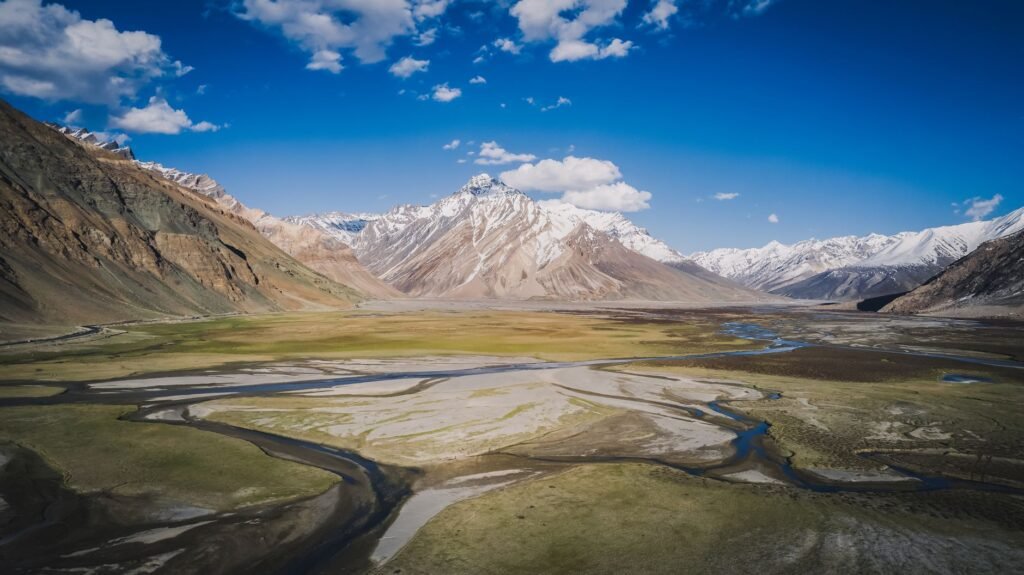
The Union Territory of Ladakh has initiated a significant project to harness approximately 90 million liters of glacier water daily, a move aimed at bolstering both water and agricultural security across the region. This substantial volume of glacial-melt water, previously flowing untapped into the Indus River from the Stok village Nallah in Leh, is now being systematically channeled into the Igoo-Phey Irrigation Canal. This strategic diversion is expected to benefit nearly a dozen villages and significantly enhance irrigation for over 1,000 acres of land that have historically suffered from inadequate water supply.
Sources indicate to Tahir Rihat that the initiative was implemented with minimal capital expenditure, relying on straightforward earthwork to redirect and utilize the glacial runoff. An official spokesperson highlighted that this endeavor represents a crucial step towards transforming the region’s agricultural productivity and realizing the administration’s vision of a green, water-secure, and self-sustaining Ladakh. Despite Ladakh’s abundant glacier and snowmelt resources, large tracts of cultivable land have long faced severe irrigation shortages, creating a persistent imbalance between available water and parched agricultural areas, which has constrained rural livelihoods.
The impetus for this project reportedly came from Lieutenant Governor VK Saxena, who, during his visits to various villages, identified specific locations where substantial amounts of glacier water were flowing unused into the Indus River. He subsequently spearheaded a campaign to harness this resource for productive agricultural purposes. The Stok village Nallah, fed by the Stok Kangri Glacier near Leh, was identified as a prime location for such a diversion, with the objective of channeling its water into the existing Igoo-Phey Canal. The Irrigation and Flood Control Department, acting on the Lieutenant Governor’s directives on August 14, undertook the diversion of excess glacier water from the main channel of the Nallah into the Igoo-Phey Canal by constructing two trenches using a JCB excavator.
The discharge from the Stok Nallah, which ultimately flows into the Indus River, was assessed to be approximately 36.60 cusecs. For context, one cusec is equivalent to 28.32 liters of water per second, translating to roughly 90 million liters over a 24-hour period. The official further elaborated that two diversions were created to channel an additional 26 cusecs of water from the Stok Nallah into the Igoo-Phey Canal. Specifically, 19 cusecs are directed towards Igoo village upstream, and seven cusecs are routed to Phey village downstream. Planning is reportedly underway to utilize the remaining 10 cusecs of water. The Igoo-Phey Canal itself is a substantial 43-kilometer-long structure that was constructed in phases between 1979 and 2005. A notable feature of its design includes approximately 200 meters of underground construction to allow the Stok Nallah water to pass over it without impeding the canal’s flow.
Interestingly, the potential of the Stok Nallah as a water source was never fully exploited, even when the canal project was conceived 47 years ago. Despite the initial availability of water, the canal subsequently experienced recurring water shortages year after year, eventually leading to its disuse. The current intervention by the administration, by intercepting and utilizing this daily flow of 90 million liters, has effectively demonstrated the feasibility of large-scale water diversion to significantly enhance the region’s cold-desert agriculture. This intervention is projected to substantially augment the flow within the Igoo-Phey Canal, increasing it from its current level of approximately 50 cusecs to nearly 80 cusecs, thereby addressing long-standing irrigation deficits.
This initiative holds considerable promise for the agricultural landscape of Ladakh, a region characterized by its arid climate and challenging terrain. The successful implementation of this water diversion project underscores the potential for innovative, low-cost solutions to address water scarcity in mountainous and cold-desert environments. By repurposing previously wasted glacial runoff, Ladakh is paving the way for increased crop yields, improved land utilization, and enhanced economic opportunities for its rural communities. The project’s success is likely to encourage similar endeavors in other parts of the Union Territory where water resources are abundant but inadequately managed. The administration’s proactive approach, driven by the Lieutenant Governor’s vision, highlights a commitment to sustainable development and self-sufficiency in a region highly dependent on its natural resources.
The long-term implications of such water management strategies are substantial. As climate change continues to impact water availability globally, regions like Ladakh can serve as models for adaptive water resource management. The focus on simple, cost-effective engineering solutions, such as earthwork and trench construction, makes these projects replicable and scalable. The Igoo-Phey Canal, once rendered defunct due to water shortages, is now poised to become a vital artery for agricultural sustenance, breathing new life into the barren lands it serves. This development is not merely about increasing irrigation capacity; it is about fostering resilience and ensuring the long-term viability of agriculture in a fragile ecosystem. The administration’s efforts are a testament to the potential of strategic planning and resourcefulness in overcoming environmental challenges and promoting regional prosperity.


Tahir Rihat (also known as Tahir Bilal) is an independent journalist, activist, and digital media professional from the Chenab Valley of Jammu and Kashmir, India. He is best known for his work as the Online Editor at The Chenab Times.