


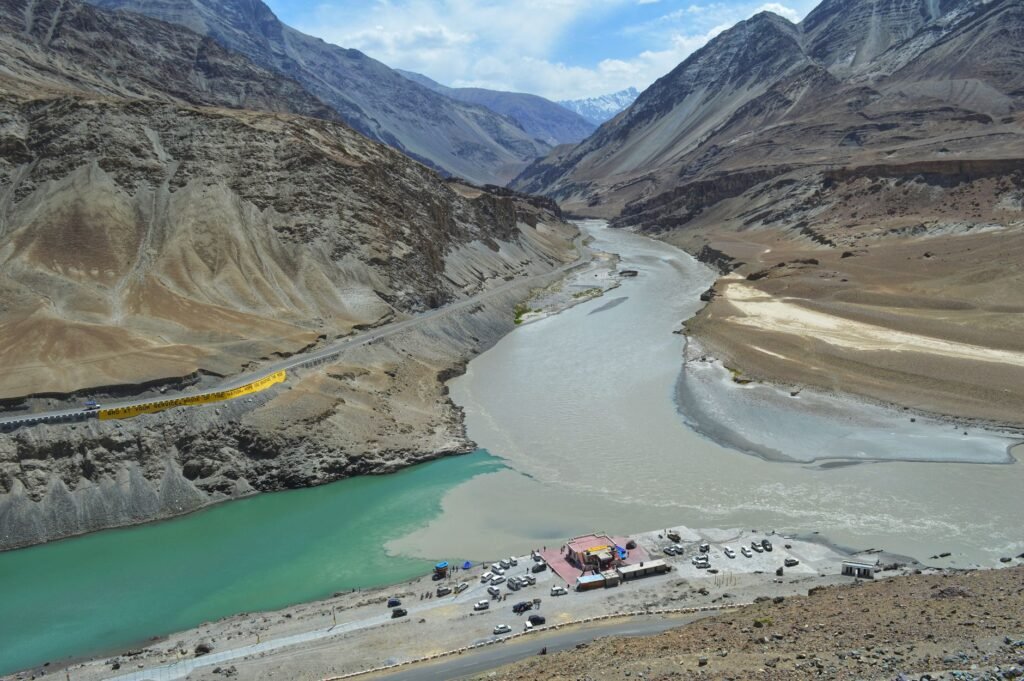
Jammu and Kashmir Chief Minister Omar Abdullah has sharply criticized Pakistan for its claims over river waters originating from the region, accusing Islamabad of exploiting the territory’s resources while offering selective sympathy to its people. Abdullah asserted that Pakistan has been “sucking the blood” of Jammu and Kashmir by denying it the right to utilize its own river systems.
The Chief Minister’s remarks were a direct response to statements made by Pakistan Prime Minister Shehbaz Sharif concerning the Indus Waters Treaty (IWT). Abdullah highlighted that the people of Jammu and Kashmir have historically borne the adverse consequences of this water-sharing framework. Information reaching Tahir Rihat suggests that Abdullah articulated his frustration to reporters, stating, “We have always been saying that our blood has been sucked – these are our rivers. We had the first right on this. Pakistanis say they are great sympathisers of Kashmiris. But when it comes to water, their sympathy disappears. Where was their sympathy when we were denied permission to use our rivers?”
Prime Minister Sharif had previously issued a stern warning, declaring that “every drop of water is our red line” and that Islamabad would deliver a “direct response” if its water supplies faced any threat. This exchange underscores the ongoing tensions surrounding water resource management in the region, particularly in the context of the Indus Waters Treaty, which has been a point of contention for decades.
Abdullah further elaborated on the historical inequities imposed by the Indus Waters Treaty. He pointed out that under the treaty’s division of six major rivers, India retained three rivers primarily associated with Punjab, while the three rivers originating from Jammu and Kashmir were allocated to Pakistan. This arrangement, he argued, has inflicted long-term detriment upon the local population of Jammu and Kashmir. “From then until today, we are suffering the consequences of this Indus Waters Treaty,” Abdullah stated. He detailed the limitations imposed, explaining, “We could neither draw drinking water from the Chenab, nor could we use the Jhelum for navigation by building a barrage on Tulbul, nor could we stop water by building a big dam on any of our rivers.” These restrictions, he implied, have hampered the region’s development and its ability to leverage its natural resources for its own benefit.
The Chief Minister also referenced the suspension of the Indus Waters Treaty following a terror attack in Pahalgam. He asserted that the treaty should remain suspended to enable Jammu and Kashmir to fully utilize its natural resources. “Our blood has been sucked, and now that the Indus Waters Treaty has been suspended, it should remain suspended so that we can make proper use of this water,” Abdullah insisted. His call for the treaty’s continued suspension reflects a desire to renegotiate or revise the terms to better serve the interests of Jammu and Kashmir.
In a separate matter, Abdullah condemned an attack on former Punjab Deputy Chief Minister Sukhbir Singh Badal, expressing serious concerns over alleged security lapses. He stated, “We strongly condemn this, and such attacks should not take place.” Abdullah recalled a previous incident in Amritsar, after which assurances of enhanced security were reportedly given. “Before this also, there was an attack in Amritsar, after which it was stated that special care would be taken of his security, that there would be Z-plus security. But where is the Z-plus? The attack took place for the second time, this time he was even injured, and had to be taken to the hospital,” he added, underscoring his dismay at the repeated security breaches.


Tahir Rihat (also known as Tahir Bilal) is an independent journalist, activist, and digital media professional from the Chenab Valley of Jammu and Kashmir, India. He is best known for his work as the Online Editor at The Chenab Times.