


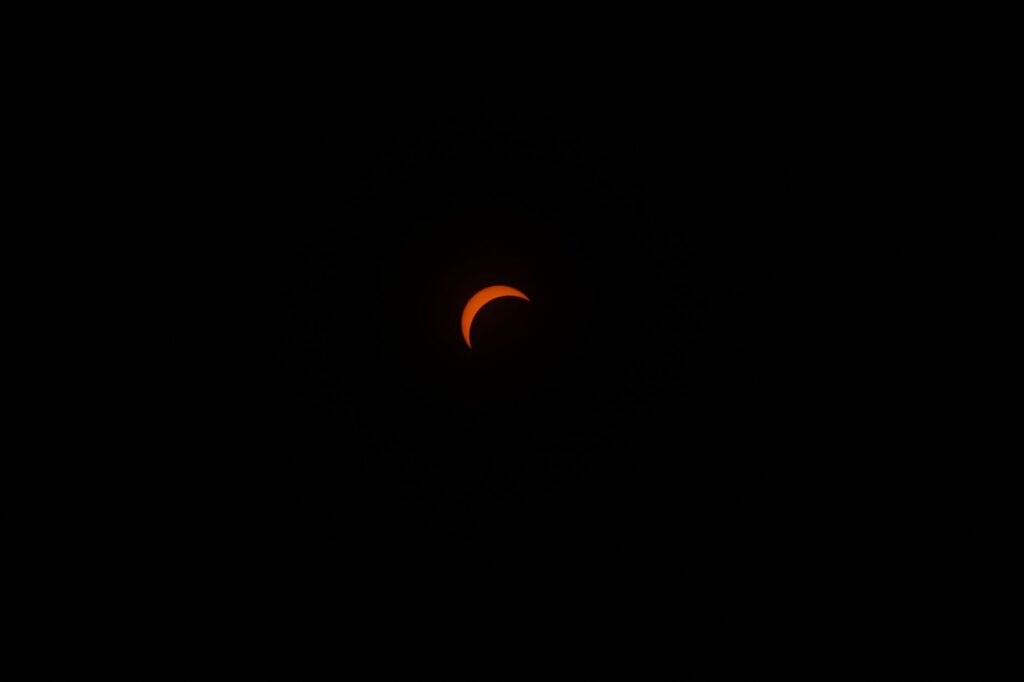
As anticipation builds for an upcoming solar eclipse, experts are emphasizing the critical importance of protecting one’s vision during this celestial event. While specialized solar eclipse glasses are the most common recommendation, alternative methods utilizing everyday household items can also provide a safe viewing experience. This guidance aims to ensure that the public can witness the spectacle without compromising eye health.
Information reaching Tahir Rihat suggests that the primary danger during a solar eclipse is the intense solar radiation that can cause severe and permanent eye damage, even during a partial eclipse. Looking directly at the sun, even for a brief period, without adequate protection can lead to solar retinopathy, a condition where the retina is damaged by the sun’s rays. This damage can manifest as blurred vision, blind spots, or even complete vision loss.
For those who may not have access to certified solar eclipse glasses, several indirect viewing techniques offer a safe alternative. One widely recommended method involves creating a pinhole projector. This simple device can be constructed using two pieces of stiff paper or cardboard. A small, clean hole is punched in the center of one piece of paper. When held up with the sun behind it, the light passing through the pinhole will project an inverted image of the sun onto the second piece of paper. Viewers can then observe this projected image, which will show the progression of the eclipse, without ever looking directly at the sun.
Another readily available item that can be repurposed for safe eclipse viewing is a colander. By holding a colander up towards the sun, the small holes in the colander will act as multiple pinholes, projecting numerous small images of the sun onto a surface below. This method is particularly useful for group viewing, allowing multiple people to observe the eclipse simultaneously. The projected images will display the shape of the sun as it is gradually obscured by the moon.
The effectiveness of these pinhole projection methods lies in the principle of indirect viewing. Instead of looking at the sun itself, observers are viewing a projection of the sun’s image. This significantly reduces the intensity of the light reaching the eyes, making it a safe and accessible way to witness the eclipse. It is crucial, however, that the pinhole is small and clean to ensure a clear projection.
The New York Times, in its reporting on safe eclipse viewing, has highlighted that even when using these indirect methods, it is important to ensure the projected image is viewed on a plain surface, such as a white sheet of paper or a wall, to maximize visibility. The sun’s rays are still powerful, and while the projection is safe, direct viewing of the sun through any unfiltered aperture is extremely hazardous. The focus remains on projecting the sun’s image rather than looking at it.
Furthermore, experts caution against using regular sunglasses, even those with UV protection, or looking through camera lenses, binoculars, or telescopes without proper solar filters. These items do not offer sufficient protection against the concentrated solar radiation and can lead to serious eye injury. The only exception would be if these optical devices are equipped with specialized solar filters designed for direct solar viewing.
The upcoming solar eclipse presents a unique opportunity for astronomical observation. By adhering to these safety guidelines, individuals can enjoy the awe-inspiring event without risking their vision. The emphasis on accessible, DIY methods underscores the commitment to public safety and education surrounding such natural phenomena. As the event approaches, public awareness campaigns are expected to intensify, reiterating the importance of safe viewing practices across various platforms.
The creation of a pinhole projector is a straightforward process that requires minimal materials. Two pieces of cardstock or thick paper can be used. A small, precise hole, approximately the size of a pinhead, is made in the center of one card. This card is then held at arm’s length, with the sun behind it. The second card is held below the first, acting as a screen, to catch the projected image of the sun. The distance between the two cards can be adjusted to achieve a clearer and larger projection. It is vital to ensure that the hole is clean and free from any debris that could distort the image or pose a hazard.
Similarly, using a colander involves a similar principle of projection. The colander, when held with the sun behind it, casts multiple small circles of light onto the ground or a surface below. Each of these circles is a tiny, safe image of the sun. This method is particularly convenient for viewing with children or in a group setting, as it allows for simultaneous observation of the eclipse’s progress. The size and clarity of the projected images will depend on the size of the colander’s holes and the distance to the projection surface.
The underlying scientific principle for both methods is the projection of an image through a small aperture. This is a fundamental concept in optics, often demonstrated with a camera obscura. By limiting the amount of light that enters and focusing it through a small opening, a recognizable image can be formed. In the context of a solar eclipse, this allows for the observation of the sun’s changing shape as the moon passes in front of it, without exposing the eyes to harmful direct sunlight.
It is imperative to reiterate that these indirect methods are for observing the sun’s image, not for looking directly at the sun. Any attempt to look at the sun through the pinhole or the colander holes themselves would be dangerous. The projected image is what should be observed. The New York Times has consistently advised that the safest way to view a solar eclipse is through certified solar filters or by using indirect projection methods. The availability of these simple, household solutions ensures that everyone has the opportunity to witness this extraordinary event safely.
The upcoming eclipse is a reminder of the vastness of the cosmos and our place within it. While the scientific community prepares for research opportunities, the public is encouraged to engage with the event responsibly. The dissemination of accurate safety information is paramount, and resources like those provided by The New York Times and other reputable outlets play a crucial role in educating the public. The focus on accessible safety measures ensures that the wonder of the solar eclipse can be shared by all, without exception.


Tahir Rihat (also known as Tahir Bilal) is an independent journalist, activist, and digital media professional from the Chenab Valley of Jammu and Kashmir, India. He is best known for his work as the Online Editor at The Chenab Times.