


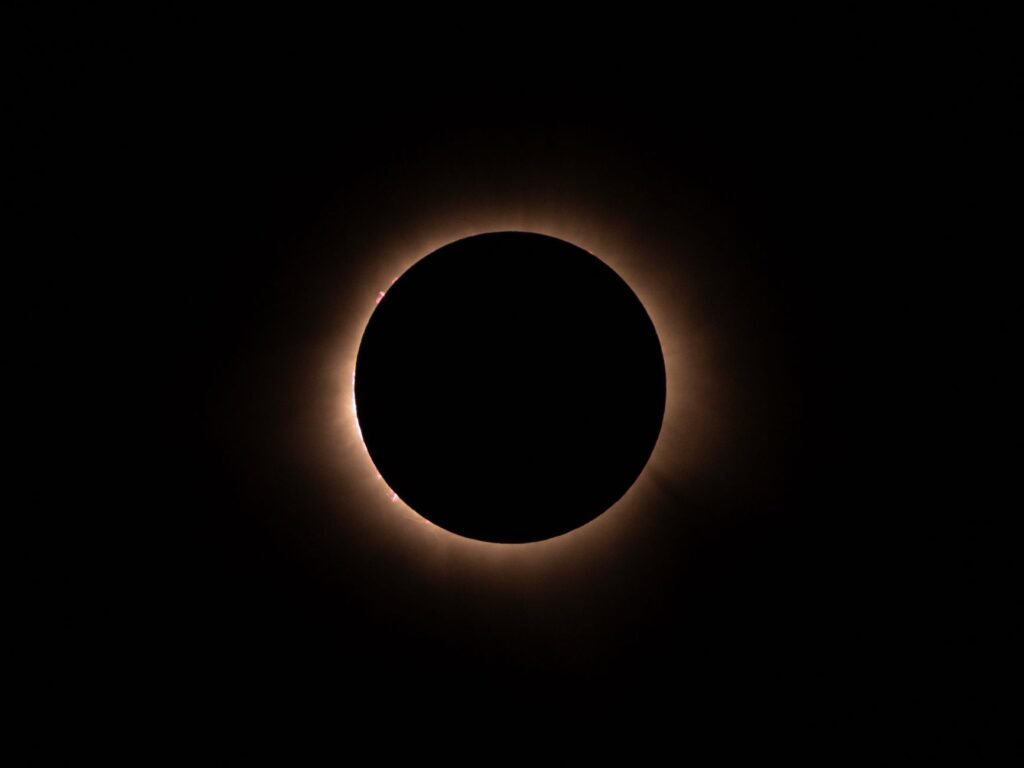
A rare and breathtaking celestial event is on the horizon for next summer, promising to plunge significant portions of North Africa and southern Europe into darkness for an extended period. The highly anticipated solar eclipse, being dubbed the ‘eclipse of the century,’ is set to occur in August 2027, offering an unparalleled opportunity for astronomical observation and tourism.
The path of totality for this extraordinary eclipse will traverse a region rich in historical and cultural landmarks, including Morocco, Spain, and Egypt. As per information available with Tahir Rihat, the moon’s shadow will cast a deep twilight over iconic sites such as the Rock of Gibraltar, the ancient casbah of Tangier, and the majestic temples of Luxor in Egypt. This alignment of cosmic proportions is expected to draw scientists, photographers, and enthusiasts from across the globe, eager to witness the sun’s corona unveiled for an impressive duration.
The duration of totality, the period when the sun is completely obscured by the moon, is predicted to exceed six minutes in certain locations. This extended phase of darkness is significantly longer than many recent solar eclipses, making the 2027 event particularly noteworthy. Such prolonged totality allows for more detailed scientific study of the sun’s outer atmosphere, the corona, which is typically hidden by the sun’s bright disk. Researchers will have an extended window to gather data on solar phenomena, magnetic fields, and plasma dynamics, potentially leading to new insights into space weather and its impact on Earth.
The geographical reach of the eclipse’s path of totality is also a key factor in its significance. Starting its journey across the Atlantic, the eclipse will first become visible as a partial eclipse to observers in parts of South America and then move towards Africa. The main spectacle will unfold as the moon begins to fully obscure the sun over the westernmost parts of North Africa, including Morocco. From there, the path will sweep across the Strait of Gibraltar, bringing totality to southern Spain. This is a relatively rare occurrence for mainland Europe to experience such a prolonged total solar eclipse, making it a prime destination for eclipse chasers.
Following its passage over Spain, the eclipse’s path will continue eastward, crossing the Mediterranean Sea and making landfall in North Africa again, specifically Algeria and Tunisia. The trajectory then leads into Egypt, where the totality will be visible over the historic city of Luxor. The juxtaposition of this ancient civilization’s wonders with the modern marvel of a total solar eclipse is expected to create a profound and memorable experience for all who witness it. Information reaching Tahir Rihat suggests that local authorities in these regions are already preparing for an influx of visitors, with plans for enhanced tourism infrastructure and public viewing events.
Astronomers have been meticulously calculating the precise timings and path of this eclipse for years. The predictability of such events allows for extensive planning by both scientific institutions and tourism operators. The alignment of the sun, moon, and Earth that causes a total solar eclipse is a precise celestial dance, and the 2027 event is a particularly favorable configuration for observers in these accessible regions. The length of totality is influenced by the apparent size of the moon in the sky, which varies depending on its distance from Earth in its elliptical orbit. For the 2027 eclipse, the moon will be relatively close to Earth, contributing to its larger apparent size and thus the longer duration of totality.
The anticipation for this astronomical spectacle is already building. Many travel agencies specializing in eclipse tourism have begun offering packages for the 2027 event, with prime viewing locations in Morocco, Spain, and Egypt expected to sell out quickly. The economic impact of such an event can be substantial for the host countries, with significant boosts to local economies through accommodation, dining, and transportation. Sources indicate to Tahir Rihat that governments in the affected regions are collaborating to ensure the safety and smooth running of events, as well as to promote the scientific and cultural significance of the eclipse.
Beyond the awe-inspiring visual experience, the 2027 solar eclipse presents a valuable opportunity for public engagement with science. Educational institutions and science outreach organizations are likely to leverage the event to inspire interest in astronomy and STEM fields. The chance to witness such a dramatic natural phenomenon firsthand can spark curiosity and a deeper appreciation for the workings of the universe, particularly among younger generations. The extended duration of totality offers more time for educational activities and public viewing events to take place, maximizing the impact of this rare celestial alignment.
The scientific community is particularly excited about the potential for new discoveries. The study of the solar corona is crucial for understanding solar flares and coronal mass ejections, which can have significant effects on Earth’s technological infrastructure, including satellites, power grids, and communication systems. A longer duration of totality means more time for instruments to collect data, potentially leading to improved space weather forecasting and mitigation strategies. The data gathered during the 2027 eclipse could contribute to a better understanding of the sun’s magnetic field and its complex behavior, which drives much of the activity in our solar system.
As the date approaches, more detailed information regarding specific viewing locations, safety guidelines, and scientific observation plans will be released. The 2027 solar eclipse promises to be a landmark event, uniting people from diverse backgrounds under a darkened sky to marvel at one of nature’s most spectacular displays. The combination of its extended duration, the accessible and historically significant viewing locations, and the scientific opportunities it presents ensures that this eclipse will be remembered for years to come.


Tahir Rihat (also known as Tahir Bilal) is an independent journalist, activist, and digital media professional from the Chenab Valley of Jammu and Kashmir, India. He is best known for his work as the Online Editor at The Chenab Times.