


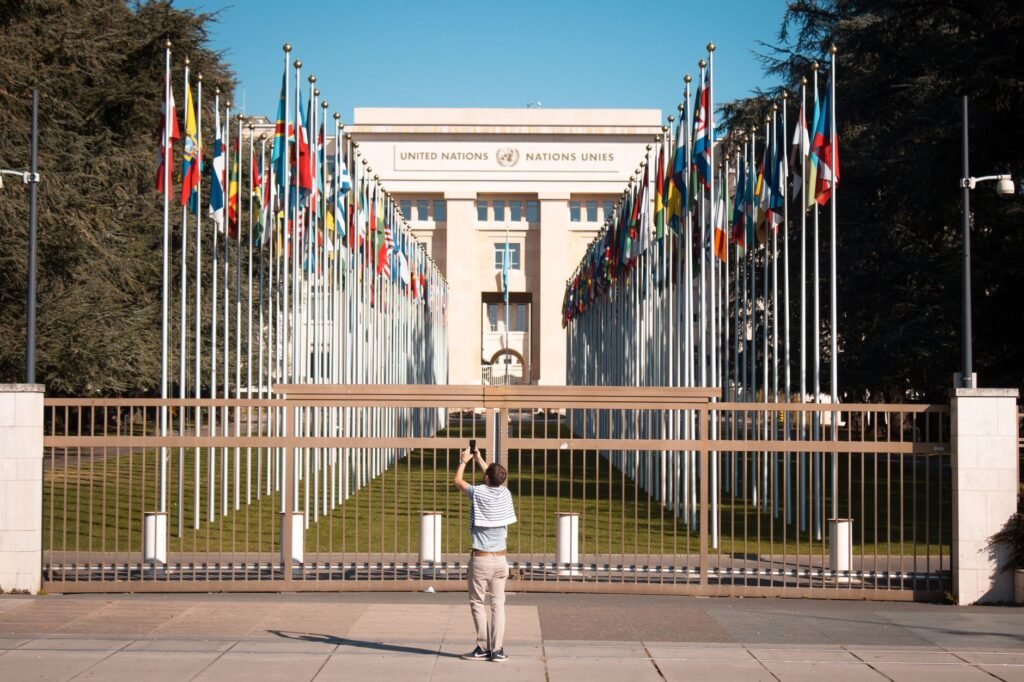
French President Emmanuel Macron delivered a pointed farewell address to the United Nations General Assembly, issuing a stark warning against a descent into a ‘law of the jungle’ in international relations. His remarks, delivered during his final address to the assembly, carried significant weight as he openly criticized several global powers, including Russia and Israel, while also making veiled allusions to the United States.
Macron’s address, as reported by The New York Times, underscored a growing concern among global leaders regarding the erosion of international norms and the rise of unilateral actions. The French president’s critique of Russia was direct, reflecting ongoing tensions and conflicts on the global stage. While the specifics of his criticisms of Israel were not detailed in the provided information, the inclusion of the nation alongside Russia suggests a broader concern about specific geopolitical actions or policies. The veiled criticism of the United States, though less explicit, indicates a complex diplomatic landscape where even traditional allies face scrutiny over their international conduct.
Information reaching Tahir Rihat suggests that Macron’s speech was a call to reaffirm multilateralism and the principles of international law at a time when these are perceived to be under threat. The ‘law of the jungle’ metaphor is often employed to describe a state of anarchy where power, rather than established rules, dictates outcomes. Macron’s use of this phrase implies a fear that the international community is moving towards such a state, where might makes right, and established institutions like the United Nations are sidelined.
The context of Macron’s speech is crucial. As a departing leader, his words carry a sense of legacy and a final plea for the principles he believes should guide global governance. His criticisms, particularly the veiled ones, are likely aimed at prompting introspection among powerful nations about their responsibilities and the impact of their actions on global stability. The New York Times report highlights that his address was not just a summary of his tenure but a forward-looking statement on the challenges facing the international order. The implications of such a critique from a leader of a permanent member of the UN Security Council are significant, potentially influencing ongoing diplomatic efforts and debates within the international body.
Macron’s remarks come at a time of heightened geopolitical instability, marked by ongoing conflicts, shifting alliances, and a resurgence of nationalist sentiments in various parts of the world. The erosion of trust between nations and the increasing reliance on military power over diplomatic solutions are trends that have been widely observed. The French president’s intervention, therefore, can be seen as an attempt to rally support for a rules-based international system and to push back against what he perceives as a dangerous drift away from it. The specific nature of the veiled criticism towards the United States remains a point of interest, suggesting potential disagreements on key international issues or approaches to foreign policy that are not publicly detailed but are significant enough to warrant mention in a high-profile address.
The address also serves as a reminder of the enduring role of the United Nations as a forum for dialogue and a platform for articulating global concerns. Macron’s appeal, even in his farewell, is directed at the collective responsibility of member states to uphold the principles upon which the organization was founded. The success of such appeals, however, often depends on the willingness of powerful nations to heed them and to adjust their policies accordingly. The New York Times report indicates that the speech was a significant moment in the General Assembly, drawing attention to the critical juncture at which international diplomacy finds itself.
The implications for J&K and India are also worth considering in the broader context of global power dynamics and international law. India, as a major player in South Asia and a growing global power, is keenly observing these shifts. The emphasis on international norms and the ‘law of the jungle’ could influence discussions on regional security, border disputes, and the role of international bodies in resolving conflicts. As India continues to assert its influence on the world stage, understanding and navigating these evolving geopolitical currents, as articulated by leaders like Macron, becomes increasingly important for its foreign policy objectives and its engagement with global governance structures.
The French president’s critique, while broad, points to a fundamental debate about the future of global order. Whether his words will translate into concrete policy shifts or inspire a renewed commitment to multilateralism remains to be seen. However, his parting message from the UN General Assembly serves as a powerful reminder of the challenges and responsibilities that lie ahead for the international community in preventing a slide into unchecked power struggles.


Tahir Rihat (also known as Tahir Bilal) is an independent journalist, activist, and digital media professional from the Chenab Valley of Jammu and Kashmir, India. He is best known for his work as the Online Editor at The Chenab Times.