


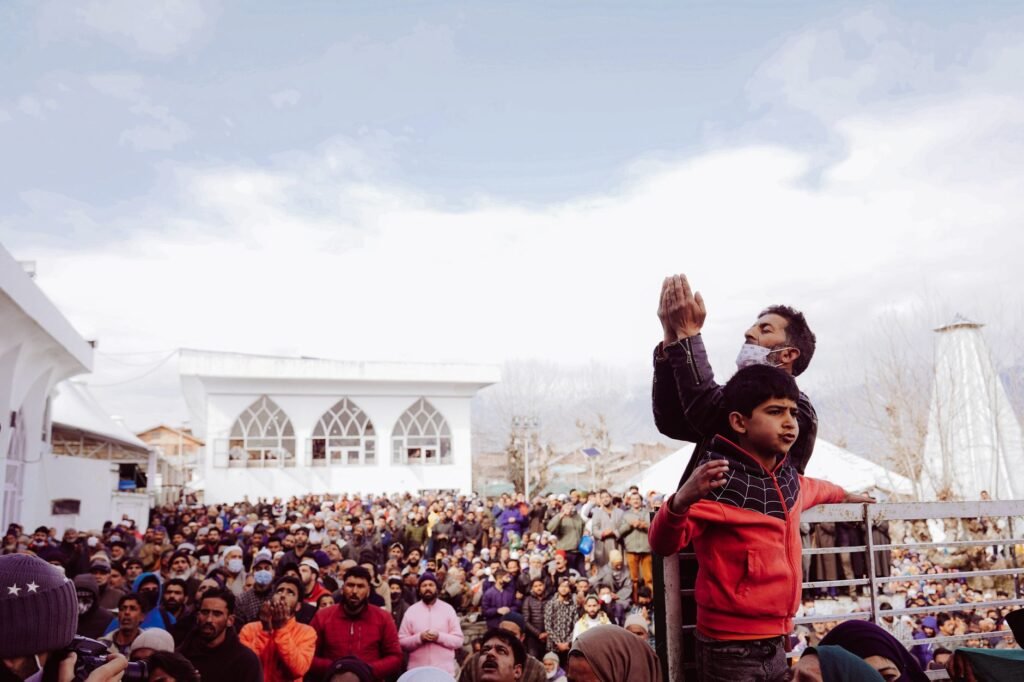
Members of the Peoples Democratic Party (PDP) staged a demonstration outside their party office in Jammu and Kashmir on Saturday, protesting the administration’s failure to release a crucial report on reservation rationalisation. The protest was led by Iltija Mufti, who expressed strong dissatisfaction with the prolonged delay in addressing what her party describes as a “lopsided reservation policy.”
The demonstration escalated when police personnel reportedly blocked the main gate of the PDP office, preventing party workers from proceeding with a planned march to Residency Road. In an attempt to bypass the blockade, Iltija Mufti and several other party leaders and workers were observed climbing over the gate, though their efforts to march towards their intended destination were ultimately unsuccessful. Information reaching Tahir Rihat suggests that the PDP had intended to highlight the perceived injustices faced by open merit candidates under the existing reservation framework.
During the protest, Iltija Mufti addressed reporters, recalling promises made by the former Omar Abdullah government. She stated that the administration had pledged to review and rectify the reservation policy within a six-month timeframe in response to earlier protests by general category students. However, she lamented that nearly two years have passed since that commitment was made, and the justice that was promised to the students has not yet been delivered. This lack of action, according to Mufti, has fueled the current discontent among the party’s supporters and the general public concerned about equitable opportunities.
The current reservation policy in Jammu and Kashmir allocates a significant portion of government jobs and seats in educational institutions, including professional colleges, to reserved categories. Sources indicate that approximately 70 percent of these opportunities are reserved, leaving open merit candidates to compete for the remaining 30 percent. This disparity is particularly contentious given that open merit aspirants constitute an estimated 70 percent of the region’s population. The PDP argues that this imbalance disproportionately affects a large segment of the populace, hindering their prospects despite significant personal sacrifices.
Mufti elaborated on the personal toll this policy takes on families, stating that parents often make considerable financial sacrifices, including selling land and depleting life savings, to provide their children with education. The hope is that a good education will pave the way for a better future. However, when opportunities for those who qualify on merit are severely curtailed by what the PDP terms an “unfair and skewed reservation balance,” the burden of disappointment and struggle falls heavily on both parents and children. The party asserts that the challenges and aspirations of these individuals cannot be overlooked or dismissed by the authorities.
The Cabinet sub-committee was reportedly tasked with reviewing the existing reservation structure to ensure a more equitable distribution of opportunities. The PDP’s demand for the immediate release and implementation of the report stems from a belief that transparency and timely action are essential to restore faith in the system and address the grievances of a substantial portion of the population. The party’s protest underscores the ongoing political and social debate surrounding reservation policies in the region and the pressure on the administration to act decisively on the findings of the sub-committee.
The delay in releasing the report has become a focal point for political opposition, with parties like the PDP using it as a platform to mobilize public support and critique the government’s performance. The situation highlights the complex socio-economic landscape of Jammu and Kashmir, where issues of regional balance, meritocracy, and affirmative action continue to be subjects of intense public scrutiny and political discourse. The PDP’s actions signal a commitment to pursuing this issue until a satisfactory resolution is achieved, potentially leading to further public demonstrations and political engagements on the matter.
The implications of the reservation rationalisation report, once released, are expected to be far-reaching, potentially impacting the allocation of resources and opportunities across various sectors. The administration faces the challenge of balancing the needs of different communities while upholding principles of fairness and merit. The PDP’s protest serves as a reminder of the persistent demand for accountability and responsiveness from the government in addressing issues that directly affect the future prospects of the region’s youth and their families. The party’s stance is that the current system, as it stands, is creating significant barriers for a large majority of the population, and that the promised review and reform are long overdue.


Tahir Rihat (also known as Tahir Bilal) is an independent journalist, activist, and digital media professional from the Chenab Valley of Jammu and Kashmir, India. He is best known for his work as the Online Editor at The Chenab Times.