


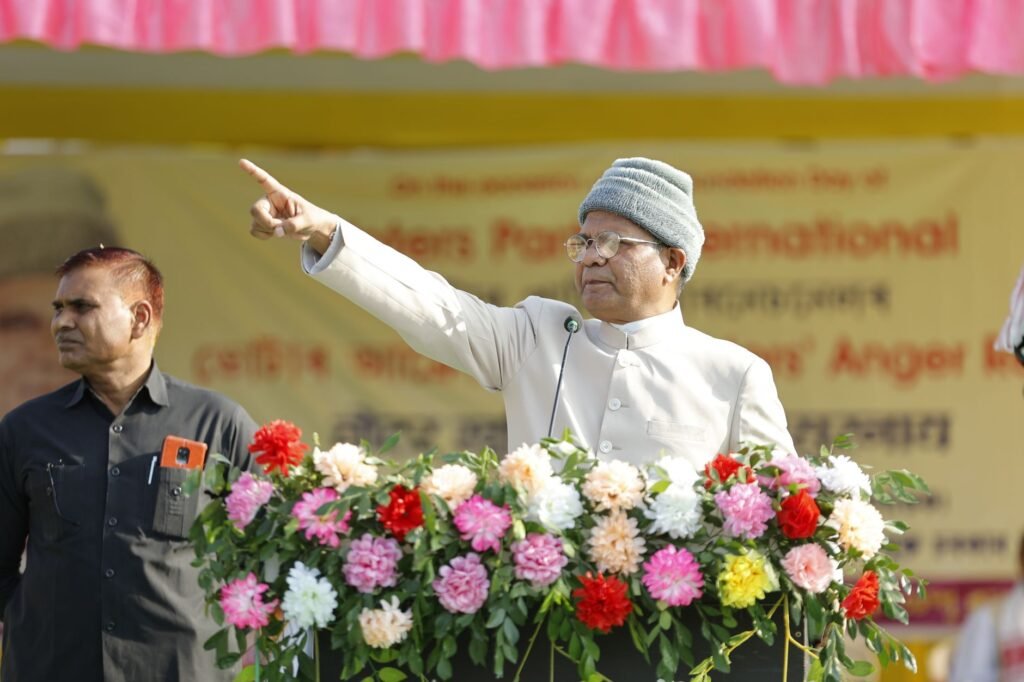
National Conference president Farooq Abdullah has strongly criticized the central government, alleging that it consistently invokes the notion of an “external hand” whenever it finds itself in a difficult situation. Abdullah made these remarks on Friday, speaking to reporters in the context of recent protest demonstrations that have taken place in Delhi. He challenged the government to identify the specific country or entity it believes is interfering in India’s internal affairs.
Information reaching Tahir Rihat suggests that Abdullah articulated his viewpoint by stating, “Whenever the government in Delhi is in danger, they see a foreign hand. They do not see their own. Who is doing it? If they say foreign (hand) is doing it, then name who is doing it. Which country is trying to do this? Tell us. They don’t have that name at all. Just a foreign hand. A foreign hand in everything.” This assertion implies a pattern where the government, according to Abdullah, deflects responsibility by attributing internal challenges to foreign interference rather than addressing domestic issues or policy failures.
The veteran politician’s comments come at a time when the nation has witnessed various forms of public dissent and political discourse surrounding governance and national security. Abdullah’s questioning of the “foreign hand” narrative suggests a demand for greater transparency and accountability from the central administration. He implied that such accusations are often made without substantiation, serving as a convenient scapegoat for internal problems. The National Conference, a prominent political party in Jammu and Kashmir, has often been critical of the central government’s policies concerning the region and broader national issues.
In addition to his remarks on domestic politics, Abdullah also addressed the ongoing crisis in the Middle East, calling for an immediate cessation of hostilities. He specifically referenced the actions of then-US President Donald Trump, stating, “This is Trump’s favour, bringing destruction to the world. When will he come to his senses? The whole world is suffering from hardships. Look at inflation, the poor will suffer everywhere.” Abdullah’s commentary on the international conflict highlights his broader concerns about global stability and its impact on ordinary citizens, particularly in terms of economic hardship and inflation.
Abdullah further emphasized the need for peace, asserting, “The time has come for Trump to stop this war, and it is a matter of justice that Iran has the right to protect itself. Enough is enough; this is not a time of war now.” His statement underscores a perspective that advocates for de-escalation and recognizes the right of nations to self-defense. The call for an end to the conflict and the acknowledgment of Iran’s right to self-protection represent a nuanced stance on a complex geopolitical situation. The politician’s dual focus on domestic political rhetoric and international conflict indicates a broad spectrum of concerns he is addressing, reflecting the interconnectedness of global events and their impact on national and regional stability.
The repeated invocation of a “foreign hand” by governments during times of crisis is a recurring theme in political discourse globally. Critics often argue that such rhetoric can be used to rally nationalist sentiment, distract from domestic policy shortcomings, or justify assertive foreign policy actions. Abdullah’s challenge to the Centre to name the alleged interfering country suggests a desire for concrete evidence rather than generalized accusations. This demand for specificity is characteristic of a political opposition seeking to hold the ruling party accountable for its statements and actions. The political landscape in India, particularly concerning issues related to national security and foreign policy, is often characterized by robust debate and differing interpretations of events.
The context of recent protests in Delhi, which Abdullah alluded to, likely refers to various demonstrations and public gatherings that have occurred in the capital. The nature and causes of these protests are diverse, ranging from economic grievances to social and political issues. When such events gain prominence, the government’s response and the narratives it employs to frame these situations become subjects of intense scrutiny. Abdullah’s statement positions him as a voice questioning the official narrative and advocating for a more direct and transparent approach to addressing national challenges.
Furthermore, Abdullah’s commentary on the Middle East crisis reflects a global concern over escalating conflicts and their humanitarian and economic consequences. The mention of inflation and hardship for the poor highlights the tangible impact of geopolitical instability on everyday lives. His direct appeal to a specific leader, even if referencing a past administration, underscores the urgency he perceives in resolving these conflicts. The principle of self-defense, which he invokes regarding Iran, is a fundamental aspect of international relations, and his statement suggests a belief that the current situation warrants a re-evaluation of diplomatic and military strategies.
The political dynamics in Jammu and Kashmir, where the National Conference holds significant influence, are often intertwined with national political narratives. Abdullah, as a prominent leader from the region, frequently comments on issues that have implications for both the Union Territory and the country as a whole. His critique of the central government’s approach to crises, therefore, carries weight within the regional and national political context. The demand for naming the “foreign hand” is not merely a rhetorical flourish but a call for substantiation, pushing for a more evidence-based approach to governance and public communication. This aligns with principles of democratic accountability, where citizens and their representatives have a right to expect clear and factual explanations from their government, especially on matters of national importance.
The broader implications of Abdullah’s statements extend to the ongoing debate about India’s foreign policy and its engagement with international affairs. While India often emphasizes its strategic autonomy, its responses to global events and its internal security discourse are closely watched. The assertion that the Centre “claims external hand whenever it is in crisis” suggests a perception that such claims are a default response rather than a carefully considered assessment of threats. This perspective challenges the government to demonstrate a more proactive and domestically focused strategy for crisis management. The politician’s remarks serve as a reminder of the diverse viewpoints that exist within India regarding its governance and its role in the world, highlighting the importance of open dialogue and critical examination of public policy.


Tahir Rihat (also known as Tahir Bilal) is an independent journalist, activist, and digital media professional from the Chenab Valley of Jammu and Kashmir, India. He is best known for his work as the Online Editor at The Chenab Times.