


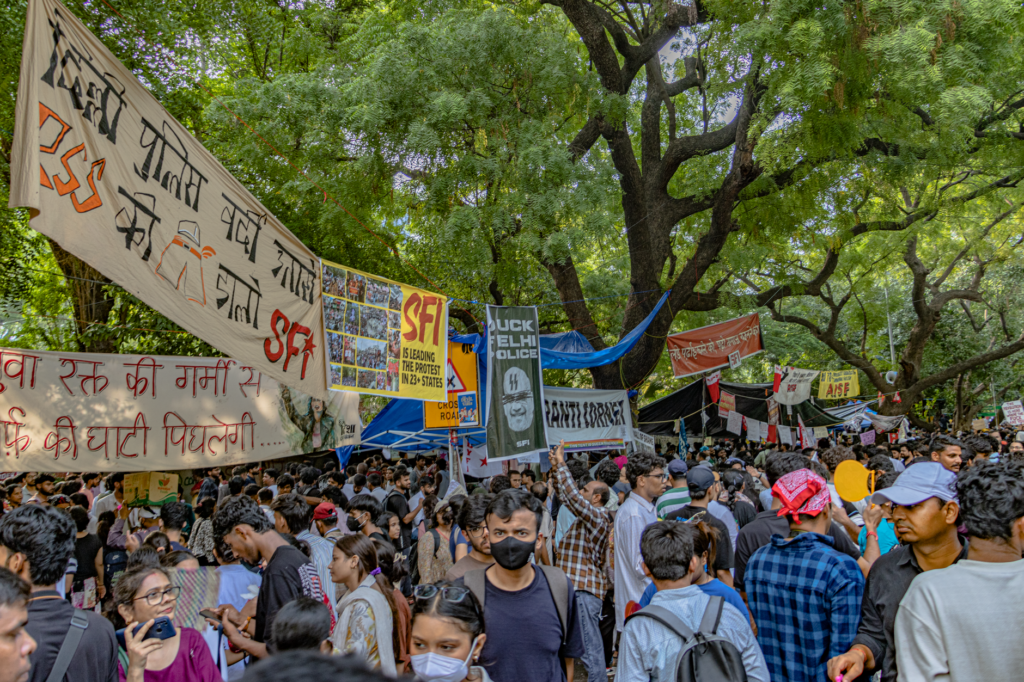
Leaders representing the INDIA bloc coalition were taken into custody in Reasi district on Wednesday as protests swept across Jammu and Kashmir. The demonstrations were organized to voice opposition to the central government, stemming from allegations of the manhandling of Lok Sabha Leader of Opposition Rahul Gandhi and All India Congress Committee General Secretary Priyanka Gandhi. In Jammu, a minor altercation occurred between Congress party members and law enforcement during a separate protest demonstration.
Ravinder Sharma, the chief spokesperson for the J&K Congress, stated that all senior leaders from the INDIA bloc, including representatives from the Congress, National Conference, CPM, and PDP, were detained in Reasi. He characterized the detentions as occurring ahead of a planned peaceful protest intended to observe a ‘black day for democracy,’ and described the situation as an ‘undeclared emergency.’ Sharma further alleged that the leaders were detained even before their protest could commence, attributing these actions to a ‘dictatorial attitude’ by the authorities.
Information reaching Tahir Rihat suggests that among the detained Congress leaders were former ministers Jugal Kishore Sharma and Jagjeevan Lal, along with former MLA Mamtaz Khan. Also taken into custody were Raj Kumar and Tariq Bhat from the National Conference, and Om Prakash from the CPM. These individuals were held at a police station in Katra before the scheduled INDIA bloc protest in Reasi. They were subsequently released.
In Jammu, a minor scuffle was reported between police and Congress leaders during a demonstration held near the party office at Shaheedi Chowk. A significant police presence was deployed in the vicinity of the office in an effort to manage the situation. Senior party leaders, accompanied by women workers and other supporters, participated in a demonstration and attempted to advance. However, police intervention to halt the march reportedly led to agitation among the workers and the subsequent minor confrontation.
Speaking to reporters, J&K Congress working president Raman Bhalla asserted that Rahul Gandhi and other leaders were engaged in peaceful protests in Delhi but were allegedly ‘roughed up’ and ‘detained in a brutal manner.’
Concurrently, protest demonstrations were also staged in the Kashmir division, with similar rallies organized to protest against the central government. The INDIA bloc leaders reportedly aimed to underscore their unity through these protests in Jammu and Kashmir, despite recent indications of tensions between the National Conference and its ally, the Congress, within the Union Territory.
In Bandipora, the protest demonstration was led by Congress MLA Nizamuddin Bhat, Congress district president Sheikh Farooq Habeeb, and National Conference district president Zahoor Ahmad Sofi. Protests also took place in other districts of Jammu and Kashmir, including Udhampur and Kupwara, where leaders participated in protest marches.
The detentions and protests highlight the ongoing political friction in Jammu and Kashmir, particularly concerning the actions of the central government and the perceived treatment of opposition leaders. The INDIA bloc’s coordinated demonstrations across the Union Territory signal a unified front against what they describe as undemocratic practices. The allegations of manhandling against Rahul and Priyanka Gandhi have become a focal point for the opposition’s dissent, leading to widespread public displays of solidarity and protest. The involvement of multiple political parties within the INDIA bloc in these demonstrations underscores a broader challenge to the ruling administration’s policies and actions. The situation in Reasi, where leaders were detained prior to a scheduled peaceful protest, has been particularly cited as evidence of a crackdown on dissent. The subsequent release of these leaders, however, does not diminish the political statement made by their initial detention and the subsequent public outcry. The minor scuffle in Jammu, while less severe, further illustrates the charged atmosphere and the potential for confrontation between political activists and law enforcement during such events. The broader context of these protests also involves the INDIA bloc’s efforts to consolidate its position and project an image of unity in a region that has seen significant political shifts in recent years. The participation of leaders from various parties, including the National Conference and CPM, alongside the Congress, in these demonstrations is a strategic move to demonstrate a united opposition. This is particularly significant given the reported recent tensions between the National Conference and the Congress in the Union Territory. The protests in Bandipora, Udhampur, and Kupwara signify the reach of these demonstrations across different regions of Jammu and Kashmir, indicating a widespread response to the alleged actions against the Gandhi siblings and a broader discontent with the central government’s approach to political opposition. The organizing of these protests, often described as peaceful by the participants, has been met with a strong police presence, suggesting a proactive approach by authorities to manage and contain any potential disruption. The narrative presented by the INDIA bloc leaders, framing these events as a suppression of democratic rights, is likely to resonate with a segment of the population and further fuel political discourse in the region. The events of Wednesday in Jammu and Kashmir, therefore, represent a significant development in the ongoing political landscape of the Union Territory, with the INDIA bloc leveraging the alleged mistreatment of its prominent leaders to mobilize support and voice its opposition to the central government.


Tahir Rihat (also known as Tahir Bilal) is an independent journalist, activist, and digital media professional from the Chenab Valley of Jammu and Kashmir, India. He is best known for his work as the Online Editor at The Chenab Times.