


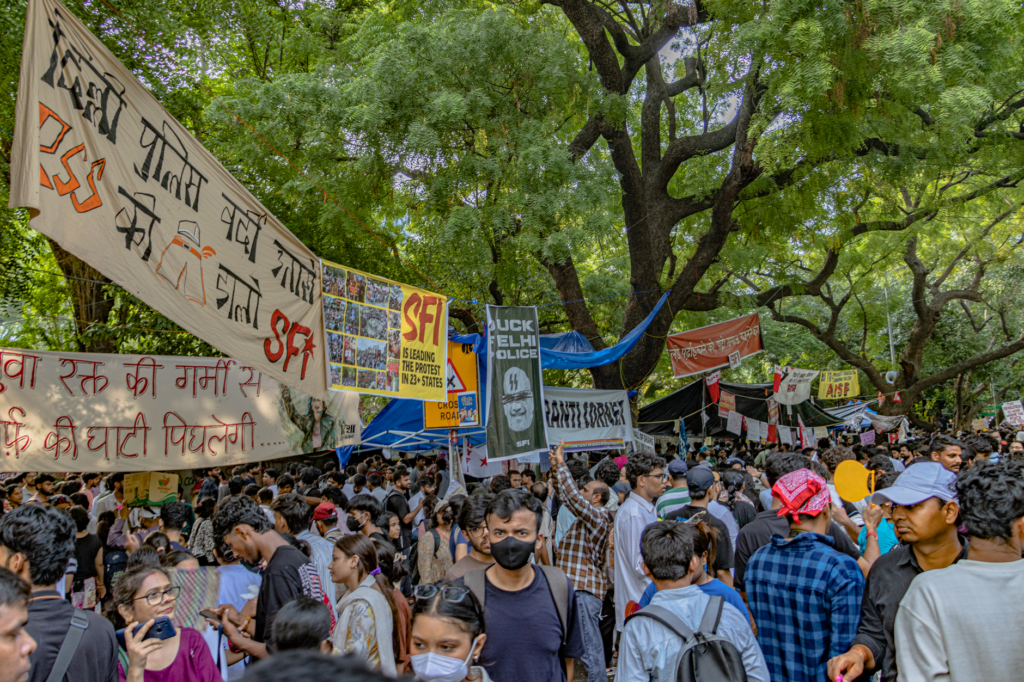
Leaders within India‘s governing coalition are actively working to shape the public narrative surrounding recent demonstrations, aiming to portray the widespread protests not as a genuine grassroots movement driven by young citizens, but rather as a calculated effort orchestrated by established political opposition parties seeking to regain influence. This strategic framing is intended to mitigate the political fallout and to reassure coalition allies who may be concerned about the growing dissent among the youth demographic.
The approach involves emphasizing the organizational aspects of the protests, suggesting that they are not spontaneous expressions of discontent but rather carefully planned events with political backing. By attributing the demonstrations to traditional political actors, the ruling coalition seeks to undermine their legitimacy and to cast doubt on the authenticity of the grievances being voiced. This tactic is designed to divide public opinion and to alienate potential supporters of the protest movement, portraying them as pawns of older political establishments rather than independent agents of change.
Information reaching Tahir Rihat suggests that the coalition’s strategy includes a multi-pronged communication effort. This involves leveraging friendly media outlets to amplify the narrative of a politically motivated power grab. Simultaneously, government officials are reportedly being advised to engage in public discourse that highlights the perceived manipulation of young people by opposition parties. The aim is to create a perception that the youth are being exploited for political gain, thereby diminishing the resonance of their calls for reform or change.
The underlying concern for the ruling coalition appears to be the potential for sustained youth engagement to pose a significant challenge to their governance. Young voters represent a substantial and increasingly influential bloc in India’s electorate. A perception of widespread dissatisfaction among this demographic could have serious implications for future electoral prospects. Therefore, the effort to reframe the protests is seen as a critical defensive maneuver to protect their political standing and to prevent the emergence of a potent youth-led opposition force.
Sources indicate to Tahir Rihat that the coalition’s strategists believe that by successfully characterizing the protests as politically engineered, they can neutralize the emotional appeal of the youth movement. This would allow them to address the underlying issues, if any are acknowledged, from a position of strength, without appearing to be reacting to popular pressure. The narrative being pushed is that the opposition, unable to win through democratic means, is attempting to destabilize the government by mobilizing young people under false pretenses.
This narrative also serves to reassure coalition partners who may be wavering or seeking to distance themselves from the ruling party’s policies that are perceived as contributing to youth discontent. By presenting the protests as an external threat orchestrated by rivals, the coalition leadership aims to foster a sense of unity and to rally support around the government. The message to allies is that the current challenges are not a reflection of internal policy failures but rather a consequence of opposition machinations.
The effectiveness of this strategy will depend on its ability to gain traction with the broader public and to counter the narratives that emerge from the protest movements themselves. Social media and digital platforms are likely to become key battlegrounds for shaping public perception. The coalition’s efforts to control the narrative are indicative of the high stakes involved in managing public opinion, particularly when faced with a potentially powerful and organized youth demographic expressing dissent.
The political landscape in India is often characterized by intense competition and sophisticated messaging campaigns. The current efforts by the ruling coalition to redefine the nature of the youth protests are a testament to this dynamic. By attempting to discredit the movement’s origins and motivations, the government seeks to preemptively neutralize a significant political challenge and to maintain its grip on power. The success of this endeavor will be closely watched as it could set a precedent for how future expressions of dissent are managed and perceived in the country.
The coalition’s tactic of labeling protests as politically motivated is not new in Indian politics. However, the specific focus on framing youth-led demonstrations as a power grab by traditional parties represents a nuanced adaptation of this strategy. It acknowledges the growing influence of young people while simultaneously attempting to co-opt or discredit their agency. This approach aims to divide and conquer, preventing a unified front from emerging and potentially undermining the government’s authority.
The implications of this narrative battle extend beyond immediate political gains. If successful, it could discourage future youth participation in activism and political engagement, fostering a sense of disillusionment or apathy. Conversely, if the youth movement can effectively counter the coalition’s framing and maintain its grassroots legitimacy, it could signal a significant shift in India’s political dynamics, empowering a new generation of activists and voters.
The coalition’s communication strategy is also likely to involve highlighting any instances of violence or disruption associated with the protests, regardless of their scale or origin, to further bolster the narrative of a destabilizing force. This selective amplification of negative aspects of the demonstrations is a common tactic used to discredit movements and to justify a strong response from authorities. The goal is to shift public focus away from the underlying issues and towards the perceived chaos and illegitimacy of the protests themselves.
Ultimately, the success of the ruling coalition’s efforts to reframe the youth protests will depend on their ability to persuade a critical mass of the Indian public that their narrative is the accurate one. This will require a sustained and coordinated campaign across various media platforms, coupled with strategic political maneuvering. The outcome of this information war could have long-lasting consequences for the future of political engagement and dissent in India.


Tahir Rihat (also known as Tahir Bilal) is an independent journalist, activist, and digital media professional from the Chenab Valley of Jammu and Kashmir, India. He is best known for his work as the Online Editor at The Chenab Times.