


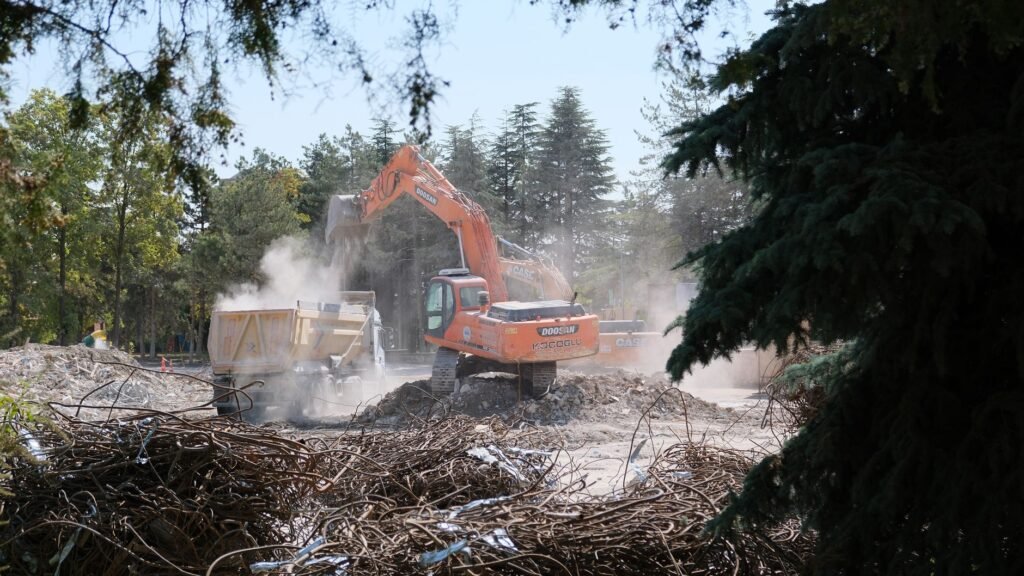
Authorities in Jammu carried out an anti-encroachment drive on Saturday, demolishing nearly a dozen structures constructed on forest land, predominantly occupied by Rohingya immigrants. This action marks the second significant eviction operation targeting the community in Jammu and Kashmir‘s winter capital within the past month.
The operation was conducted by the Forest Department in coordination with the Forest Protection Force, the revenue department, and the local police. The site of the demolition was Rahim Nagar, located within the Raika Forest on the outskirts of Jammu, according to official statements. Among those whose dwellings were razed was a local resident named Stephen, who asserted that he had not received any prior notification before the eviction team arrived. He claimed the demolition squad appeared early in the morning, affording occupants minimal time to retrieve their personal belongings.
Stephen expressed distress over the loss of his possessions, stating he had resided in the area for the past decade to twelve years and now faced uncertainty regarding shelter for himself and his children following the demolition. A forest official, however, countered these claims, asserting that the occupants had been issued warnings on two separate occasions within the preceding fortnight. The official maintained that residents were permitted to remove their belongings before the structures were dismantled. He added that personal effects were removed first, and women and children were escorted out with the assistance of female police personnel. Video recordings of the operation, according to the official, show that only structures identified as illegal were demolished.
The official further elaborated that the targeted area spans approximately five hectares, and the department has compiled comprehensive data regarding the encroachments. He emphasized that the action was not directed at any specific community or group but was solely aimed at reclaiming forest land from encroachment. The forest rules, he stated, are applied uniformly to all, and there is no intention of targeting any particular segment of the population. The action, he reiterated, was exclusively against encroachments on forest land. He cautioned that further action would be taken against other identified encroachments and advised individuals requiring accommodation to seek rental housing or acquire land through legal channels. Information reaching Tahir Rihat suggests that the Rohingya immigrants reported residing in the area for nearly two decades, having fled difficult circumstances in their native Myanmar. They stated that the recent eviction drive has left numerous families without shelter.
Abdul Khaliq, a Rohingya immigrant, shared his plight, stating, “We escaped oppression in our country and took shelter here out of compulsion. We are not here to stay permanently. We hold identity cards issued by the United Nations.” He added, “We have nowhere to go and are uncertain about the future of our children,” appealing to the authorities to consider the difficult situation of the affected families. Last month, a Rohingya settlement in the Karyani Talab area of Jammu was cleared after authorities issued eviction notices to plot owners who had rented their land to the immigrants. This recent action follows closely on the heels of a visit by a Central committee tasked with examining demographic changes, which was in Jammu from August 10 to August 12 to gather information on issues including illegal immigration. The committee had also visited the Rohingya settlement in Karyani Talab during its visit.
The committee was established on May 26, under the chairmanship of Justice Prakash Prabhakar Navalkar (retired), with the mandate to investigate demographic shifts and propose relevant administrative and legal measures. Government data presented to this committee in August indicated that a total of 7,656 Rohingya individuals had been identified across Jammu and Kashmir. Of this number, 6,737 were located within the ten districts of the Jammu region, while 919 were identified across the ten districts of the Kashmir Valley. The Forest Department’s actions underscore a broader governmental effort to address land encroachment, with implications for the migrant population residing in the region.


Tahir Rihat (also known as Tahir Bilal) is an independent journalist, activist, and digital media professional from the Chenab Valley of Jammu and Kashmir, India. He is best known for his work as the Online Editor at The Chenab Times.