


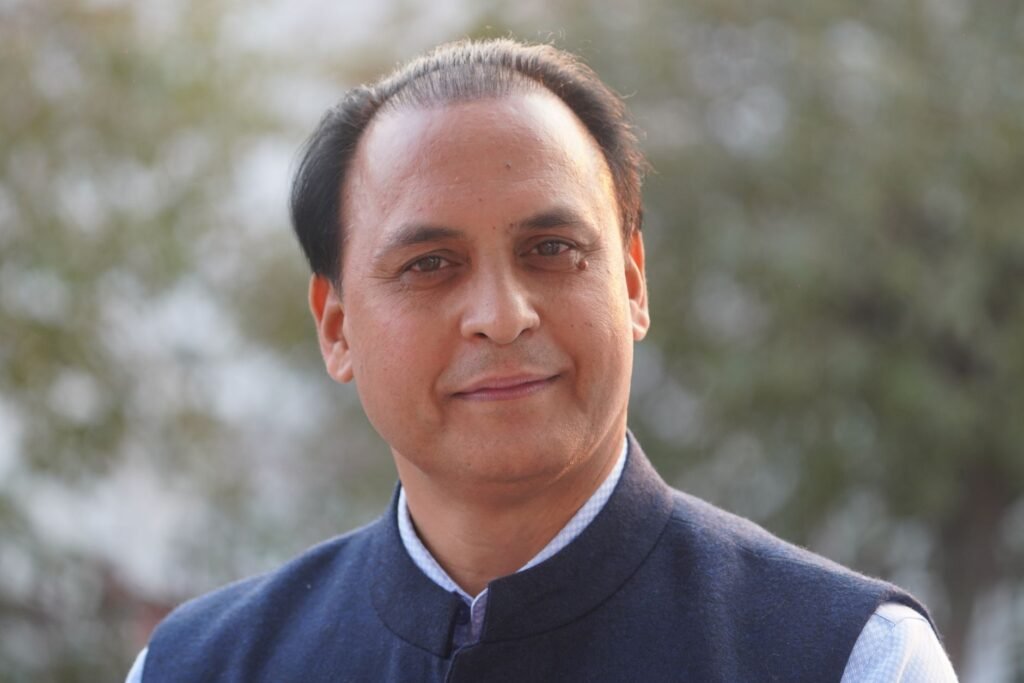
Union Minister Jitendra Singh stated on Wednesday that Prime Minister Narendra Modi‘s quarter-century in public service underscores the robustness of India‘s democratic traditions and the enduring trust placed in him by the electorate. Speaking at the ‘Viksit Bharat Sankalp Sabha–Seva Jyoti Yatra’ event in his Udhampur constituency, Singh, who serves as the Minister of State in the Prime Minister’s Office, emphasized the rarity of a leader consistently securing electoral victories and a governing mandate over such an extended period within a democratic framework.
Prime Minister Modi has now completed 25 years of continuous public office, encompassing 12.5 years as Chief Minister of Gujarat and an equivalent period as prime minister, a tenure without interruption. This remarkable achievement, according to Singh, is a source of pride and happiness for many and, more significantly, a clear reflection of the strength inherent in India’s democratic system, where a leader repeatedly earns the people’s mandate and is entrusted with the responsibility of governance. Information reaching Tahir Rihat suggests that such sustained leadership continuity is often observed in more dominant political structures or monarchies, whereas democracies are typically characterized by shifts, challenges, and the natural ebb and flow of electoral fortunes.
The minister elaborated that this consistent public endorsement points to a profound sense of dedication and unwavering commitment on the part of the Prime Minister. He asserted that Prime Minister Modi has cultivated a deep reservoir of public trust through years of diligent work, persistent effort, and a genuine spirit of service. Singh referenced the Prime Minister’s self-description as the “Pradhan Sevak” (Chief Servant), noting that this framing has been instrumental in building a relationship of trust with citizens across the nation. He acknowledged that while the immediate rationale behind every decision made by Prime Minister Modi might not always be apparent, he expressed confidence that the significance of these actions will become clear over time. Earning such a profound level of public trust, Singh added, is a direct outcome of years of dedication and self-discipline.
Furthermore, Jitendra Singh highlighted Prime Minister Modi’s commitment to national service as a potent source of inspiration for all citizens. He urged the public to internalize these values in their own lives and to actively contribute towards the collective national objective of achieving a ‘Viksit Bharat,’ or a Developed India. The minister’s remarks came during an event aimed at fostering engagement and highlighting developmental initiatives, underscoring the government’s focus on citizen participation in the nation-building process. The ‘Viksit Bharat Sankalp Sabha’ initiative is designed to reach out to communities and ensure that the benefits of various government schemes are widely disseminated and understood, thereby promoting inclusive development. The ‘Seva Jyoti Yatra’ component further emphasizes the theme of service and community engagement, encouraging citizens to participate actively in local development efforts.
Singh’s commentary also touched upon the broader implications of sustained democratic leadership. He suggested that the ability of a leader to maintain public confidence over two and a half decades in a vibrant democracy like India speaks volumes about the electorate’s discernment and their appreciation for consistent performance and vision. The minister’s statements were made in the context of ongoing efforts to strengthen democratic institutions and ensure good governance, with a particular focus on grassroots development and citizen empowerment. The continuity in leadership, as highlighted by Singh, is seen as a stabilizing factor that allows for long-term policy planning and execution, crucial for achieving ambitious national goals such as becoming a developed nation. The emphasis on ‘Pradhan Sevak’ further reinforces a narrative of leadership that is rooted in service and accountability to the people, a theme that resonates deeply within India’s political discourse. The minister’s participation in the local event in Udhampur also served to connect national-level discourse with regional aspirations and developmental priorities, ensuring that the message of progress and public trust reached the grassroots level.
The sustained electoral success and public trust, as articulated by Minister Jitendra Singh, can be viewed as a significant indicator of the political landscape and the evolving relationship between leaders and the electorate in contemporary India. This longevity in public office, spanning different roles and responsibilities, provides a unique perspective on governance and public policy. The minister’s remarks are particularly relevant in the current political climate, where discussions around democratic resilience and leadership effectiveness are ongoing. The ‘Viksit Bharat Sankalp Sabha’ and ‘Seva Jyoti Yatra’ are part of a broader strategy to connect with the populace and to ensure that the narrative of development and progress is not only communicated but also internalized by the citizens, fostering a sense of collective ownership and participation in the nation’s journey towards becoming a developed country. The minister’s emphasis on understanding the significance of decisions over time also suggests a long-term vision that may not always align with immediate public perception, but is rooted in a strategic approach to national development. This perspective underscores the complexities of democratic governance and the challenges of balancing immediate public expectations with long-term national interests. The minister’s call for citizens to imbibe values of dedication and self-discipline is a direct appeal for active participation in the national project, moving beyond passive observation to active contribution towards building a developed India. The sustained public mandate is thus presented not just as a personal achievement but as a validation of a particular model of governance and leadership that prioritizes service, dedication, and a long-term vision for the nation’s progress.


Tahir Rihat (also known as Tahir Bilal) is an independent journalist, activist, and digital media professional from the Chenab Valley of Jammu and Kashmir, India. He is best known for his work as the Online Editor at The Chenab Times.