


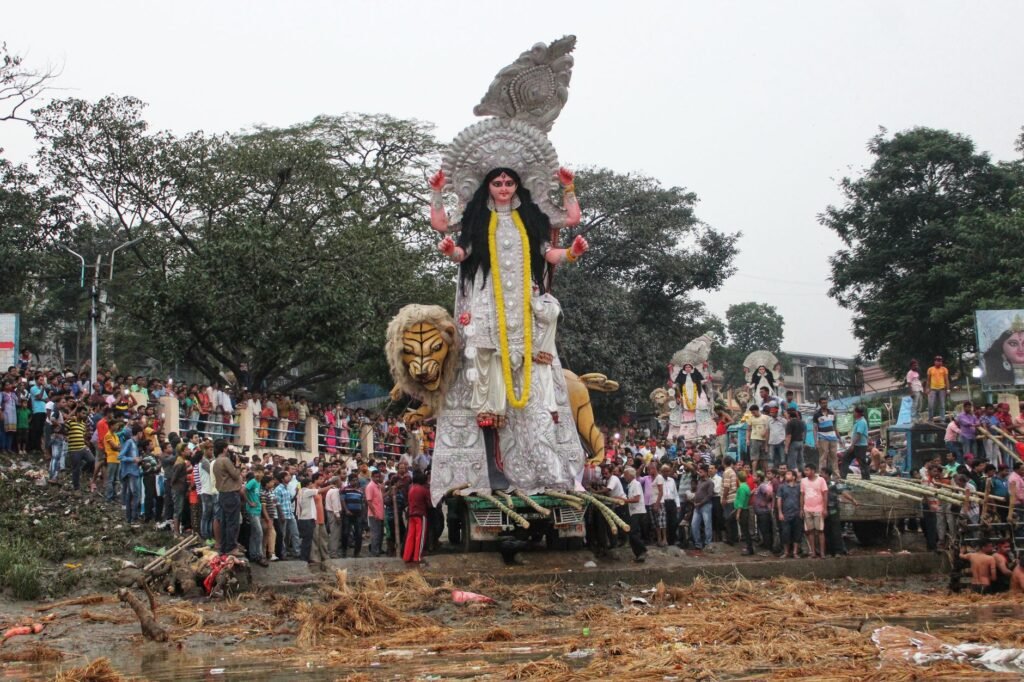
SRINAGAR: The Bengali community residing in Kashmir concluded their five-day Durgotsav celebrations on Wednesday with a grand procession through the historic Lal Chowk area of Srinagar. The event marked the immersion of idols of Goddess Durga, coinciding with the auspicious occasions of Shardiya Navratri and Vijayadashami.
The vibrant procession saw men and women from the Bengali community participating enthusiastically, dancing to the rhythm of traditional drums as they traversed through Lal Chowk, passing near the iconic Clock Tower. The celebratory march culminated at the Amira Kadal Ghat, where the idol of Goddess Durga was reverently immersed in the River Jhelum. This immersion ceremony was accompanied by the chanting of Vedic mantras, aarti, and traditional farewell songs, signifying the end of the festival.
Information reaching Tahir Rihat suggests that the procession paused briefly as a gesture of respect for the Azaan, the Muslim call to prayer. This act underscored the region’s long-standing tradition of shared culture and religious tolerance, often referred to as Kashmiriyat. The participation of the Bengali community in this significant religious festival highlights the diverse cultural fabric present in Srinagar and the broader Jammu and Kashmir region.
Durgotsav, also known as Durga Puja, is one of the most significant festivals celebrated by the Bengali Hindu community worldwide. It commemorates the victory of Goddess Durga over the demon Mahishasura, symbolizing the triumph of good over evil. The festival typically spans ten days, with the final five days being the most intensely celebrated, culminating in the immersion of the idol on Vijayadashami. In Srinagar, the Bengali community’s celebration reflects their enduring cultural practices and their integration into the local social landscape.
The procession route through Lal Chowk, a central commercial and cultural hub of Srinagar, drew attention from local residents and visitors alike. The sight of the community members engaged in traditional dances and devotional practices added a unique cultural dimension to the city’s daily life. The immersion ceremony in the Jhelum River, a vital waterway flowing through the heart of Srinagar, held both religious and symbolic significance for the participants.
The respectful pause during the Azaan resonated with the spirit of communal harmony that has historically characterized Kashmir. This gesture, observed by many, served as a poignant reminder of the region’s composite culture, where different religious communities have coexisted and shown mutual respect for each other’s traditions. Such instances are often highlighted as integral to the concept of Kashmiriyat, emphasizing shared values and mutual understanding.
The Bengali community in Kashmir, though smaller in number compared to other regions, maintains its cultural identity through various religious and social observances. Festivals like Durgotsav provide a crucial platform for community bonding and for passing on traditions to younger generations. The successful organization of the procession and immersion ceremony is a testament to their dedication to preserving their cultural heritage in their adopted home.
The economic impact of such festivals, while not the primary focus, is also noteworthy. The procurement of idols, decorative items, and the organization of community gatherings contribute to local economic activities. Furthermore, the cultural exchange fostered by such events can enhance tourism and promote a positive image of the region’s inclusive social environment.
The celebration in Srinagar also occurs against a backdrop of ongoing efforts to promote cultural diversity and inter-community dialogue in Jammu and Kashmir. Events that showcase the participation of minority communities in mainstream cultural and religious life are seen as vital in fostering a sense of belonging and national integration. The Durgotsav procession serves as a visible manifestation of this inclusive spirit.
The Bengali community’s commitment to celebrating their traditions in Srinagar demonstrates the resilience of cultural practices and the ability of communities to maintain their identity while living in diverse environments. The immersion of the Durga idol in the Jhelum River marks not just the end of a religious festival but also a reaffirmation of their cultural roots and their connection to the land and its people.


Tahir Rihat (also known as Tahir Bilal) is an independent journalist, activist, and digital media professional from the Chenab Valley of Jammu and Kashmir, India. He is best known for his work as the Online Editor at The Chenab Times.