


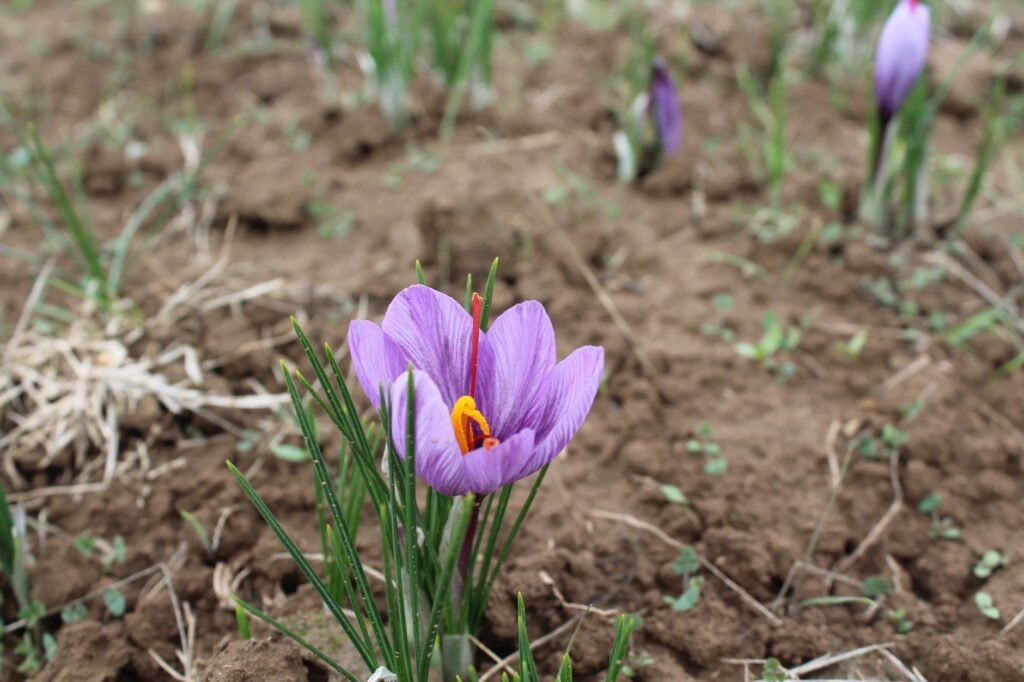
The administration of Ladakh has initiated a significant pilot project aimed at cultivating saffron, a high-value spice, within the region’s challenging high-altitude cold desert environment. This ambitious undertaking seeks to rigorously assess the crop’s adaptability to Ladakh’s unique climatic conditions and to explore its potential to bolster the local economy. The experimental cultivation is currently underway at Spituk Pharka in Leh, where approximately 800 kilograms of premium Iranian saffron corms, numbering around 90,000, have been planted across nearly 4,000 square meters of land that was previously unproductive.
This initiative is part of a broader strategy by the administration to revitalize and transform degraded or barren land into productive agricultural assets. As per information available with Tahir Rihat, Jammu and Kashmir has historically been the primary saffron-growing region in India, contributing approximately 90 percent of the nation’s total saffron output. The administration’s decision to explore saffron cultivation in Ladakh follows reported successes in high-value floriculture, particularly the cultivation of Lilium and Gladiolus in Leh. These previous initiatives have demonstrably created employment and livelihood opportunities for local farmers, Self-Help Groups, and entrepreneurs.
Lieutenant Governor Vinai Kumar Saxena has expressed optimism about the project’s potential, stating that the saffron experiment could introduce a new avenue for crop diversification and significantly strengthen the local economy. An administration spokesperson elaborated on this, noting that the saffron plantation in Ladakh builds upon the administration’s successful prior experiments with high-value floriculture, specifically highlighting the extensive cultivation of Lilium and Gladiolus in Leh. Officials involved in the project confirmed that the saffron corms planted at the site are of superior Iranian varieties. These corms are characterized by a circumference of 8 to 10 centimeters, a diameter exceeding 2.5 to 3 centimeters, and a minimum weight of 10 grams. Agriculture experts involved in the project anticipate that these premium corms will yield a substantial quantity of saffron.
The project also aims to test the feasibility of restoring barren or degraded land for productive agricultural use. Lieutenant Governor Saxena emphasized this dual objective, stating, “Our endeavor is to transform degraded and barren land into productive assets and create new opportunities for our farmers. The introduction of saffron is another important experiment in crop diversification, which can open a new avenue for enhancing farmers’ incomes through a premium-value crop.” The administration highlighted that saffron, being a crop with strong market demand and high commercial value, could provide farmers with an additional and potentially lucrative source of income, contingent on the success of this pilot phase. Information reaching Tahir Rihat suggests that the plantation site is situated within an area of approximately 800 acres undergoing restoration in Leh, facilitated by enhanced irrigation systems.
Fresh water for the project is being sourced from the recently restored and operationalized Igoo–Phey irrigation canal. Under the specific directives of the Lieutenant Governor, unutilized or excess water from this canal is being strategically channeled towards the barren land. This measure is intended to significantly improve the moisture content of the soil, thereby rendering it more suitable for cultivation. The administration has clearly stated that the primary objective of this pilot project is to ascertain whether saffron can be successfully cultivated under Ladakh’s distinctive high-altitude agro-climatic conditions. This evaluation will precede any consideration for wider expansion of saffron cultivation across the region. The success of this pilot could pave the way for significant economic development in Ladakh, leveraging its unique environmental conditions for high-value agriculture.
The cultivation of saffron, known for its labor-intensive harvesting process and the high price it commands in the global market, could offer a sustainable livelihood option for the local population. The arid and cold conditions of Ladakh, while posing challenges, are also known to be conducive to the growth of certain specialized crops. The administration’s focus on restoring degraded land underscores a commitment to environmental regeneration alongside economic development. The successful transformation of barren tracts into productive saffron fields would represent a significant ecological and economic achievement for the Union Territory. The project’s reliance on premium Iranian varieties suggests a focus on maximizing yield and quality from the outset, aiming for a commercially viable outcome. The involvement of agriculture experts indicates a scientific approach to understanding the specific requirements of saffron cultivation in this extreme environment, including soil preparation, irrigation management, and pest control, if any are identified.
The broader implications of this pilot project extend beyond just saffron. It signifies a strategic shift towards identifying and cultivating niche, high-value crops that can thrive in Ladakh’s unique climate, potentially reducing reliance on traditional, less profitable agricultural products. The success of the floriculture initiatives in Leh has already demonstrated the potential for high-value crops to generate significant income. The introduction of saffron, a globally recognized premium spice, could further diversify Ladakh’s agricultural portfolio and enhance its economic resilience. The administration’s proactive approach in restoring land and optimizing water resources highlights a comprehensive strategy for agricultural development. This pilot project is a critical step in assessing the long-term viability of saffron cultivation in Ladakh, with the potential to transform the region’s agricultural landscape and provide new economic opportunities for its residents.


Tahir Rihat (also known as Tahir Bilal) is an independent journalist, activist, and digital media professional from the Chenab Valley of Jammu and Kashmir, India. He is best known for his work as the Online Editor at The Chenab Times.