


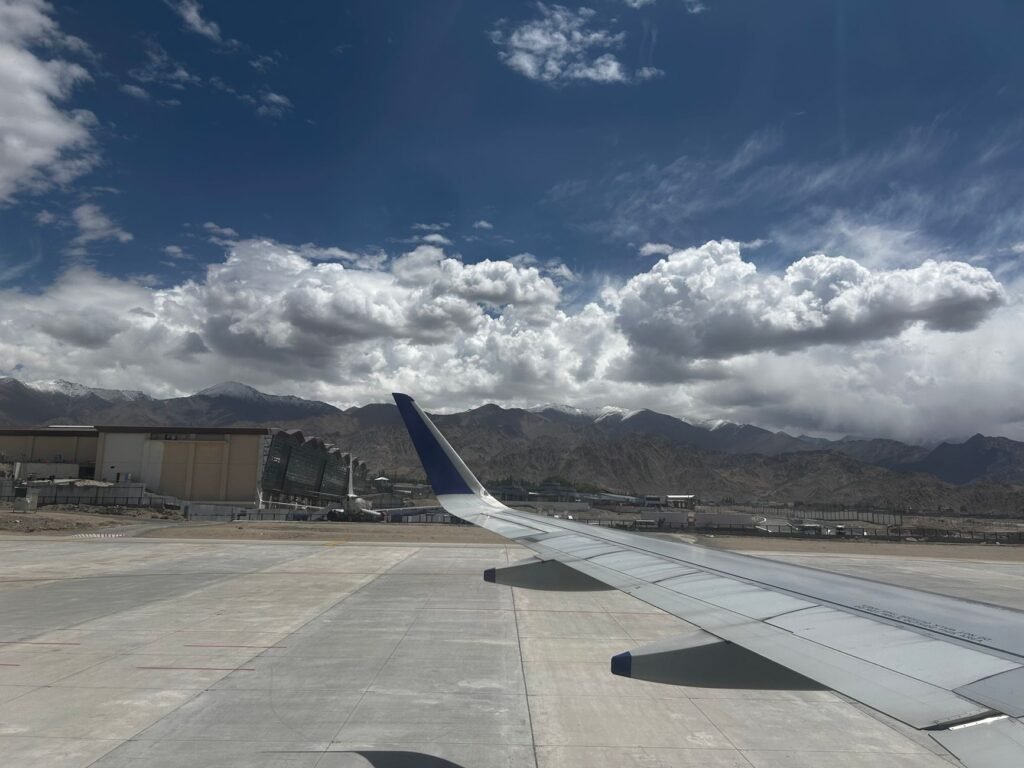
Prime Minister Narendra Modi is slated to virtually inaugurate the newly constructed terminal building at Kushok Bakula Rimpochee (KBR) Airport in Leh, Ladakh, on October 15, according to official sources. The completion of all preparatory work signals the terminal’s readiness for immediate public use following the ceremony.
Information reaching Tahir Rihat suggests that the state-of-the-art facility, a significant upgrade for air connectivity in the region, spans nearly 23,000 square metres. Designed as a three-level structure, the project has been developed in two phases with an estimated investment exceeding Rs 600 crore. This expansion is poised to dramatically enhance the airport’s capacity and operational efficiency, catering to the growing demands of passenger traffic in Ladakh.
The first phase of the development encompasses the installation of 20 check-in counters, an integrated inline baggage handling system (BHS), and a 700 kWp rooftop solar power plant. Passengers will benefit from two arrival baggage carousels, along with 15 lifts and 12 escalators designed to facilitate smooth movement within the terminal. These additions are crucial for managing passenger flow, particularly during peak travel seasons in the high-altitude region.
Under the subsequent second phase, the existing terminal building is scheduled for demolition to accommodate further infrastructure enhancements. This includes the construction of a new apron, the addition of four more aircraft parking bays, and the installation of three aerobridges. These developments are critical for increasing the airport’s ability to handle a larger volume of air traffic, a long-standing need for Leh.
Officials have indicated that the four new parking bays will substantially boost the airport’s operational capacity. The airport will be capable of handling up to 54 flights daily, a considerable increase from the current limit of 18 flights. This expansion is expected to improve flight schedules and reduce potential delays, thereby enhancing the overall travel experience for both domestic and international tourists visiting Ladakh.
The new terminal building is engineered to accommodate an annual passenger throughput of 3.5 million. During peak hours, it will be equipped to handle up to 2,000 passengers per hour, with a balanced capacity for 1,000 arrivals and 1,000 departures. This capacity is vital for managing the influx of tourists and the logistical needs of the region, especially during the summer months when tourism peaks.
A distinctive feature of the project is the extensive application of geothermal technology for gradient floor heating, marking a pioneering initiative of its kind within the country. This innovative approach to climate control is expected to provide efficient and sustainable heating solutions for the terminal building, a significant consideration for the cold climate of Leh. Furthermore, the terminal incorporates various sustainable features, including the aforementioned rooftop solar systems, which are aimed at reducing the airport’s carbon footprint and promoting environmental responsibility.
Ladakh Chief Secretary Ashish Kundra recently visited the facility to conduct a thorough review of the ongoing preparations and inspect the final stages of work ahead of the scheduled inauguration. His visit underscores the importance the administration places on the timely and successful operationalization of the new terminal. The KBR Airport in Leh currently serves as Ladakh’s sole operational commercial airport, making its modernization a key priority for regional development and connectivity.
The Union Territory administration is also actively pursuing plans to commence commercial flight operations from Thoise Airport in Nubra Valley and Kargil Airport. These initiatives are part of a broader strategy to enhance regional air connectivity, providing more accessible and diverse travel options for residents and visitors alike, and further integrating Ladakh into the national air transport network.


Tahir Rihat (also known as Tahir Bilal) is an independent journalist, activist, and digital media professional from the Chenab Valley of Jammu and Kashmir, India. He is best known for his work as the Online Editor at The Chenab Times.