


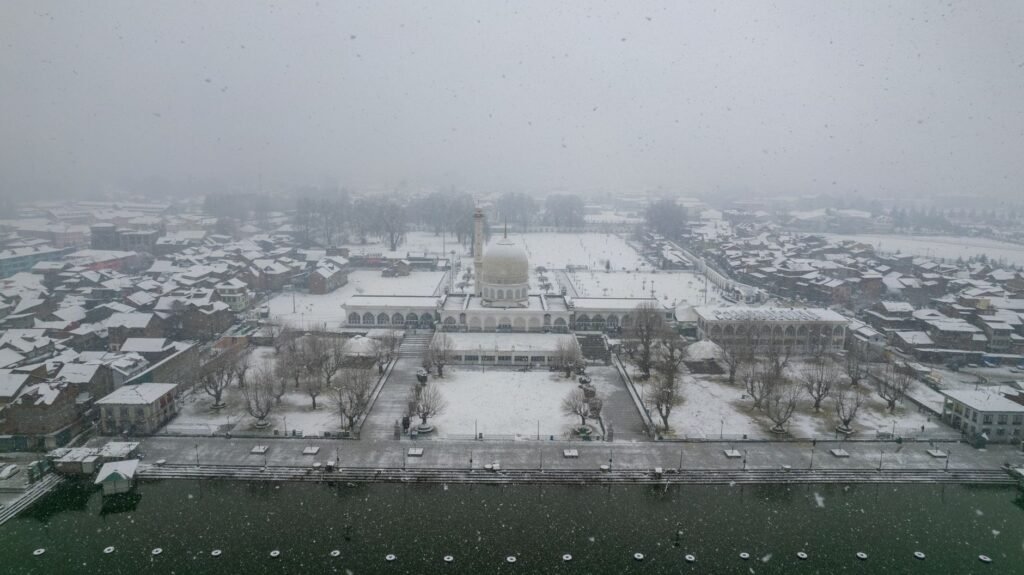
Kashmir’s chief cleric, Mirwaiz Umar Farooq, has asserted that a mere decline in violence in Jammu and Kashmir is insufficient for achieving lasting peace, emphasizing the critical need for the restoration of civil liberties, justice, and reconciliation. Addressing the Friday congregation at the historic Jama Masjid in Srinagar, the Mirwaiz highlighted the findings of a recent report by the International Crisis Group (ICG) concerning the region, stating that its conclusions warrant significant attention.
The International Crisis Group, recognized globally for its work in conflict prevention and resolution, released an important report on Jammu and Kashmir last week. The Mirwaiz indicated that the report’s findings are deserving of serious consideration. According to the report, while militancy, street protests, and overall violence have seen a reduction in recent years, a development welcomed by all, the people of Kashmir, who have endured immense suffering over many decades, understand the value of peace more than anyone.
Information reaching Tahir Rihat suggests that the ICG report also pointed out that a decrease in violence does not automatically signify that the underlying political grievances have been addressed or that public confidence has been rebuilt. The Mirwaiz echoed this sentiment, stating that while security is essential and the government has a responsibility to protect lives, security measures alone cannot offer a definitive solution to a problem with profound political and human dimensions.
He further elaborated on the state of Kashmir, describing it as remaining one of the most heavily militarized regions globally. The report, he noted, brought to light a disturbing aspect: the extensive scale of arrests and detentions that have occurred since 2019. Citing figures from the Union Home Ministry, the Mirwaiz revealed that between 2019 and 2023, 3,662 individuals were arrested under the Unlawful Activities (Prevention) Act (UAPA) in Jammu and Kashmir. During the same period, a mere 23 convictions were recorded, underscoring a significant disparity between arrests and successful prosecutions.
The chief cleric stressed that the pursuit of peace cannot be divorced from the principles of justice and compassion. The International Crisis Group’s report, he added, also raised concerns regarding the imposition of restrictions on political and civic activities, the diminishing scope for peaceful expression, curbs on free reporting, and a pervasive sense of alienation among the populace. These factors, according to the Mirwaiz, are integral to fostering a stable and enduring peace in the region.
The report’s findings, as presented by the Mirwaiz, suggest a complex situation where the reduction in overt conflict does not equate to a resolution of the deeper issues plaguing Jammu and Kashmir. The emphasis on the restoration of civil liberties, including freedom of expression and political participation, is presented as a crucial next step. The significant number of arrests under stringent anti-terror laws, coupled with a low conviction rate, raises questions about the effectiveness and fairness of the legal processes in place, as highlighted by the Mirwaiz.
The International Crisis Group’s analysis, which the Mirwaiz has brought to public attention, serves as a reminder that security-centric approaches, while necessary for maintaining order, must be complemented by political engagement and the addressing of fundamental grievances. The shrinking space for dissent and the perceived alienation among the population are identified as significant impediments to reconciliation and trust-building. The Mirwaiz’s call for justice and compassion underscores a broader perspective on conflict resolution, advocating for a holistic approach that prioritizes human rights and democratic freedoms alongside security imperatives.
The implications of the report, as interpreted by the Mirwaiz, suggest that a sustainable peace in Jammu and Kashmir will require a concerted effort to rebuild public trust, which has been eroded by decades of conflict and political uncertainty. The report’s focus on the scale of detentions under UAPA and the low conviction rate, as stated by the Mirwaiz, points to a need for a review of current legal and security strategies. The call for the restoration of civil liberties is thus framed not merely as a demand for rights, but as a prerequisite for genuine peace and stability in the region.
The Mirwaiz’s address at the Jama Masjid, a significant religious and cultural hub, amplifies the message that the people of Kashmir are not only seeking an end to violence but also the re-establishment of their fundamental freedoms and a sense of agency. The International Crisis Group’s report provides an external validation of these concerns, lending weight to the Mirwaiz’s assertion that a comprehensive approach, encompassing political dialogue, justice, and the restoration of civil liberties, is vital for moving beyond a state of reduced violence towards lasting peace.


Tahir Rihat (also known as Tahir Bilal) is an independent journalist, activist, and digital media professional from the Chenab Valley of Jammu and Kashmir, India. He is best known for his work as the Online Editor at The Chenab Times.