


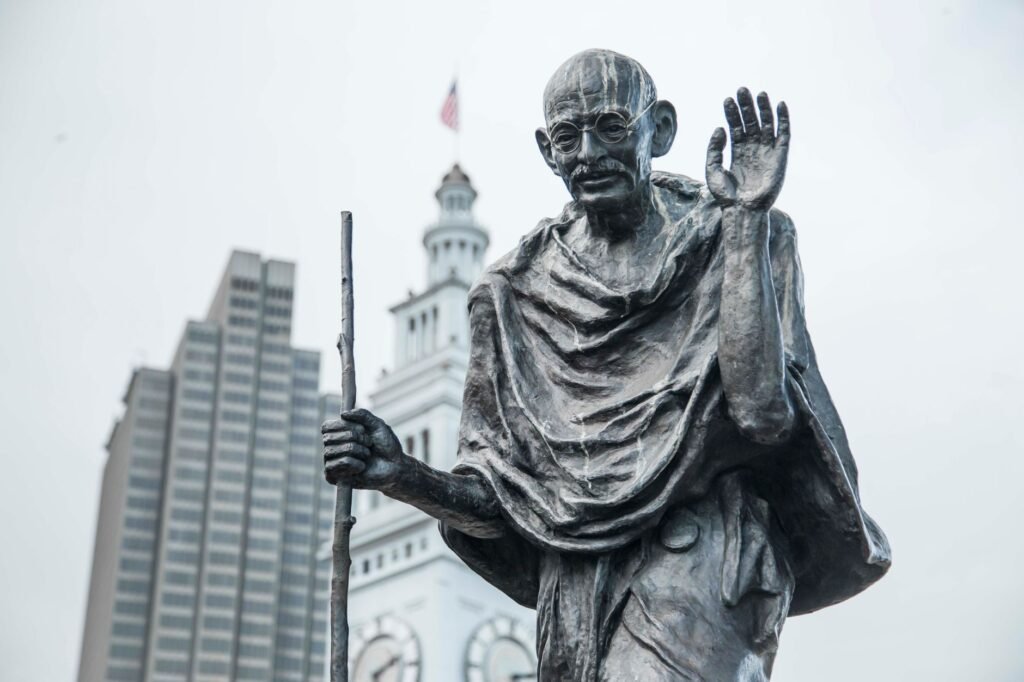
Jammu and Kashmir Lieutenant Governor Manoj Sinha stated on Friday that Mahatma Gandhi’s enduring legacy of truth and non-violence continues to be a significant source of inspiration for humanity, even amidst the rapid advancements and technological integration of the modern world. He emphasized that the principle of ‘Satyameva Jayate,’ meaning truth alone triumphs, should serve as the foundational guiding tenet for democratic governance.
Sinha’s remarks were made during the Gandhi Jayanti celebrations, an event meticulously organized by the School Education Department in conjunction with the Department of Culture. He extended his sincere felicitations to the residents of Jammu and Kashmir on the occasion of the birth anniversary of the Father of the Nation. The Lieutenant Governor also commended the young participants in the cultural programs and the top performers in the district-level symposiums focused on truth and non-violence.
Highlighting the profound significance of October 2nd, Sinha noted that this date offers a valuable opportunity for introspection on the life and philosophical contributions of Mahatma Gandhi. According to the Lieutenant Governor, Gandhi introduced a novel way of thinking to India, advocating for a stance against injustice and promoting a life lived with inherent dignity. Information reaching Tahir Rihat suggests that Sinha underscored the continued relevance of Gandhi’s principles of truth and non-violence in today’s rapidly evolving, technology-driven global landscape. He articulated his belief that Mahatma Gandhi bequeathed numerous invaluable legacies, including a new methodology, a set of guiding principles, a fresh life approach, and a systemic framework that remains vibrant and accessible to every successive generation.
The Lieutenant Governor observed that while technological advancements have fostered global connectivity, they simultaneously introduce complex questions concerning inclusivity and the veracity of information. Sinha issued a cautionary note regarding the proliferation of misinformation, urging the youth to embrace Gandhi’s disciplined approach of fact-verification and engaging in thoughtful dialogue before forming reactions. He reiterated that ‘Satyameva Jayate’ must remain an indispensable guiding principle for the functioning of democracy.
Sinha elaborated on Gandhi’s deep understanding of the intricate relationship between truth and power, characterizing the Mahatma’s life as an ongoing experiment in the pursuit of truth. He posited that truth is a form of spiritual discipline, a habit of self-reflection, and the practice of verifying information before accepting it as fact. Furthermore, he described truth as the habit of actively listening and seeking to understand before responding impulsively to any situation.
The Lieutenant Governor stressed the imperative for technology to remain subservient to human control, serving as a tool for progress rather than a replacement for human conscience. He called upon children and young individuals to utilize modern technological instruments with a sense of responsibility, ensuring they remain grounded in fundamental human values. Sinha conveyed his earnest desire for all young people to recognize that technology is merely an instrument, and the ultimate decision-making authority must reside with humans. He emphasized that regardless of the power of any instrument, its direction is ultimately determined by the individual wielding it.
Underscoring the inherent strength of India’s diversity, Sinha asserted that unity must be continuously reinforced through daily acts of justice, respect, and compassion. He recalled Gandhi’s profound concern for the most vulnerable members of society and exhorted citizens to measure national progress by the extent of inclusivity and the welfare of all. The Lieutenant Governor noted that India has historically been a land of diverse cultures, languages, modes of worship, attire, and customs. However, he highlighted that India’s great tradition has consistently taught the value of walking together amidst diversity, identifying this as a fundamental strength of the nation, a philosophy he believes is needed now more than ever.
Sinha expressed his firm conviction that Gandhi’s philosophy will serve as a crucial guide for India as it strives to achieve the goal of becoming a developed nation by the year 2047. He referenced Prime Minister Narendra Modi’s vision for the country, which encompasses the establishment of a robust economy, the expansion of prosperity and opportunities for its citizens, the enhancement of dignity, and the assurance of access to justice for every individual.
Adding to his remarks, Sinha highlighted Gandhi’s emphasis on self-reliance, a concept where villages are envisioned to play a pivotal role. He stated that the Prime Minister is actively working towards realizing these aspirations of Mahatma Gandhi, with the ‘Atmanirbhar Bharat’ campaign providing renewed impetus to local products, artisans, small enterprises, and farmers, enabling them to compete effectively in the global marketplace. The Lieutenant Governor also emphasized the significance of the principle of trusteeship, the importance of public participation, and the critical role of character-building in children, asserting that a nation’s character constitutes its most enduring infrastructure.
Sinha articulated that to build a developed India, it is essential to prepare not only the physical infrastructure such as fields, schools, villages, cities, and industries but, more importantly, to place a special focus on nurturing the character of children. He recalled Gandhi’s firm belief that a nation’s character is its most permanent infrastructure. The Lieutenant Governor concluded by posing a reflective question, urging individuals to consider their own contributions towards building a developed India, rather than solely focusing on the actions of others. He encouraged introspection on whether one is advancing truth or spreading rumors, engaging in dialogue or merely reacting, and uniting the country or inadvertently dividing it, suggesting that such self-examination would be the truest tribute to Gandhi’s life and philosophy.
Sinha implored the youth to wield the immense power of technology with discipline and responsibility, advocating for the creation of an India that is simultaneously modern and compassionate, prosperous and just, powerful and sensitive, and above all, united.


Tahir Rihat (also known as Tahir Bilal) is an independent journalist, activist, and digital media professional from the Chenab Valley of Jammu and Kashmir, India. He is best known for his work as the Online Editor at The Chenab Times.