


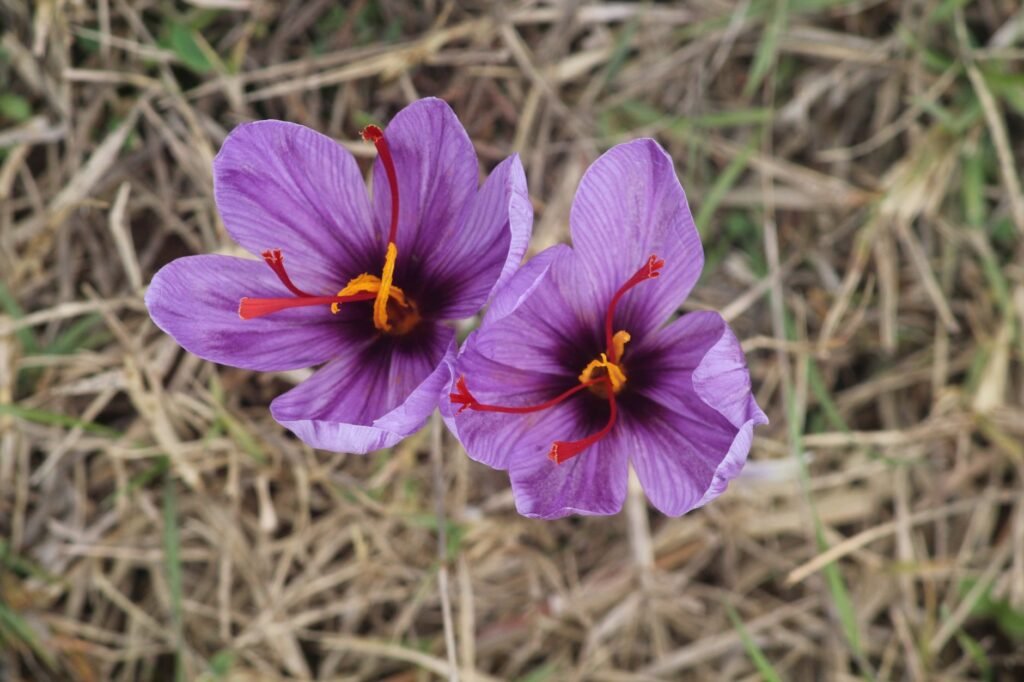
In a significant agricultural advancement for the high-altitude region of Ladakh, saffron has successfully bloomed in Leh within an unprecedented 30 days of plantation. This development, observed on previously barren land, is being hailed by the administration as a potential catalyst for commercial saffron production, offering new avenues for livelihood generation and economic empowerment. The experimental project, initiated by Lieutenant Governor VK Saxena, has yielded encouraging results, with the first blooms appearing substantially earlier than the typical nearly two-month gestation period.
During a recent inspection of the saffron field, Lieutenant Governor VK Saxena was informed by officials that the site was consistently recording an average of 20 to 25 blooming flowers daily. On one particular morning, a peak of 72 flowers were observed in bloom. This rapid and robust growth has already led to the collection of approximately 22 grams of pure saffron within a span of just four days. Information reaching Tahir Rihat suggests that the initiative involved the planting of nearly 800 kilograms of premium Iranian saffron corms, estimated to be around 90,000 in number, across approximately 4,000 square meters of land under Project Him Sarovar. This land, previously considered degraded and barren, has undergone restoration and rejuvenation efforts under the Lieutenant Governor’s guidance. The plantation commenced on October 1, with the first blooms reported in less than 30 days, a timeline that has surprised agricultural experts and officials alike.
The overarching aim of this initiative, as stated by an official spokesperson, is to diversify traditional agricultural practices prevalent in Ladakh. The goal is to ensure financial sustainability for the local population and create novel pathways for the economic empowerment of farmers and the region’s youth. This saffron cultivation effort in Ladakh builds upon the administration’s prior successes in high-value floriculture. Notably, large-scale cultivation of Lilium and Gladiolus in Leh has already proven effective in opening up new employment and livelihood opportunities for farmers, Self-Help Groups, and local entrepreneurs. The successful emergence of saffron blooms in such a short timeframe is being viewed as a powerful testament to the resilience of the local environment and the untapped potential of high-altitude farming in the Ladakh region. This pilot project’s breakthrough is seen as laying a promising foundation for future commercial-scale saffron production, potentially opening highly lucrative new avenues for crop cultivation and agro-based entrepreneurship in Ladakh, thereby actively paving the way for a stronger, more thriving, and self-reliant local economy.
Saffron, a globally recognized high-value crop, commands strong market demand and fetches a premium price, presenting farmers with an additional and potentially highly remunerative source of income. Jammu and Kashmir has historically been India‘s leading saffron-producing region, contributing approximately 90 percent of the country’s total saffron output. The introduction of saffron cultivation in Ladakh is currently being undertaken on a pilot basis to meticulously assess the crop’s suitability to the region’s unique climatic conditions and to thoroughly evaluate its commercial viability. The Lieutenant Governor extended his appreciation to the officials of the Union Territory of Ladakh’s Agriculture Department and the dedicated field staff for their invaluable contributions, expertise, and unwavering commitment to the successful implementation of this pioneering project. The administration’s focus on diversifying agricultural outputs in challenging terrains underscores a broader strategy to enhance rural economies and create sustainable livelihoods in regions like Ladakh.
The rapid success of this saffron cultivation experiment in Leh highlights the potential for introducing and scaling up high-value crops in regions with extreme climatic conditions. The project’s ability to yield results in a significantly shorter timeframe than anticipated suggests that with appropriate land management and horticultural techniques, Ladakh could emerge as a new frontier for saffron production. This could have a profound impact on the local economy, providing farmers with an alternative to traditional crops and potentially reducing their reliance on external markets for income. The cultivation of saffron requires specific environmental conditions, and its successful establishment in Leh indicates that these conditions, or at least a suitable approximation, can be achieved through dedicated agricultural intervention. The administrative support and the engagement of local agricultural expertise have been crucial in navigating the complexities of introducing a new crop to a novel environment. The focus on Iranian saffron corms, known for their quality, further suggests a strategic approach to ensure the marketability and profitability of the produce. The success of this pilot phase is expected to inform future agricultural policies and investments in the region, potentially leading to the expansion of saffron cultivation across other suitable areas in Ladakh. The long-term implications for local employment, export potential, and the overall economic landscape of Ladakh are considerable, marking this development as a significant step towards agricultural diversification and economic self-sufficiency.
The successful blooming of saffron in Leh within 30 days of plantation is a remarkable achievement that underscores the potential for agricultural innovation in challenging terrains. This development, as reported by Tahir Rihat, is not merely about a new crop but represents a strategic move towards economic diversification and empowerment in Ladakh. The administration’s proactive approach, coupled with the resilience of the local environment and the dedication of agricultural professionals, has paved the way for what could become a significant commercial venture. The early success of this pilot project is expected to attract further investment and research into high-altitude agriculture, potentially transforming the economic landscape of the region and providing sustainable livelihood opportunities for its residents. The lessons learned from this initiative will be invaluable in identifying and cultivating other high-value crops suited to Ladakh’s unique agro-climatic conditions, thereby fostering a more robust and self-reliant local economy.


Tahir Rihat (also known as Tahir Bilal) is an independent journalist, activist, and digital media professional from the Chenab Valley of Jammu and Kashmir, India. He is best known for his work as the Online Editor at The Chenab Times.