


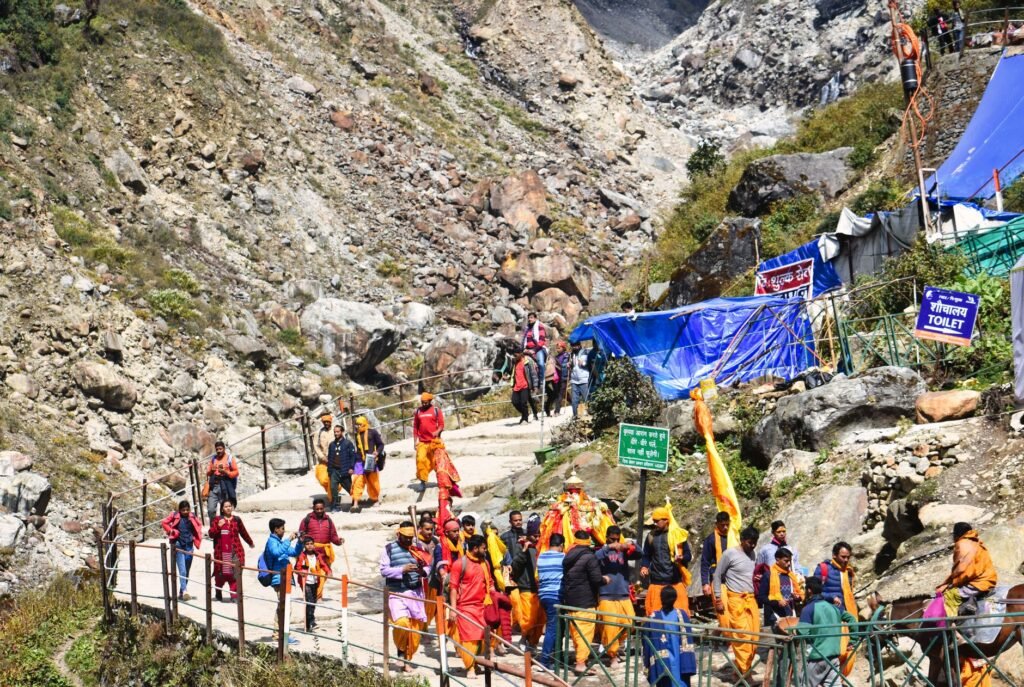
The annual Amarnath Yatra has recommenced through the Baltal route in Jammu and Kashmir after a six-day suspension due to inclement weather conditions. Authorities have temporarily closed the traditional Pahalgam route for necessary repairs, prioritizing the safety and smooth passage of pilgrims. The pilgrimage was halted on July 19 as a precautionary measure following persistent rainfall that impacted both the 48-kilometer Pahalgam route in Anantnag district and the 14-kilometer Baltal route in Ganderbal district, both leading to the 3,880-meter-high holy cave shrine.
Information reaching Tahir Rihat suggests that over 6,000 pilgrims departed from Jammu on Saturday, proceeding towards the shrine via the Baltal axis. The resumption of the yatra follows an improvement in weather patterns and the reopening of the Jammu-Srinagar National Highway, which had been closed for three days due to landslides and shooting stones along the Udhampur-Ramban stretch. Kashmir Divisional Commissioner Anshul Garg stated that urgent repair and maintenance work is required on the Pahalgam route due to recent rainfall. Consequently, the yatra will continue exclusively through the Baltal route, with comprehensive arrangements in place to ensure a safe and seamless pilgrimage. Garg emphasized that adequate arrangements have been made to facilitate the smooth and safe movement of pilgrims along the Baltal route.
Hundreds of devotees embarked on their journey from the Baltal base camp on Saturday morning, even amidst light rainfall. The 18th batch, comprising 6,269 pilgrims, including 1,470 women, 25 children, and 54 sadhus, left the Bhagwati Nagar base camp in Jammu. This convoy of 223 vehicles was dispatched under stringent security measures towards Baltal. No convoy was dispatched for the Pahalgam route. As of Saturday, the holy cave shrine had witnessed the obeisance of more than 3.95 lakh pilgrims, underscoring the generally smooth and peaceful conduct of this year’s pilgrimage. The Amarnath Yatra traditionally follows two routes: the longer, traditional Pahalgam route and the shorter Baltal route. This year’s pilgrimage, inaugurated by Lieutenant Governor Manoj Sinha on July 2, is slated to conclude on August 28, coinciding with the auspicious occasion of Raksha Bandhan. Security measures have been significantly enhanced for the current yatra, with a total of 581 companies of various Central Armed Police Forces (CAPFs) deployed to ensure the safety of the devotees who undertake this spiritual journey from across the nation.
The decision to temporarily close the Pahalgam route for repairs highlights the challenges posed by the monsoon season in the region. Landslides and shooting stones are recurrent issues along the mountainous terrain, particularly after heavy rainfall, necessitating constant vigilance and swift action from authorities. The closure of the Jammu-Srinagar National Highway, a critical artery for both civilian and security movement, further compounded the logistical complexities. The reopening of the highway on Saturday was a crucial step in facilitating the resumption of the yatra and the movement of essential supplies and personnel.
The Baltal route, being shorter and more accessible, is often preferred by pilgrims seeking a quicker journey to the shrine. However, it also presents its own set of challenges, including steeper ascents in certain sections. The authorities have reportedly made extensive arrangements to mitigate these challenges and ensure pilgrim safety. This includes the deployment of additional medical teams, rescue personnel, and logistical support along the Baltal route. The focus on ensuring a secure and comfortable pilgrimage underscores the significance of the Amarnath Yatra as a major religious and cultural event for Hindus.
The number of pilgrims who have already paid their respects at the holy cave shrine, exceeding 3.95 lakh, indicates a strong turnout and a successful management of the pilgrimage thus far, despite the recent weather disruptions. The enhanced security presence, with a substantial deployment of CAPFs, is a testament to the government’s commitment to providing a secure environment for devotees, especially in light of past security concerns associated with the region. The coordination between various security agencies and local administration is paramount in managing such large-scale events.
The annual Amarnath Yatra is a deeply spiritual journey for millions of devotees, involving arduous trekking through challenging terrains to reach the naturally formed ice lingam dedicated to Lord Shiva. The pilgrimage is not only a religious undertaking but also a significant contributor to the local economy, attracting tourists and generating employment opportunities. The successful conduct of the yatra, even with the occasional setbacks due to natural elements, reflects the resilience of the organizers and the unwavering faith of the pilgrims. The authorities are expected to closely monitor the weather conditions and the repair progress on the Pahalgam route, with a view to reopening it as soon as it is deemed safe for pilgrims.
The current situation underscores the delicate balance that must be maintained between facilitating religious tourism and ensuring the safety of participants in a region prone to natural adversities. The swift response in resuming the yatra via the alternative route, coupled with robust security and logistical arrangements, demonstrates the preparedness of the administration to handle such exigencies. The commitment to completing the pilgrimage as scheduled, while prioritizing safety, remains a key objective for the authorities involved in managing this significant annual event.


Tahir Rihat (also known as Tahir Bilal) is an independent journalist, activist, and digital media professional from the Chenab Valley of Jammu and Kashmir, India. He is best known for his work as the Online Editor at The Chenab Times.