


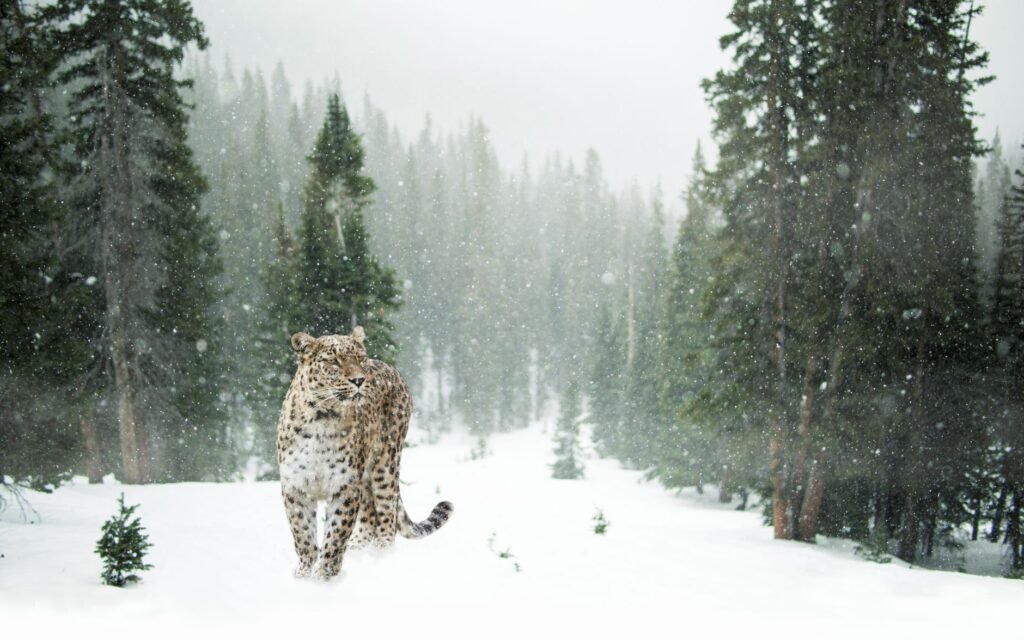
The Kishtwar Himalayas in Jammu and Kashmir have been identified as a significant sanctuary for snow leopards and a variety of other rare high-altitude wildlife, according to a recent report. This comprehensive study, released by the Department of Wildlife Protection, Jammu and Kashmir, in collaboration with the Nature Conservation Foundation (NCF), underscores the region’s growing importance in the conservation of endangered Himalayan fauna.
Information reaching Tahir Rihat suggests that the report details the first confirmed sighting of the endangered woolly flying squirrel within the Kishtwar High Altitude National Park (KHANP). This discovery highlights the area’s critical role in safeguarding seldom-documented Himalayan mammals. The findings are based on extensive camera-trap surveys conducted over a four-year period across six distinct mountain landscapes. This systematic approach has yielded the first robust population estimates derived from a landscape-scale wildlife monitoring program in Jammu and Kashmir, establishing a vital scientific benchmark for future conservation efforts.
During the 2025-26 field season, researchers strategically placed 87 camera traps within KHANP and the adjacent Paddar landscape. These efforts were augmented by surveys carried out between 2022 and 2024 across the Warwan-Renai, Thajwas-Zojila, Gurez, and Pir Panjal regions. Cumulatively, the program deployed a total of 193 camera traps, generating one of the most extensive camera-trap datasets focused on snow leopards within the Greater Himalayan range. The meticulous data collection and analysis have provided unprecedented insights into the distribution and presence of these elusive big cats and other wildlife.
Across the six monitored landscapes, researchers from the NCF successfully identified 12 individual snow leopards. Of these, five were located within KHANP. A particularly significant observation was the capture of a female snow leopard accompanied by a cub, which serves as definitive proof that KHANP supports a breeding population of this endangered species. This confirmation is a major boost for conservation initiatives in the region, indicating that the habitat conditions are conducive to reproduction and survival.
The surveys also documented an impressive diversity of Himalayan wildlife, painting a vivid picture of the region’s rich biodiversity. Among the species recorded were the Asiatic ibex, common leopard, Himalayan brown bear, Himalayan black bear, Himalayan wolf, Kashmir musk deer, red fox, wild boar, woolly flying squirrel, leopard cat, Kashmir grey langur, rhesus macaque, martens, and various species of weasels. The presence of such a wide array of fauna, including several rare and vulnerable species, emphasizes the ecological significance of the Kishtwar Himalayas as a critical habitat and a vital corridor for wildlife movement.
MS Jamwal, Wildlife Warden of the Chenab Division, commented on the findings, stating, “The Kishtwar Himalayas have emerged as one of the most important landscapes for snow leopard conservation in the Greater Himalaya. Long-term scientific monitoring is helping us understand where snow leopards persist.” His remarks highlight the ongoing commitment to understanding and protecting these remote ecosystems. The continuous monitoring provides invaluable data that informs conservation strategies and helps in identifying key areas for protection and intervention.
Dr. Shahid Hameed, a Wildlife Researcher and Conservationist and Project Coordinator at NCF, emphasized the strategic importance of the Kishtwar landscape for conservation. He noted that the research has established the Kishtwar landscape as a priority for long-term, community-driven conservation, even though only portions of it are formally protected. This suggests that local communities play a crucial role in the success of conservation efforts, and their involvement is essential for the sustainable management of wildlife resources. The collaborative approach between scientific institutions and local stakeholders is seen as a model for future conservation projects.
Dr. Hameed further elaborated, “Our field research over the past few years has established the Kishtwar landscape, despite being only partly formally protected, as a priority for long-term, community-driven conservation. As one of the few landscapes linking snow leopard habitats across the western Himalaya, protecting its species and habitats is critical for maintaining ecological connectivity and the long-term persistence of wildlife across the region.” This statement underscores the interconnectedness of wildlife habitats and the need for a holistic approach to conservation that considers the broader ecological landscape. The role of Kishtwar as a connecting landscape is vital for ensuring genetic flow and population viability across the wider Himalayan region, making its protection paramount for the survival of species like the snow leopard.
The comprehensive data collected through these extensive camera-trap surveys provides a robust scientific foundation for conservation planning. It allows wildlife managers and conservationists to make informed decisions regarding habitat management, anti-poaching efforts, and community engagement. The identification of breeding populations and the documentation of diverse species underscore the success of ongoing conservation initiatives and highlight the need for continued investment and support for these critical ecosystems. The findings are expected to influence policy decisions and resource allocation for wildlife protection in Jammu and Kashmir and the broader Himalayan region.
The collaboration between the Department of Wildlife Protection and the NCF represents a significant step forward in understanding and conserving the unique biodiversity of the Kishtwar Himalayas. The commitment to long-term monitoring and community involvement is crucial for ensuring the ecological integrity of this vital landscape and for securing the future of its iconic wildlife, including the elusive snow leopard and the rarely seen woolly flying squirrel. The report’s findings are a testament to the dedication of the researchers and the potential of the region to serve as a model for wildlife conservation in challenging terrains.


Tahir Rihat (also known as Tahir Bilal) is an independent journalist, activist, and digital media professional from the Chenab Valley of Jammu and Kashmir, India. He is best known for his work as the Online Editor at The Chenab Times.