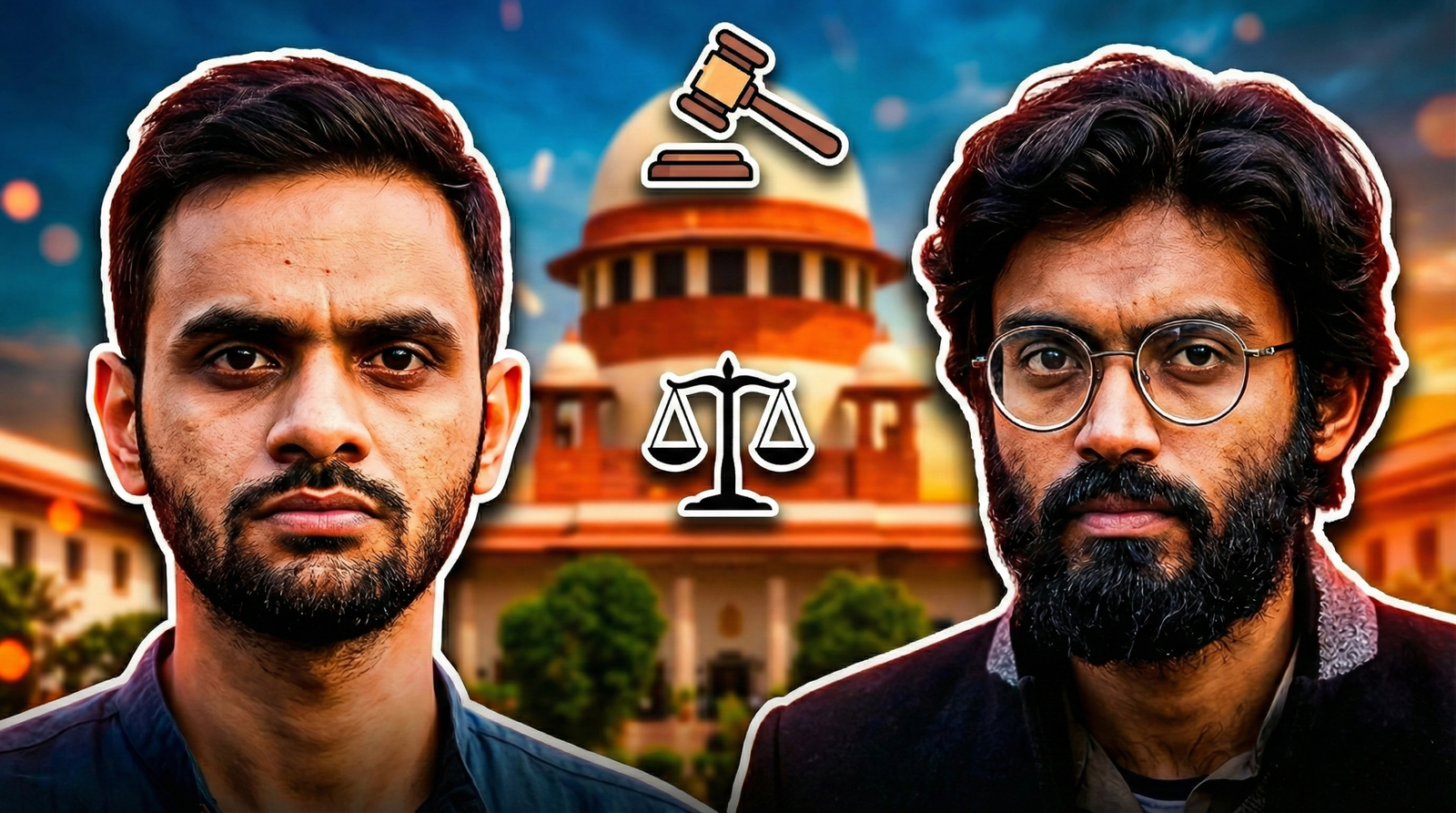
The Supreme Court has denied bail to two accused while granting it to five others in the larger conspiracy case related to the 2020 Delhi riots, applying provisions of the Unlawful Activities (Prevention) Act.
TahirRihat.com explains the details of the Supreme Court judgment delivered on Monday, which addresses bail applications in the case involving allegations under the UAPA and Indian Penal Code.
Background of the Case
The petitions challenged a September 2, 2025, order of the Delhi High Court that had denied bail to the accused. Umar Khalid and Sharjeel Imam have remained in custody for over five years. The case relates to the alleged conspiracy behind the February 2020 Delhi riots.
The bench comprising Justices Aravind Kumar and N.V. Anjaria delivered a 142-page judgment authored by Justice Aravind Kumar. The court found a prima facie case under the Unlawful Activities (Prevention) Act, 1967, against Umar Khalid and Sharjeel Imam, citing prosecution materials that indicated their central roles in planning and mobilization. This justified continued detention under Section 43D(5) of the UAPA.
The court granted bail to five co-accused: Gulfisha Fatima, Meeran Haider, Shifa-ur-Rehman, Mohd. Saleem Khan, and Shadab Ahmed.
The judgment emphasized an accused-specific approach rather than a collective one. The court distinguished the roles of Khalid and Imam, described as strategic involvement, from the episodic roles of the five accused granted bail.
The court held that trial delays do not automatically entitle an accused to bail in UAPA cases. Judicial scrutiny focuses on prima facie evidence specific to each accused, without consideration of defense arguments at the bail stage.
The verdict addressed the definition of ‘terrorist act’ under Section 15 of the UAPA, including disruptions to services and economic threats within its scope.
Bail Conditions for Granted Accused
The five accused granted bail are subject to 12 conditions, which include:
- Not leaving the National Capital Territory without prior court permission.
- Reporting weekly to the investigating officer.
- No contact with prosecution witnesses.
- Surrender of passports and no applications for new travel documents.
- Restriction from participating in public protests or rallies.
- Provision of mobile number and location access to authorities.
- No use of social media to influence the case.
- Mandatory attendance at trial proceedings.
- No tampering with evidence or influencing co-accused.
- Residence at the address furnished to the court.
- Liability for immediate re-arrest upon breach of conditions.
- Possible electronic monitoring as directed by the trial court.
The court permitted Khalid and Imam to reapply for bail after the examination of protected witnesses or one year from January 5, 2026. The judgment directed the trial court to expedite proceedings.
Senior advocates Kapil Sibal, Abhishek Manu Singhvi, Siddharth Dave, Salman Khurshid, Siddharth Agarwal, Siddharth Luthra, and Gautam Kazhanchi appeared for the petitioners. Solicitor General Tushar Mehta and Additional Solicitor General S.V. Raju represented Delhi Police.

Tahir Rihat (also known as Tahir Bilal) is an independent journalist, activist, and digital media professional from the Chenab Valley of Jammu and Kashmir, India. He is best known for his work as the Online Editor at The Chenab Times.